How to conquer travel anxiety?
From Panic to Passport: How to Conquer Travel Anxiety in 2025 (Backed by Science)
We’ve all been there. The suitcase is half-packed, the itinerary is set, and theoretically, you should be thrilled. But instead of excitement, there’s a pit in your stomach the size of a carry-on bag. Your heart races, your palms sweat, and a nagging voice in your head whispers, “Maybe I should just cancel.”
If this sounds familiar, you aren’t just “nervous.” You are likely experiencing the “72-Hour Rule”—a phenomenon where anxiety peaks exactly three days before departure. And you are certainly not alone. In my experience helping travelers navigate this, I’ve found that shame is often the secondary symptom. But here is the reality check: travel anxiety is a physiological response to the unknown, not a character flaw.
This isn’t about taking deep breaths and hoping for the best. Hope is not a strategy. We are going to use the “Control Protocol”—a method combining 2025 industry data, psychological research, and expert logistics to turn your fear into freedom.
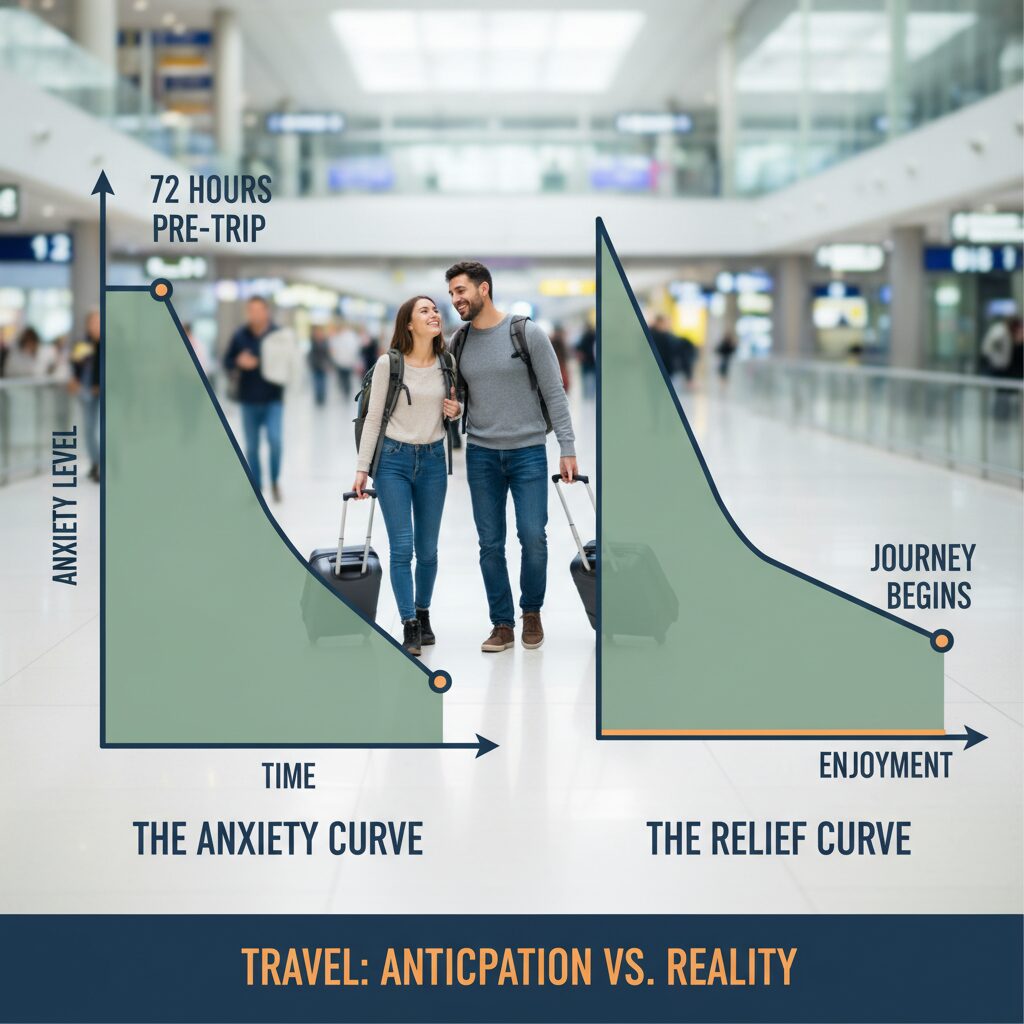
The Science of “Hodophobia”: Why Your Brain Fears Vacation
To defeat the enemy, you have to understand it. The clinical term for the fear of travel is Hodophobia. However, most people don’t have a full-blown phobia; they have an “Amygdala Hijack.”
Your amygdala is the ancient part of your brain responsible for detecting threats. When you leave your safe, predictable routine (your home), your amygdala lights up. It doesn’t know you’re going to a resort in Bali; it only knows you are leaving the cave. It floods your system with cortisol, preparing you to fight or flee.
Interestingly, the physiological symptoms of anxiety (rapid heartbeat, shallow breathing) are nearly identical to excitement. The difference is the narrative your brain attaches to them.
“Travel triggers physical activities and engagement with the surrounding environment… increasing dopamine and serotonin to enhance mood.”
— Dr. Jasmine Sawhne, Board Certified Psychiatrist (Source: TravelPulse Interview, May 2024)
Phase 1: Pre-Trip Strategy (The Control Phase)
Most anxiety is anticipatory. According to recent data, this is where the battle is won or lost. A February 2024 report by StudentUniverse found that while 93% of Gen Z agree travel improves mental health, 89% return feeling less anxious—implying that the vast majority suffer from significant stress before they leave.
The “Micro-Itinerary” Method
Anxiety hates uncertainty. The antidote is the Micro-Itinerary. Instead of a vague plan like “Go to the airport,” break your departure day into 30-minute blocks.
- 08:00 AM: Uber arrives (booked in advance).
- 08:45 AM: Drop bags at counter.
- 09:15 AM: Coffee at Gate B12.
When your brain starts to spiral, you can look at your plan and say, “I don’t need to worry about the whole trip. I just need to get to 8:45 AM.”
Financial Anxiety: The #1 Stressor
Let’s talk about the elephant in the room: money. It’s not just about turbulence; it’s about the bank account.
According to the Allianz Partners June 2024 International Vacation Confidence Index, 55% of European travelers cite financial constraints as their primary source of travel anxiety. This mirrors trends in the U.S., where the fear of “wasting money” if a trip goes wrong is paralyzing.
The Fix: Insurance as Mental Health Care.
I tell every anxious traveler to purchase a policy with “Cancel for Any Reason” (CFAR) coverage. Knowing you can pull the ripcord and get 50-75% of your money back removes the feeling of being trapped. As Daniel Durazo, Director of External Communications at Allianz Partners USA, noted in a May 2024 press release, “While travel costs remain inflated… investing in a travel insurance policy is a smart move to protect trip investment.” It buys you the freedom to commit.
“Neuroinclusive” Planning
If you have ADHD, Autism, or high sensory sensitivity, travel processing issues can mimic panic attacks. You aren’t just “stressed”—you are overstimulated.
The industry is finally catching up. Booking.com’s October 2024 report shows that 50% of neurodivergent travelers believe their options are limited, driving a demand for AI assistance and sensory rooms.
Action Step: When booking, use AI tools to check for “quiet hours” at hotels or airports with sensory rooms (like the Sunflower Lanyard scheme recognized globally). Pre-visualize your journey using Google Maps Street View. Walking through the terminal virtually reduces the “threat” of the unknown environment.
Phase 2: In-Transit Tactics (The Acute Phase)
The doors close. The engine hums. This is usually the spike. Here is how to handle the acute phase of travel.
The “Dry Vacation” Trend
For decades, the standard advice for nervous flyers was “have a glass of wine.” In 2025, that advice is dead. Alcohol is a depressant that causes a cortisol spike as it wears off—often mid-flight—leading to “hangxiety.”
Gen Z is leading the charge here. StudentUniverse data from 2024 reveals that 80% of Gen Z student travelers are interested in “Dry Vacations” specifically to maintain control and reduce anxiety. Keeping a clear head allows you to rationalize your fears rather than numbing them temporarily.
The 3-3-3 Grounding Technique
When turbulence hits or the train stops unexpectedly, your mind goes inward. You need to force it outward. Use the 3-3-3 rule:
- Name 3 things you can see: (e.g., The seatbelt sign, the flight attendant’s watch, a blue bag).
- Name 3 sounds you can hear: (e.g., The engine hum, a baby crying, the air vent).
- Move 3 parts of your body: (e.g., Wiggle your toes, tap your fingers, roll your shoulders).
This forces the prefrontal cortex to come back online, overriding the emotional amygdala response.
Airport Survival: Lounge Access
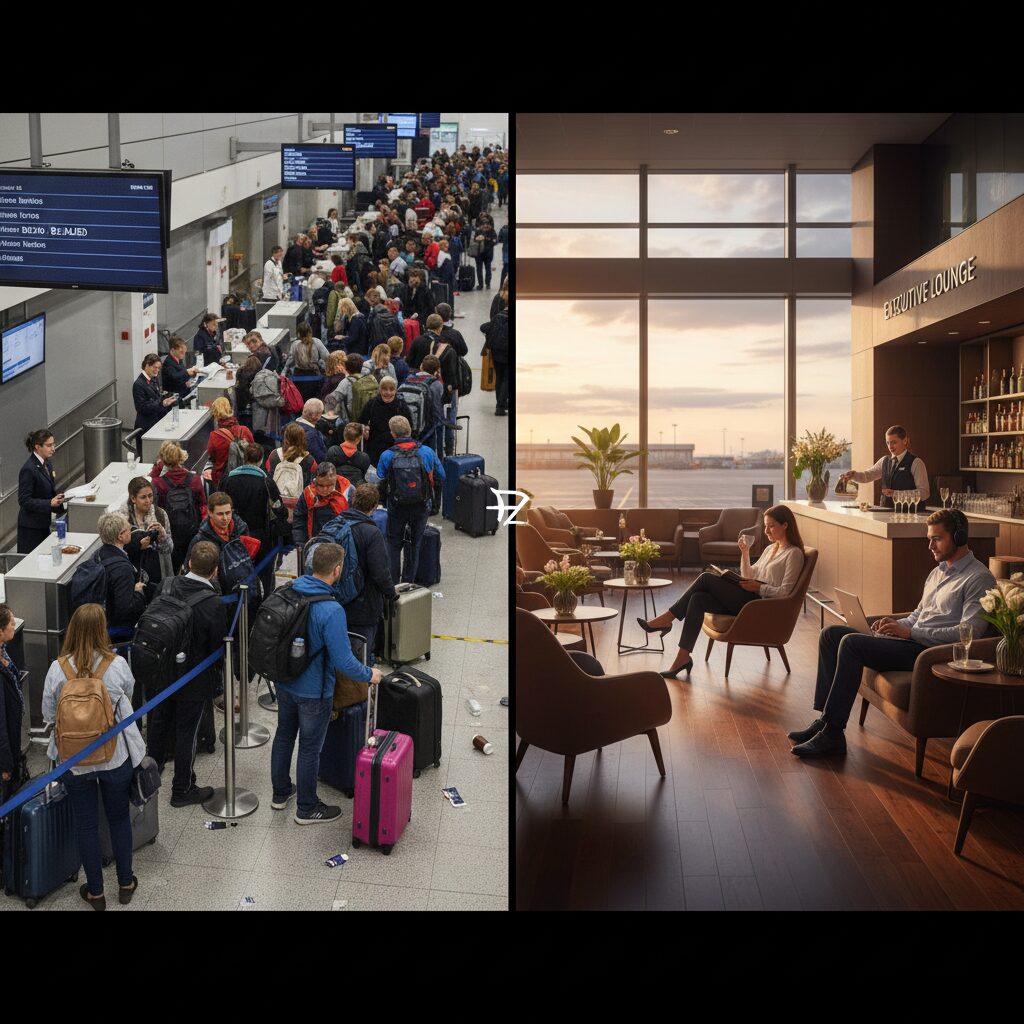
I used to think airport lounges were just for business class travelers. I was wrong. They are mental health investments. The chaotic, noisy environment of a general boarding gate triggers sensory overload. Lounges offer quieter acoustics and comfortable seating. Many credit cards now offer this as a perk—check your wallet. If not, a $50 day pass is cheaper than a panic attack.
Phase 3: Destination Decompression (The Adjustment Phase)
You’ve arrived. But why do you feel weird? It’s called the “First Night Effect.” One hemisphere of your brain actually stays more alert when sleeping in a new environment—an evolutionary leftover to protect you from predators.
Sleep Tourism and “The First Night”
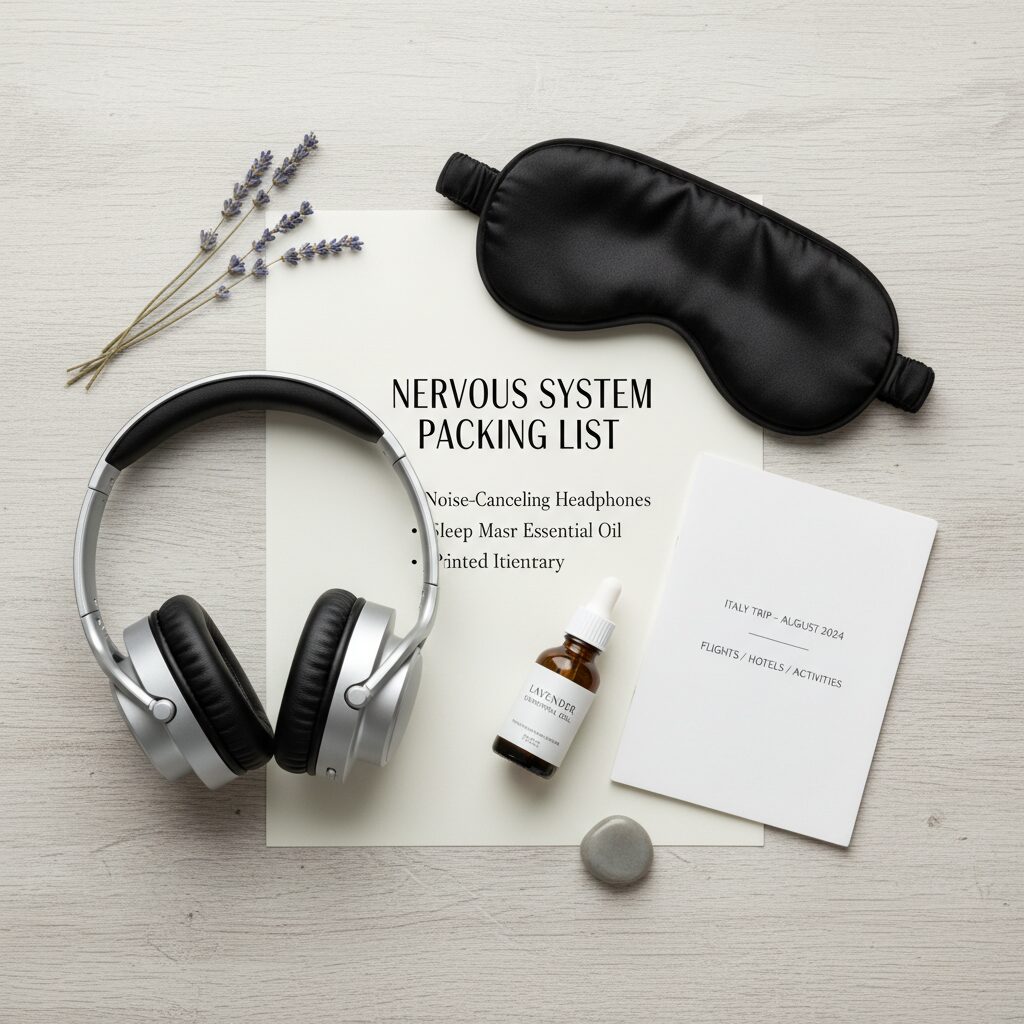
To combat this, embrace the trend of “Sleep Tourism.” Pack a “sleep kit” that mimics your home environment: your own pillowcase (scent is a powerful grounding tool), a white noise machine, or an eye mask. By making the environment familiar, you convince your brain it’s safe to power down.
Safety Anxiety and Health Fears
For many, the fear isn’t the travel; it’s the “what if I get sick?” scenario. Squaremouth’s August 2024 survey indicates that 64% of travelers report getting sick or injured is their biggest anxiety trigger.
The Fix: Don’t just bring medicine; know where the hospital is. Before you leave your hotel, simply Google “Nearest 24-hour pharmacy” and “Nearest hospital.” Save them in your phone. You will likely never need them, but knowing the data is there quiets the “what if” voice.
Phase 4: The Re-Entry Blues (Post-Trip)
We often talk about pre-trip anxiety, but the crash after the trip can be just as jarring. You return to a mountain of emails and a quiet house.
Dr. Jessica de Bloom, an Organizational Psychologist, noted in a 2024 APA podcast that “The positive effects of taking a vacation may be totally diminished within a matter of days as one returns to their workload.”
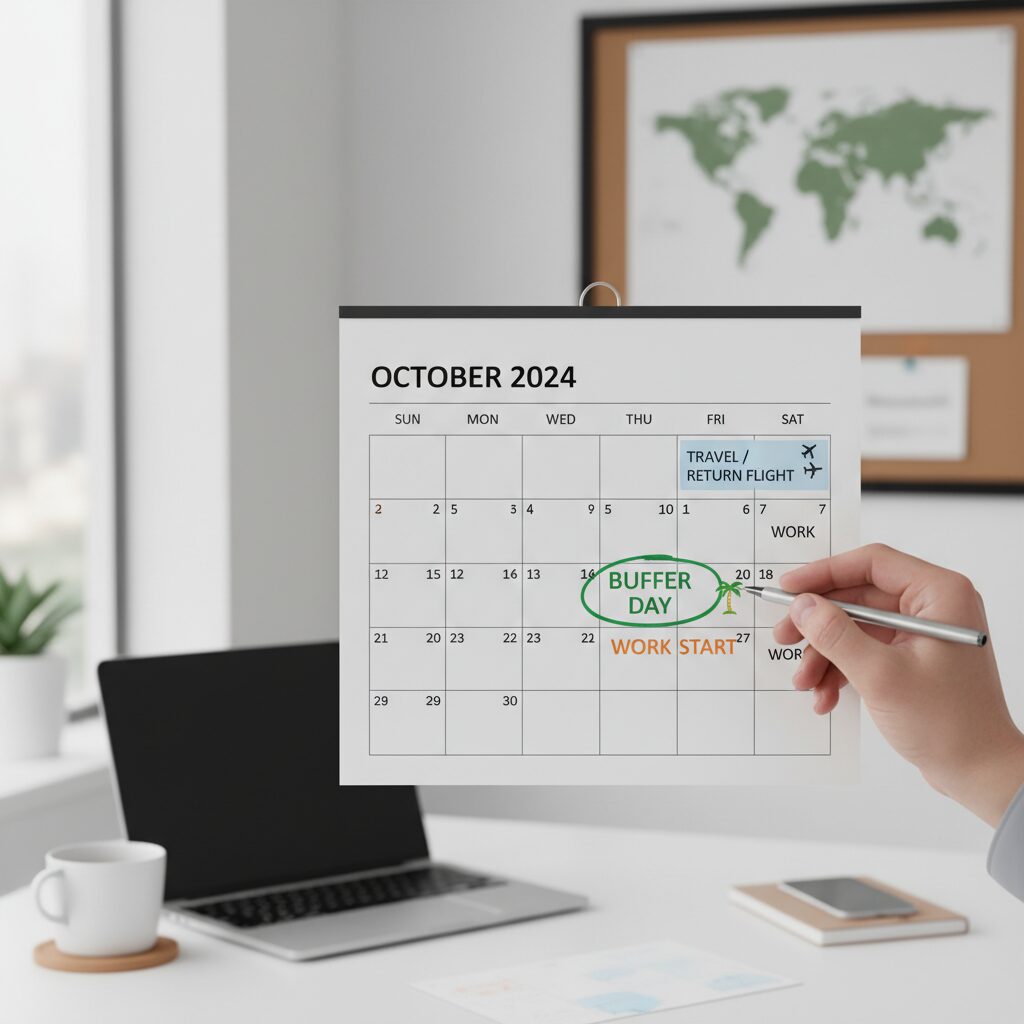
The 24-Hour Buffer Rule: Never fly back on a Sunday to work on a Monday. It’s a recipe for anxiety. Always schedule a “buffer day” at home. Use this day to do laundry, grocery shop, and sleep. This transition day acts as a decompression chamber between your travel self and your work self.
FAQ: Your Travel Anxiety Questions Answered
A: While “Hodophobia” (fear of travel) is a specific phobia, travel anxiety is often a symptom of Generalized Anxiety Disorder (GAD) or panic disorder. However, situational anxiety regarding travel is very common and does not necessarily mean you have a disorder. If it prevents you from functioning, consult a professional.
A: (Disclaimer: I am not a doctor.) While doctors may prescribe Benzodiazepines for acute flight panic, 2024 trends show a rise in natural supplements. Many travelers use L-Theanine or Magnesium Glycinate to lower cortisol levels without the sedative “zombie” effect. Always consult your healthcare provider before flying with new medication.
A: Regulate the temperature. Anxiety thrives in heat. Set the room to 65-68°F (18-20°C). Use the “4-7-8” breathing technique and consider a weighted sleep mask to provide gentle pressure on the eyes, stimulating the vagus nerve.
A: Generally, standard travel insurance does not cover cancellation due to mental health conditions unless you are hospitalized. This is why “Cancel for Any Reason” (CFAR) policies are critical for travelers with anxiety. They cost more (usually 40-50% more than standard policies), but they cover cancellation due to fear or panic.
Conclusion: The Price of Admission
Travel anxiety is uncomfortable, sticky, and exhausting. But I believe it is simply the price of admission for a larger, more vibrant life. The goal isn’t to eliminate the anxiety completely; it’s to refuse to let it make your decisions for you.
By understanding the biology of your amygdala, leveraging 2025 tools like CFAR insurance and neuroinclusive planning, and respecting the need for a re-entry buffer, you take the power back. The world is too big, and your time is too short, to stay grounded by fear.
Pack your bags. Incorporate the buffer day. Trust the protocol. You’ve got this.

Related Posts
How to document travel memories well?

Where to find authentic local food?