
Are last-minute flights cheaper for global travel?
Are Last-Minute Flights Cheaper? The 2025 Data-Backed Verdict
We all have that one friend who swears they booked a flight to Paris the day before departure for $200. They tell the story at dinner parties with a glint in their eye, evoking a nostalgia for the “standby” era of the 90s when showing up at the airport with a backpack and a dream actually worked.
But let’s be real: In 2025, relying on that strategy is a financial gamble where the house almost always wins. The romantic notion of the “last-minute deal” has been largely suffocated by sophisticated algorithms and yield management systems designed to extract maximum value from desperate travelers.
So, are last minute flights cheaper? After analyzing data from millions of flight queries and reviewing the latest reports from Expedia, Google, and the Airlines Reporting Corporation (ARC), the short answer is: No, almost never.
However, “almost” is doing a lot of heavy lifting there. In my years of analyzing travel trends, I’ve found that while the general rule is to book early, there are three specific anomalies where the algorithm breaks in your favor. If you know where to look, you can still find those elusive deals. Let’s dive into the data.
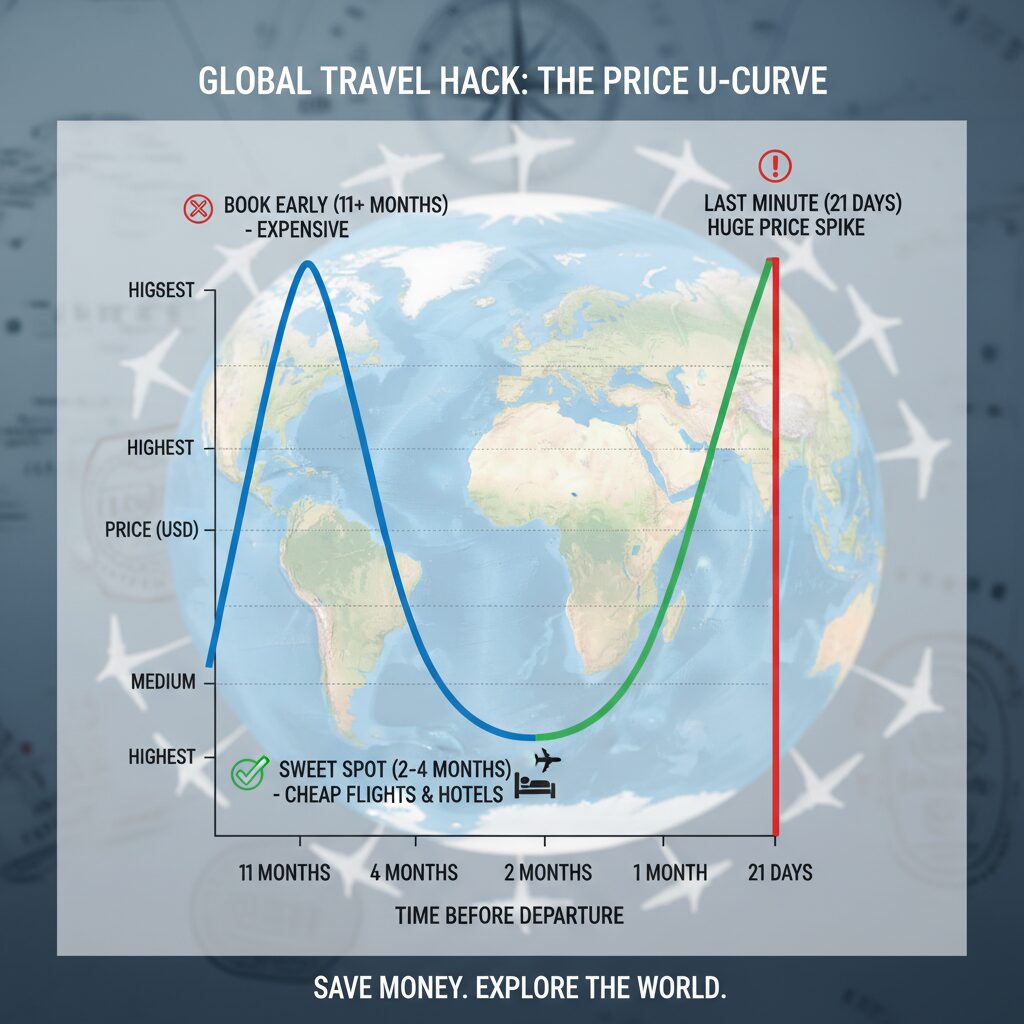
The “Last-Minute” Myth vs. Reality: What the Data Says
To understand why last-minute flights are expensive, you have to look at the numbers. It’s not just bad luck; it’s math. The industry operates on specific booking windows, and missing them costs you dearly.
The “Goldilocks Window”
There is a sweet spot for booking—not too early, not too late. According to Google’s Flight Data Team (August 2023), for trips from the U.S. to Europe, average prices tend to be lowest 72 days or more before departure. Once you cross that threshold, prices begin a slow creep upward until they skyrocket in the final weeks.
If you are flying domestically within the U.S., that window shifts. Google’s data indicates the lowest prices are found roughly 38 days prior to takeoff.
Ideal Int’l Booking Window
Savings vs Last Minute
Price Spike < 7 Days
Looking at broader global data, Expedia’s 2024 Air Travel Hacks Report confirms that for international travel, the ideal booking window is roughly 60 days out. Booking earlier than that saved travelers an average of 10% compared to those who waited until the last minute. While 10% might not sound like a fortune, on a $1,500 ticket, that pays for a night or two of accommodation.
The 21-Day Rule
The most critical concept to understand is the “21-Day Rule.” Airlines release seat inventory in “buckets.” The cheapest buckets usually have an advance purchase requirement—typically 21 days.
According to data analysis from the Airlines Reporting Corporation (ARC) in 2024, airfares purchased within seven days of travel can be 50% higher than those purchased 21 days in advance. Once that 21-day mark passes, the cheapest fare class expires and is removed from the system. Then the 14-day advance fares expire. Then the 7-day fares. You are literally paying for the privilege of procrastination.

Why Airlines Penalize Procrastination (The Economics)
Why do airlines do this? Why wouldn’t they just sell an empty seat for $50 rather than fly it empty? This is the most common question I get, and the answer lies in Yield Management.
Business Travelers vs. Leisure Travelers
Airlines know that there are two types of travelers: those with time (leisure) and those with money (business).
A leisure traveler plans a vacation months in advance. They are price-sensitive. If the flight is too expensive, they just won’t go. A business traveler, however, has inelastic demand. If a client in London needs them on Tuesday, they must fly on Monday, regardless of whether the ticket costs $600 or $2,000.
As noted in the 2024 Corporate Travel Study by Deloitte, corporate travel recovery is driving up last-minute economy fares. Airlines deliberately hold back seats for these high-paying business travelers. If they sold that last seat to you for $50 a week ago, they couldn’t sell it to the business consultant for $2,000 today.
Supply and Demand Constraints
Furthermore, planes are simply fuller. According to a January 2024 IATA Press Release, total traffic reached 99% of 2019 levels. With supply chain issues delaying the delivery of new aircraft (as reported by Reuters in June 2024), capacity is constrained. Airlines don’t *need* to discount seats to fill planes anymore.
The 3 Real Exceptions: When Last-Minute *Is* Cheaper
I told you there were exceptions. While 95% of last-minute bookings are overpriced, here are the three scenarios where waiting might actually save you money.
1. Charter Flights and Holiday Packages
This is the biggest secret in European and Canadian travel. Companies like TUI, Sunwing, or Condor operate differently than Delta or British Airways. They are tour operators first, airlines second.
If TUI has a chartered plane going to Mallorca and they have 5 unsold seats 48 hours before departure, they have already paid for the fuel and crew. They will dump those seats at a loss just to get something for them. I’ve seen charter flights drop by 40-60% in the final 72 hours.
Strategy: Don’t look at standard aggregators. Look specifically at “Last Minute Holiday” pages on tour operator websites.
2. Error Fares and “Dumped” Inventory
Sometimes, the algorithm breaks. A currency conversion error or a human typo can result in a “mistake fare.” These often happen last minute or are discovered quickly and patched. While not strictly a “last-minute deal” strategy you can plan for, they are windfalls if you catch them.
3. The “Hidden City” Strategy (Skiplagging)
This is controversial, and I need to be clear about the risks. “Hidden city” ticketing involves booking a flight with a layover that is actually your intended destination, and skipping the second leg.
For example, a flight from New York to Orlando might be $300. But a flight from New York to Miami with a layover in Orlando might be $150 because the airline is competing for the NYC-Miami market. You book the latter and get off in Orlando.

Strategic Alternatives to Last-Minute Booking
If you aren’t booking a charter flight and you don’t want to risk an airline ban, you need better tools than just “hope.”
Use “Freeze Price” Tools
According to Hopper’s 2024 Outlook, volatility is high. If you see a good price but aren’t ready to commit, apps like Hopper allow you to pay a small deposit to “freeze” a price for a few days. If the price goes up, you pay the frozen price. If it goes down, you pay the lower price.
The Tuesday Myth vs. Sunday Reality
For years, people asked, “Is there a specific day of the week to book flights?” and the answer was always Tuesday at midnight. That advice is outdated.
Data from the Expedia 2024 Air Travel Hacks Report shows that booking on a Sunday can save travelers up to 13% on international flights compared to booking on a Friday. The “Tuesday” rule applied when airlines manually loaded fares once a week. Now, dynamic pricing happens in real-time.
Top Tools to Monitor Price Drops
Don’t manually refresh pages. Use technology:
- Google Flights: Best for the “Explore” map if you are flexible on destination. Use their “Price Guarantee” badge which refunds the difference if prices drop.
- Skyscanner: Excellent for the “Everywhere” search function to find the cheapest place to fly right now.
- Momondo: Often finds smaller OTAs (Online Travel Agencies) that might have slightly cheaper inventory than the giants.

FAQ: Your Last-Minute Booking Questions Answered
Do flight prices go down on the day of departure?
No. In fact, day-of-departure fares are typically the most expensive fares possible (Full Fare Y-Class). Unless you are flying standby on a specific employee pass or using a charter holiday deal, do not expect prices to drop on the day of travel.
Is it cheaper to buy plane tickets at the airport counter?
I wish this were true, but it’s a myth. CheapAir’s 2024 study confirms that airport agents see the exact same inventory as online users, often without access to “online-only” promo codes. You save nothing and risk the flight being sold out.
Do flight prices go down at night?
The idea that airlines lower prices at midnight on Tuesdays is largely a myth in 2025. Algorithms run 24/7. However, checking widely different time zones using a VPN can sometimes yield minor currency differences, though the effort rarely justifies the savings.
Does clearing cookies actually help?
This is one of the most persistent myths. While privacy is important, there is no concrete evidence from Google Flights or Hopper that airlines increase prices specifically because you looked at a route twice. Prices change because inventory is being bought by others, not because the airline is “watching” you.
Conclusion: The Verdict for 2025
The data is clear: The era of the last-minute steal is over for scheduled commercial flights. The combination of AI-driven yield management, corporate travel demand, and capacity constraints means that procrastination is expensive.
If you are planning global travel for 2025, ignore the “last minute” fantasy. Instead, focus on the Goldilocks Window (60-72 days out for international), book on a Sunday, and fly on a Wednesday (which Hopper data suggests is 15% cheaper than Sunday departures).
The only time you should wait until the last minute is if you are truly indifferent to where you go and are willing to hunt for charter seat dumps. For everyone else: lock in that price now. The algorithm isn’t going to get any friendlier tomorrow.