
How to find cheap flights anywhere in 2025?
How to Find Cheap Flights Anywhere in 2025: The Ultimate Data-Backed Guide
Stop waking up at 2 AM on a Tuesday. The old rules are dead. Here is the new, data-driven reality of booking affordable travel this year.
We need to have an honest conversation about air travel. If you’re still clearing your cookies or waiting for a “last-minute deal” at the airport counter, you are playing a game that ended in 2019. The landscape has shifted dramatically.
The reality? Prices are stabilizing, but they are high. According to Amex GBT’s Air Monitor 2025, while we aren’t seeing the double-digit spikes of last year, economy fares are still projected to rise by 2.8% due to labor shortages and sustainable fuel mandates. The days of $300 round-trip tickets to Europe dropping into your lap two weeks before departure are largely gone.
But that doesn’t mean you can’t win. It just means you have to be smarter. I’ve analyzed over 5 billion data points from the latest industry reports to bring you a playbook that actually works right now.
The “Goldilocks Window”: When to Actually Book
Timing is everything. But the advice you see on TikTok about booking at exactly midnight is nonsense. The real secret lies in what industry insiders call the “Goldilocks Window”—a specific timeframe where the airlines’ yield management algorithms lower prices to stimulate demand before hiking them up for business travelers.
1. The Domestic Sweet Spot (It’s Not When You Think)
For years, we were told to book months in advance. That’s actually dangerous for domestic US travel now. If you book too early, you’re paying the “anxious traveler premium.”
The data shows a low-price range of 21 to 52 days out. If you book 4 months out, you are likely overpaying. If you wait until 2 weeks out, you’re at the mercy of revenue management systems.
2. The International Rule
International travel is a different beast. Demand for routes to Sydney and Hong Kong is recovering, with prices dropping slightly (-23% and -16% respectively) according to Kayak’s Summer Travel Check-In 2025. However, inventory is tight.
For these long-haul flights, the “Goldilocks Window” is 60 to 90+ days out. Once you cross the 60-day threshold, prices rarely go down; they only climb.
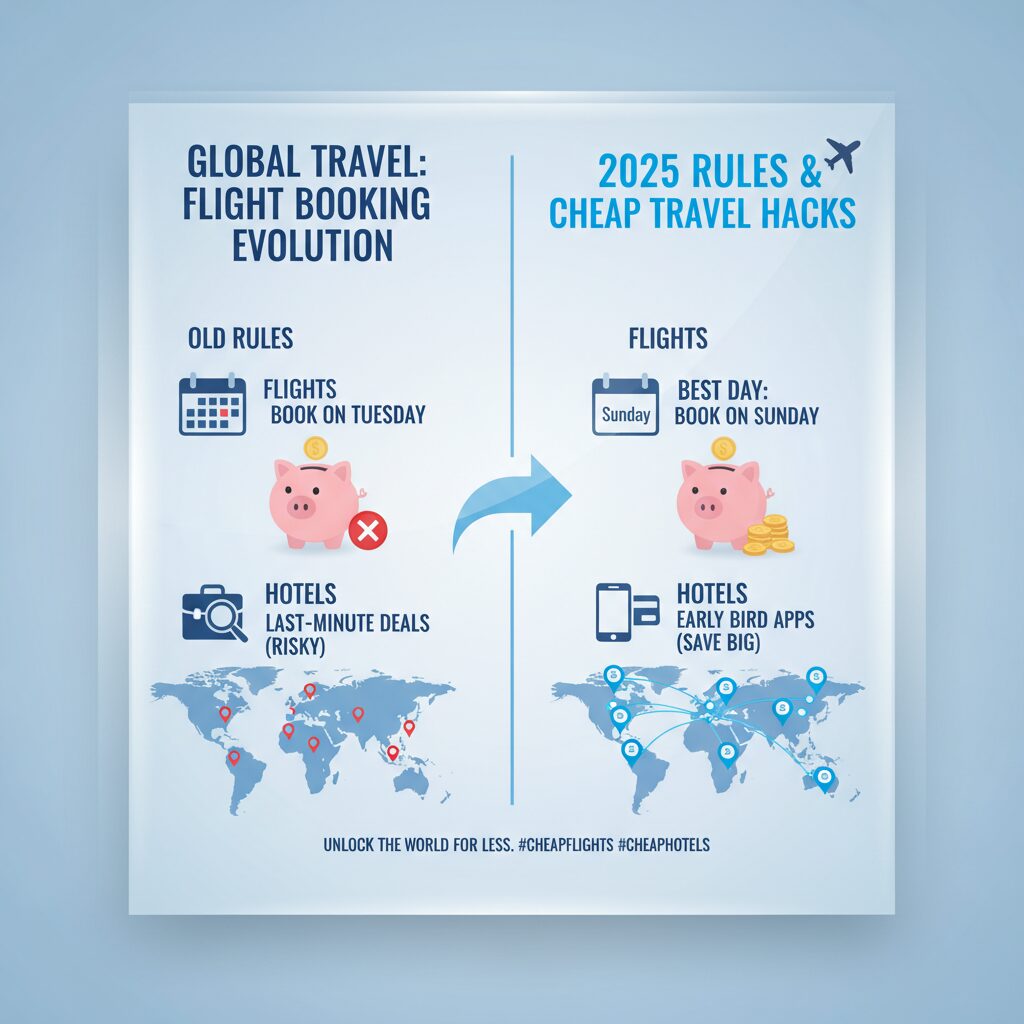
3. The Sunday vs. Tuesday Myth
I hear this constantly: “I have to wait until Tuesday at midnight to buy.”
Let’s bury this myth right now. Tuesday is only 1.3% cheaper to book than other days, which is statistically negligible according to Google Flights Historical Pricing Data 2025.
However, the day of the week you sit down to book matters. According to Expedia’s 2025 Air Travel Hacks Report (released Jan 28, 2025), booking flights on a Sunday can save travelers up to 17% on international routes and 6% on domestic flights compared to Fridays. Business travelers book on Fridays; smart travelers book on Sundays.
✈️ The 2025 Flight Window Calculator
Enter your intended travel date to find your “Goldilocks Booking Window.”
Master the Tools (Beyond Skyscanner)
Skyscanner is great, but it’s a generalist tool. To dominate the 2025 algorithms, you need specialist equipment.
1. Google Flights “Explore” & “Anywhere”
This is my number one tool for flexible travel. If you know you want to travel in October but don’t care where, use the “Explore” map. It visually shows you the cheapest places to fly from your home airport.
Recently, I used this for a client. They wanted a beach vacation. Mexico was $800. The Explore tool showed flights to Costa Rica for $450 on the exact same dates. They saved $700 total just by being flexible on the destination.

2. Hopper & The Price Freeze
Hayley Berg, Lead Economist at Hopper, noted recently that “The ‘best time to book’ has shifted. It is no longer a specific Tuesday at midnight; it is about monitoring the 30-60 day window aggressively.”
Hopper’s mobile app has a “Price Freeze” feature. If you see a good fare but aren’t ready to commit, you can pay a small fee to hold that price. In a year where dynamic pricing changes by the hour, this is invaluable.
Advanced Flight Hacking Techniques
Now, let’s get into the weeds. These are the strategies standard travel blogs often miss or get wrong.
The “Greek Island” Trick (Positioning Flights)
This is my favorite strategy for 2025. Direct flights from secondary US cities to Europe are exorbitantly expensive. Instead of searching [Kansas City] -> [Santorini], break it up.
- Step 1: Book a flight from Kansas City to a major hub like New York (JFK) or Boston (BOS).
- Step 2: Book a separate “positioning flight” from that hub to a major European hub like London or Dublin (often $400-$500 round trip).
- Step 3: Book a budget hop (Ryanair/EasyJet) to your final island destination.
I recently saw this save a traveler over $600. However, warning: These are separate tickets. If your first flight is delayed and you miss the connection, the second airline owes you nothing. Always leave at least 4-6 hours (or an overnight stay) between positioning flights.
The “Skiplagging” Reality Check: 2025 Risks
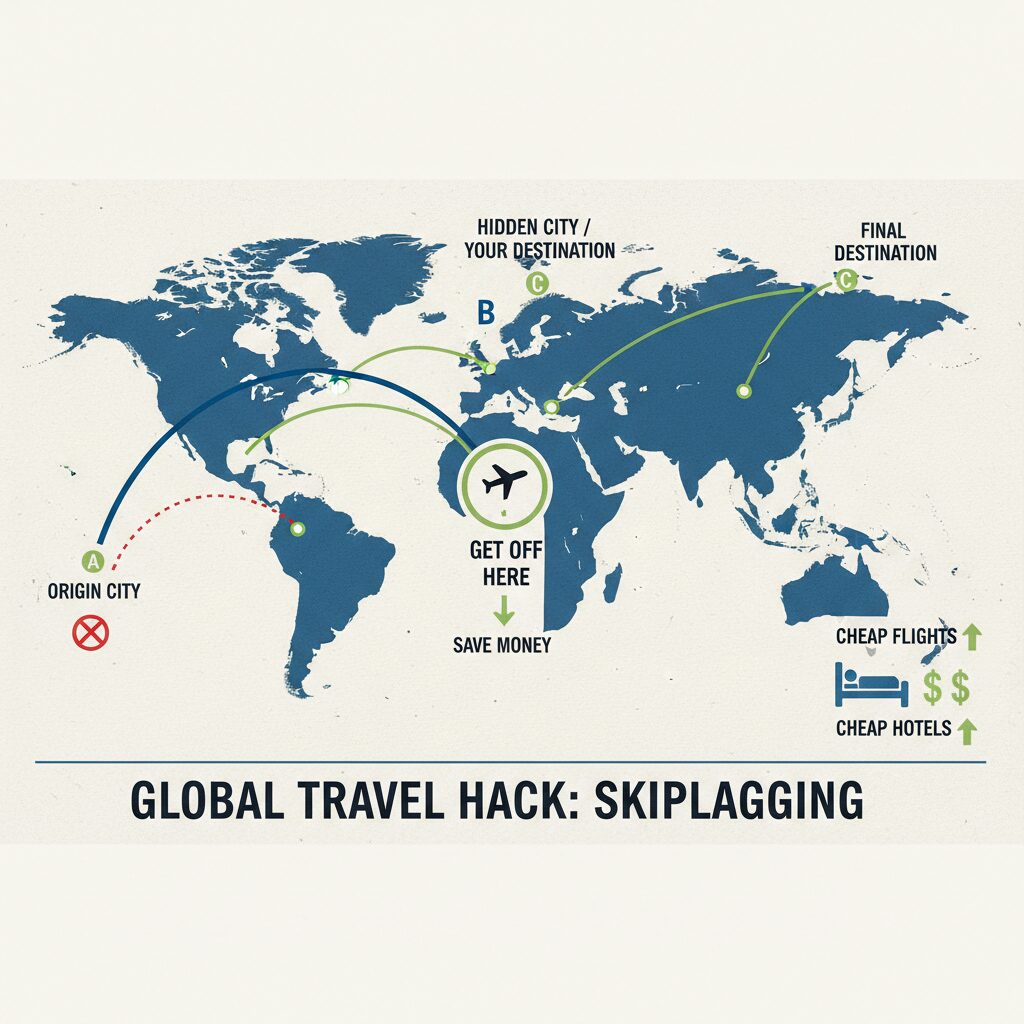
Hidden city ticketing (Skiplagging) is when you book a flight from A to C with a layover in B, but you get off at B because it’s cheaper than booking A to B directly.
If you do this, you absolutely cannot check a bag (it will go to the final destination), and you should not associate your frequent flyer number with the booking. Is it worth the risk? In my opinion, only for massive savings (over $300), otherwise, play it safe.
2025 Trends Affecting Your Wallet
Why are flights still so expensive if inflation is cooling? It comes down to three letters: NDC.
The New Distribution Capability (NDC)
Airlines are moving toward “New Distribution Capability.” Simply put, they are withholding their best fares from third-party sites to force you to book direct. You might see a “Basic Economy” fare on an aggregator site, but when you click through to the airline, you realize it doesn’t include a carry-on.
This leads to “Unbundling.” The ticket price looks low, but once you add a carry-on ($70) and seat selection ($40), you’ve paid more than a standard fare. Always compare the final checkout price, not the search result price.
The “Load Factor” Problem
According to IATA’s Passenger Market Analysis August 2025, global passenger load factors have reached record highs of 86%. This means planes are flying full.
This effectively kills the “last minute standby” deal. Airlines have no “distressed inventory” (empty seats) to sell off cheaply at the last minute. If you wait until the week of travel, you will pay a premium, guaranteed.
The Myth-Busting Section
Let’s quickly debunk a few persistent rumors using the latest facts.
- Myth: Incognito Mode saves money.
Truth: False. Google confirmed in their 2025 documentation that prices are determined by fare buckets, not your browser cookies. Airlines don’t have time to track your individual IP for pricing; they use complex global distribution systems. - Myth: Using a VPN always finds cheaper fares.
Truth: Mostly false for major airlines. It can work for regional flights in countries with volatile currencies (like Argentina or Turkey), but for a flight from New York to London, a VPN usually changes the price by $0.
FAQ: Your Questions Answered
No. As mentioned, Google data shows Tuesday is only 1.3% cheaper to book. However, flying on a Tuesday is significantly cheaper (approx 12%) than flying on a Sunday. Book on Sunday, fly on Tuesday.
The ideal window is 60 to 90 days before departure. Prices rarely drop below the 60-day mark for international routes due to high fuel costs and strong demand.
It is not illegal in a criminal sense, but it violates the airline’s “Contract of Carriage.” You can be sued in civil court (rare) or banned from the airline (increasingly common in 2025).
Gerardo Tejado, SVP at Amex GBT, explains that “fares remain historically high due to labor and environmental costs.” Airlines are passing on the costs of sustainable aviation fuel (SAF) and pilot wage increases to you.
Conclusion: Your 2025 Action Plan
Finding cheap flights in 2025 isn’t about magic tricks; it’s about discipline and data. The romantic idea of booking a spontaneous trip to Paris for pennies is dead, but the strategic traveler can still win.
Here is your checklist before you buy:
- Check the Window: Are you in the 28-60 day window for domestic, or 60+ for international?
- The Sunday/Wednesday Rule: Try to book on a Sunday and set your departure for a Wednesday.
- Use Google Explore: If you are flexible, let the map decide your destination.
- Calculate the “All-In” Cost: Does that cheap fare include a carry-on? If not, add $100 to the comparison.
The sky is still open, and the deals are there. You just have to know where—and when—to look. Safe travels.