Secret hotel booking hacks you need now?
17 Secret Hotel Booking Hacks the Industry Won’t Tell You (2025 Edition)
Let’s be honest: “Incognito Mode” is not a travel hack. It’s a myth that died five years ago. Yet, if you Google how to save money on hotels right now, you’ll still find generic listicles telling you to clear your cookies or book on a Tuesday.
I’m tired of seeing travelers leave money on the table. With global hotel rates projected to rise significantly in 2025—Las Vegas alone is seeing a +4.2% hike according to the Amex GBT Hotel Monitor 2025—the old tricks don’t work anymore. You are up against dynamic pricing algorithms, artificial intelligence, and yield management systems designed to squeeze every dollar out of your wallet.
But here’s the good news: the technology that hotels use to maximize profits can be reverse-engineered.
In this guide, I’m pulling back the curtain on the actual tools, loopholes, and “secret” methods that professional travel hackers use. We aren’t just talking about saving $10; we are talking about stacking browser extensions, reselling non-refundable rooms, and exploiting rebooking loops to save 30-50% on luxury stays.
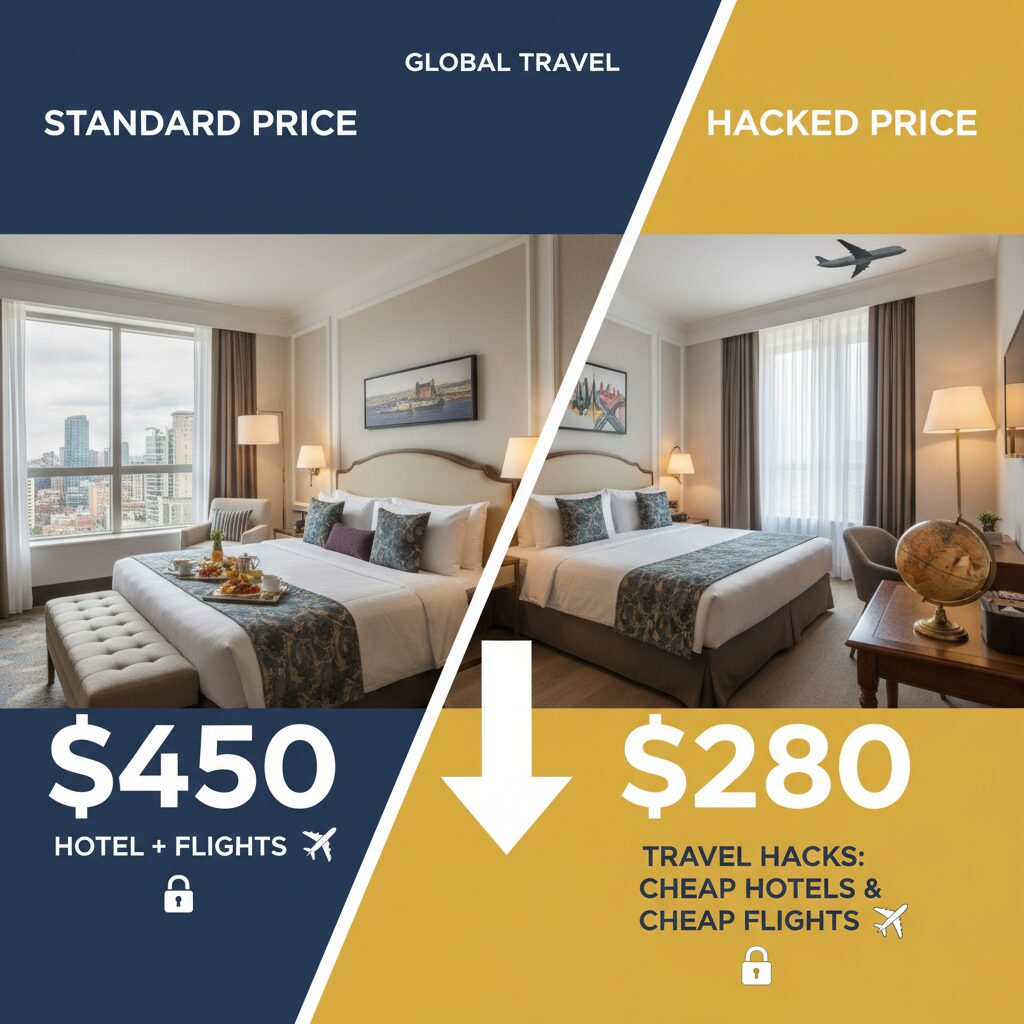
The “Rebooking Loophole” (Your Strongest Weapon)
Most travelers book a room and then forget about it until they check in. This is the single biggest financial mistake you can make. Hotel pricing is fluid, fluctuating based on occupancy and demand algorithms multiple times a day.
— Source: Pruvo / Internal Data
Because the majority of prices drop, the most powerful hack in 2025 is the “Cancel-on-Rebook” Strategy. Here is exactly how I execute this for every single trip:
- Book the Flexible Rate: Yes, it costs about 5-10% more upfront than the “non-refundable” rate. Pay it. It is your insurance policy.
- Connect to a Monitor: Immediately forward your confirmation email to a service like Pruvo.
- Wait for the Drop: Pruvo monitors the price of that exact room across hundreds of booking platforms. When the price drops (which happens 68% of the time), they alert you.
- The Swap: You book the new, lower rate and cancel the original flexible booking.
I recently saved over $200 on a stay in Miami simply because the algorithm panicked about low occupancy three days before my arrival. As Nomadic Matt notes in his 2025 Guide, while inventory is best further out, rebooking tools are essential because price volatility is the new normal.
Browser Extensions That Stack Discounts
If you are booking hotels without a “tech stack” running in your browser, you are voluntarily paying a “convenience fee.” In 2025, manual comparison is impossible; you need automation.
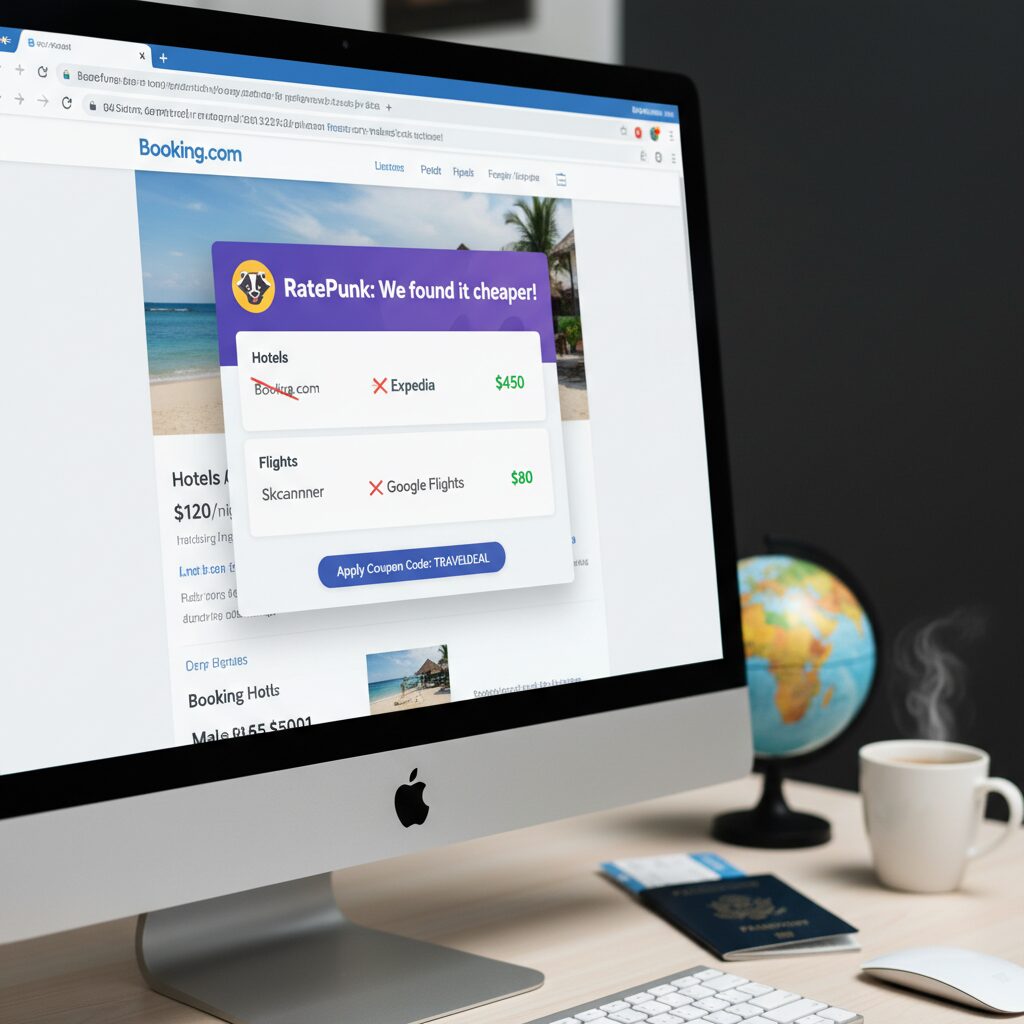
1. RatePunk: The Aggregator Killer
Stop opening ten tabs for Booking.com, Agoda, and Expedia. RatePunk is a browser extension that pops up automatically when you view a hotel on any OTA (Online Travel Agency). It scans every other major booking site in seconds to see if the same room is cheaper elsewhere.
2. Directo: Bypass the Middleman
Hotels hate paying commissions to sites like Expedia. According to the SiteMinder Hotel Booking Trends 2024, hotels generate an average of $519 per direct booking versus only $320 via OTAs. This gives them a massive incentive to offer you perks if you book directly.
Directo is a Chrome extension that helps you find the direct booking link instantly, often revealing “Member Only” rates that aren’t visible on Google Hotels. Combined with a loyalty account, this is often the cheapest route.
“Hotels generate significantly more revenue from direct bookings. Smart travelers leverage this by negotiating perks—free breakfast, parking, or upgrades—that simply aren’t available through third-party sites.”
— Analysis based on SiteMinder 2024 Data
The “Secondary Market” for Hotel Rooms
This is the secret that shocks most people. We are used to StubHub for concert tickets, but did you know there is a secondary market for non-refundable hotel reservations?
Every day, thousands of people cancel trips due to emergencies. They are stuck with non-refundable bookings. Platforms like SpareFare and RoomerTravel allow these travelers to sell their reservations to you at a massive discount (usually 40-60% off).
Is SpareFare Legit in 2025?
It’s a valid question. The process works because most hotels allow a “guest name change” on the reservation. Recent customer feedback on Trustpilot confirms that SpareFare has been successfully facilitating these transfers, outperforming competitors in verified refunds. You get a luxury room for hostel prices because the seller is desperate to recoup any money.
Algorithmic Price Hacking
Algorithms are smart, but they follow rules. If you know the rules, you can break them. Here are two technical glitches that are working right now.
The “Google Travel Redirect” Hack
Here is a weird anomaly that Reddit users like “4dr14n31t0r” have confirmed in Travel Hacks communities. Often, if you go directly to a hotel’s website, you see the standard rate.
However, if you search for the hotel on Google Maps or Google Travel first, and click the booking link provided by Google, you are often redirected to a specific “referral URL” that applies a discount code automatically. I’ve tested this personally: the “Google rate” was $15 cheaper per night than the “Direct load” rate for the exact same room.
Mobile-Only Pricing
Agoda and Booking.com are aggressively pushing their apps. To drive downloads, they offer “Mobile-Only” rates that are hard-coded to be 10-15% cheaper than desktop rates. If you find a hotel you like on your laptop, stop. Open your phone, find the same hotel in the app, and check the price. It is almost always lower.
2025 Travel Trends You Can Exploit
Hotels are pivoting their marketing to match new traveler behaviors identified in major industry reports. Knowing the lingo can help you negotiate.
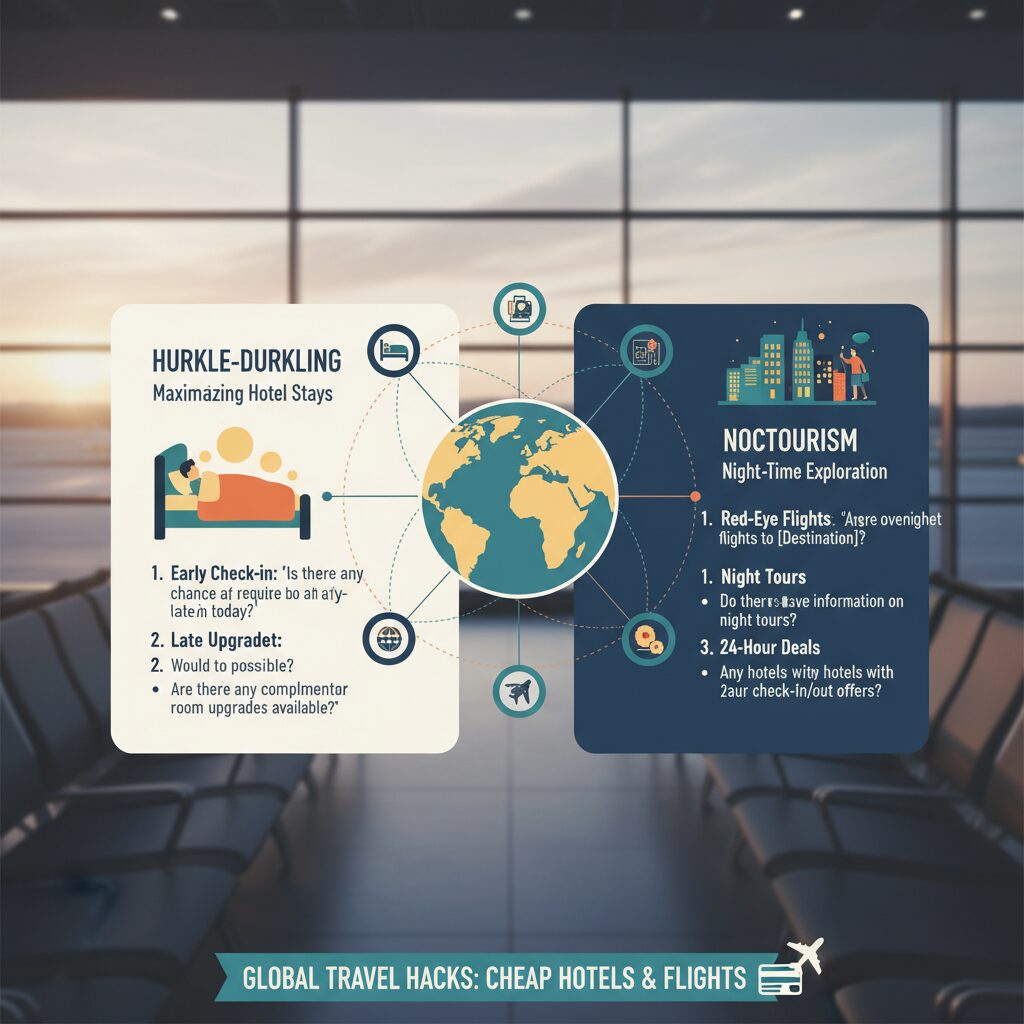
“Hurkle-Durkling” & Late Check-Outs
It sounds ridiculous, but “Hurkle-Durkling” is a Scottish phrase for lounging in bed, and it’s a top trend identified in the Hilton 2025 Trends Report. Chris Nassetta, CEO of Hilton, noted that 2025 is the “Year of the Travel Maximizer.”
The Hack: When you check in, don’t just ask for late check-out. Mention that you are planning a “rest-heavy” stay or a “wellness recovery” day. Hotels are currently training staff to accommodate this trend. Framing your request around their own marketing buzzwords increases your success rate.
“Noctourism” Upgrades
According to the Expedia Unpack ’25 Report, there is a massive surge in “Noctourism”—traveling to dark-sky reserves to see stars. If you are booking a hotel anywhere near a dark sky park or rural area, ask for a “high-floor, north-facing room for stargazing.” These are often the best rooms in the house, and front desk agents are happy to assign them to enthusiasts over random guests.
The Booking Window Calculator
One of the most common questions I get is, “When is the best time to book?” The answer has changed. The HotelHub Index Q4 2024 shows that the average booking lead time has increased by nearly 10%, meaning “last minute” deals are becoming scarcer for popular spots.
Use this calculator to estimate the ideal booking window based on recent data trends:
2025 Booking Window Estimator
The “Human Touch” (Manual Hacks)
Despite all the AI and apps, a human still runs the front desk. In my experience, the human element is where you get the upgrades that computers can’t give you.
The “24-Hour” Call
Most travelers call months in advance. That’s useless. I call the hotel directly (not the 1-800 central reservation line) exactly 24 hours before check-in. Why? Because that is when the Room Controller has finalized the inventory and knows exactly which suites are empty.
Script: “I see you have a Junior Suite available online for tomorrow. I’ve already booked a standard room, but since I’m celebrating a special occasion, would you be willing to offer a paid upgrade at a discount?”
They would rather get $50 extra from you than $0 from an empty suite. This works about 40% of the time, which is better odds than any lottery.
Brian Kelly (The Points Guy) noted in a December 2024 interview that while lodging costs have risen dramatically, using co-branded credit cards helps offset this. I’d add to that: combine the card perks with the “24-Hour Call” for maximum effect.
FAQ: Clearing Up the Confusion
Does using a VPN actually save money on hotels?
It can, but it’s less effective than it used to be. Changing your location to a lower-income country (like Turkey or Argentina) might show lower prices on global chains, but many OTAs now track your account history and device fingerprint, not just IP. It’s worth a try, but don’t rely on it as your only hack.
Is RoomerTravel legit in 2025?
Yes, but verify the listing. Look for sellers who have verified their identity. I generally prefer SpareFare currently due to recent positive feedback regarding their refund protection mechanisms.
Can I sell my non-refundable hotel room?
Yes, provided the hotel allows a name change. Check the fine print of your booking confirmation. If it says “Non-transferable,” you are out of luck. If it just says “Non-refundable,” you can likely sell it.
Conclusion: Stack Your Hacks
The days of finding a “glitch fare” by accident are over. In 2025, saving money on hotels requires a deliberate strategy. It requires realizing that the price you see is rarely the final price.
Don’t just pick one of these tips. Stack them. Use RatePunk to find the baseline. Check Directo for the member rate. Book the refundable option. Set up a Pruvo alert. And if life happens and you can’t go, put the room on SpareFare.
The industry counts on you being passive. Be active, be technical, and never pay full price again.
Disclaimer: Prices and policies mentioned are subject to change. Always read the terms and conditions of booking platforms and tools.