What are top sustainable travel tips?
The Ultimate Guide to Sustainable Travel Tips for 2025 (Backed by Data)
We need to talk about the “guilt trip.”
If you love exploring the world but feel a knot in your stomach every time you book a flight, you are not alone. In my years covering the tourism industry, I’ve seen a massive shift in how we approach our vacations. It’s no longer just about where we go, but how we leave the place when we depart.
The data backs this up. According to the Booking.com Sustainable Travel Report released in April 2024, 75% of global travelers say they want to travel more sustainably over the next 12 months. Yet, a staggering 70% feel overwhelmed by navigating the options, unsure of what actually makes a difference.
You don’t have to be perfect. You don’t need to sail across the Atlantic on a solar-powered raft to make a difference. The goal of this guide is to move you beyond the “reuse your towel” advice into high-impact, data-backed actions that reduce your carbon footprint and support local economies.
Here is your definitive roadmap to traveling responsibly in 2025, from pre-trip vetting to zero-waste packing.

The “Green Fatigue” Reality: Why 2025 is Different
Let’s be real: we are tired of hearing about the apocalypse. In the industry, we call this “Green Fatigue.” Consumers are becoming skeptical of vague claims and are less willing to pay extra for a label without proof.
According to the Euromonitor International Voice of the Consumer Survey from May 2024, green fatigue is setting in because travelers are tired of the “doom and gloom” narrative. They want empowerment, not restriction.
The “intention-action gap” is the biggest hurdle we face. Booking.com’s 2024 data reveals that while 45% of travelers feel sustainability is important, it often drops off the priority list when the stress of booking actually begins.
This guide isn’t about being a martyr for the planet. It’s about making smarter choices that often lead to better travel experiences anyway.
Phase 1: Smart Planning & “Greenwashing” Detection
The most critical sustainable travel tips happen before you even pack your bag. The term “Eco-friendly” is unregulated, meaning any hotel can slap it on their website because they stopped using plastic straws.
This is called greenwashing in tourism, and in 2025, you need to know how to spot it.
The “Green Label” Audit: How to Verify Claims
Don’t trust the hotel’s marketing; trust third-party audits. As Randy Durband, CEO of the Global Sustainable Tourism Council (GSTC), emphasized in 2025 context:
“The GSTC Criteria include guidelines for minimizing negative environmental, cultural, and social impacts… We need to verify claims… verification is key.”
— Randy Durband, GSTC
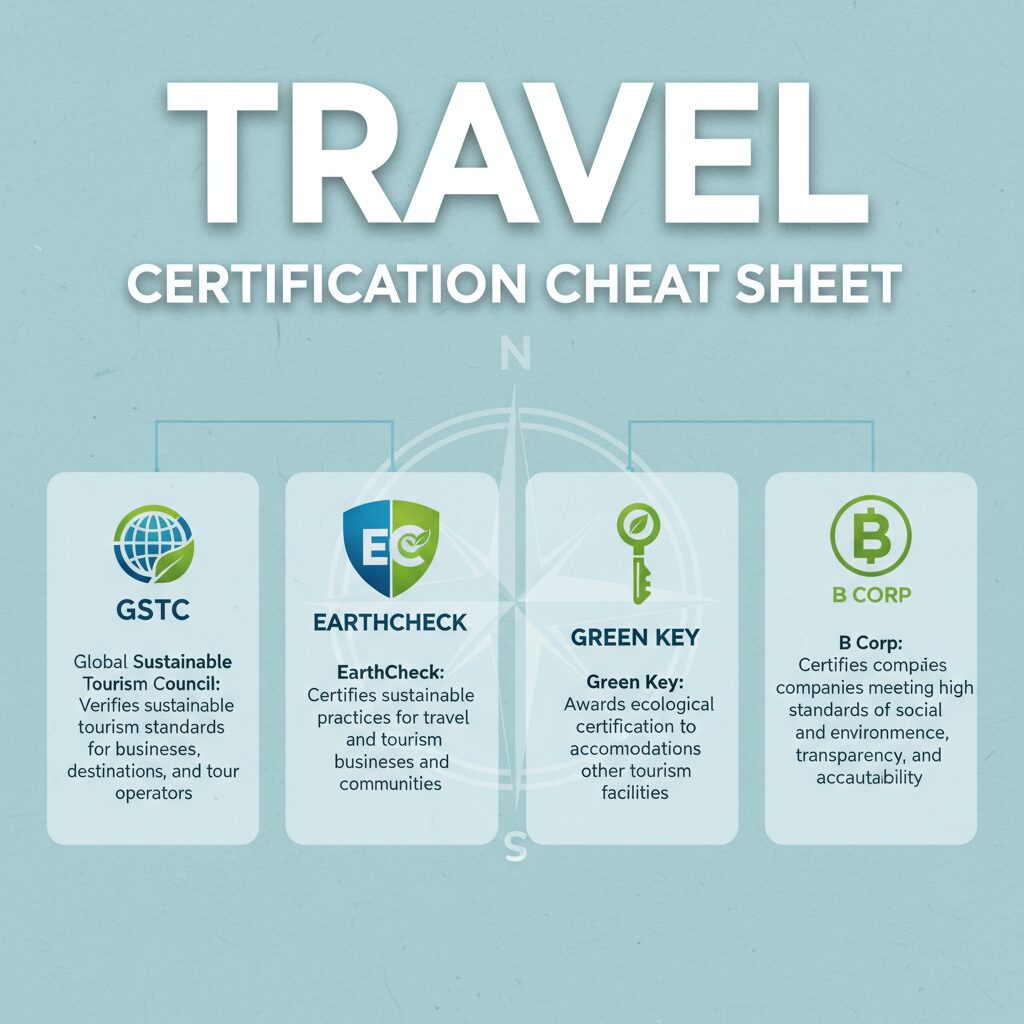
When booking, look for these “Gold Standard” certifications that require rigorous, on-site audits:
- GSTC-Accredited Certification: The highest bar in the industry.
- EarthCheck: deeply scientific and data-driven.
- Green Key: Widely recognized in Europe.
- B Corp Certification: Measures the entire company’s social and environmental impact.
A 2024 report from Booking.com notes that 45% of travelers find accommodations labeled as sustainable more appealing. But remember: if they can’t show you the certificate, it likely doesn’t exist.
Destination Selection: Avoiding Overtourism
Sustainability is also about where you go. Overtourism strains local infrastructure and degrades the very sites we visit to see. In 2025, consider “second-city tourism”—visiting a country’s lesser-known cities rather than its crowded capital.
For example, swap Venice for Treviso, or Amsterdam for Utrecht. You get a more authentic experience, and your tourist dollars support communities that actually need them.
Phase 2: The Transport Dilemma (Flying vs. Rail)
Here is the elephant in the room: Transport. According to the Intrepid Travel / Skift Sustainable Tourism Summit in June 2024, tourism accounts for roughly 8% of the world’s carbon emissions, with transport being the largest contributor.
The Train Renaissance
If you are traveling within Europe or parts of Asia, the train is your best friend. It’s not just a romantic notion; it’s a booming trend. Euromonitor International’s Travel Trends report indicates that rail transport is the fastest-growing travel category worldwide, with a projected 35.6% growth over the 2023-2024 period.
Calculating Your True Impact: Atmosfair vs. ICAO
If you must fly, you need to understand the damage to mitigate it. Most airline calculators use the standard ICAO methodology, which measures CO2 only. However, this is incomplete.
I recommend using Atmosfair. Unlike basic calculators, Atmosfair accounts for the “Radiative Forcing Index”—the non-CO2 effects of flying at high altitudes (like contrails), which can triple the climate impact of a flight.
🚆 Train vs. Plane Impact Estimator
See how much CO2 you save by taking the train (Estimated for a 500km trip, e.g., London to Paris).
Carbon Offsetting vs. Removal
Does carbon offsetting actually work? It’s controversial. In 2025, smart travelers are moving from “offsetting” (paying someone not to cut down a tree) to “removal” (technologies like Direct Air Capture). When choosing a program, look for those investing in Sustainable Aviation Fuel (SAF) or rigorous removal projects verified by the Gold Standard.
Phase 3: Accommodation & “Community Leakage”
Where does your money go when you swipe your card? This brings us to the concept of economic leakage. In many mass tourism resorts, it is estimated that only 5-10% of the money spent actually stays in the local community. The rest “leaks” out to foreign-owned hotel chains and tour operators.
According to WTTC Economic Impact Research (April 2024), Travel & Tourism contributed a massive 9.1% of global GDP in 2023. You have the power to direct that wealth to the people who host you.
How to Stop the Leak
- Book Locally Owned: Use platforms that highlight locally owned guesthouses rather than multinational chains.
- Eat Local: Skip the hotel buffet. Eating at local restaurants ensures your money goes directly to local families.
- Support Community-Based Tourism: Look for tours run by indigenous communities where the revenue funds schools or conservation projects.

Phase 4: Ethical Wildlife & Cultural Respect
One of the most heartbreaking aspects of modern tourism is the exploitation of animals. “Ethical animal tourism” is a high-volume search term for a reason—people care. But good intentions aren’t enough.
The “No Touch” Rule
If you can hug, ride, or take a selfie with a wild animal, it is likely unethical. Period. True sanctuaries do not allow direct interaction.
Darrell Wade, Co-founder of Intrepid Travel, spoke candidly at the Skift Sustainable Tourism Summit in 2024 about the difficulty of this work:
“Sustainability is not easy, it’s heavy lifting… There is too much ‘rhetorical flourish’ from travel companies… we need science-based targets.”
— Darrell Wade, Intrepid Travel
Intrepid has led the way by banning elephant rides years ago. In 2025, apply this scrutiny to marine parks and “tiger temples.” Keep wildlife wild.
Phase 5: Packing for the Planet (Zero Waste Kit)
Plastic-free travel tips are essential, especially when visiting countries with developing waste management systems. Your plastic bottle doesn’t get recycled; it often ends up in the ocean or burnt in open pits.
Your 2025 Zero Waste Essentials
I never leave home without these three items:
- Filtered Water Bottle: Brands like Grayl or LifeStraw allow you to drink tap water anywhere in the world safely, eliminating the need for thousands of plastic bottles.
- Solid Toiletries: Shampoo bars and toothpaste tabs reduce weight and plastic waste.
- Reusable Shopping Bag: For those local market trips.

FAQ: Sustainable Travel Questions Answered
What is the most sustainable mode of transport?
Walking and cycling are obviously the best, but for long distances, train travel is the clear winner, emitting up to 80-90% less carbon than flying. Electric vehicle road trips are a close second, provided the electricity source is relatively clean.
How do I know if a hotel is truly eco-friendly?
Look for third-party accreditations like GSTC, Green Key, or EarthCheck. Be wary of self-created labels like “Green Leader” unless they are backed by transparent data. Ask the hotel specifically: “How do you measure your carbon footprint?” and “Do you ban single-use plastics?”
Does carbon offsetting actually work?
It is a band-aid, not a cure. Offsetting (paying for someone else to reduce emissions) is less effective than carbon removal. However, it is better than doing nothing. Use high-quality calculators like Atmosfair that account for radiative forcing.
Is flying business class bad for the environment?
Yes. A business class seat takes up more space, meaning fewer people are on the plane, which increases the carbon footprint per passenger significantly—often 3 to 4 times higher than an economy seat.
Conclusion: From “Sustainable” to “Regenerative”
The future of travel isn’t just about sustaining the status quo—it’s about regeneration. “Regenerative tourism” means leaving a place better than you found it. It means your visit restores the environment and enriches the local community.
As Zurab Pololikashvili, Secretary-General of UN Tourism, stated in his address to the UN General Assembly in April 2024:
“Unsustainable consumption is leading to biodiversity loss, climate change and the emergence of pandemics. It’s vital that we adopt policies that accelerate transformative change.”
We have the tools. We have the data. The Booking.com report showed that 43% of travelers feel guilty when they make less sustainable choices. Use that guilt as fuel. Use the tips in this guide to plan your next adventure, knowing that every small choice—from the train you take to the hotel you book—casts a vote for the kind of world you want to explore.
Travel is a privilege. Let’s treat it like one.

Related Posts

How to document travel memories well?

Where to find authentic local food?