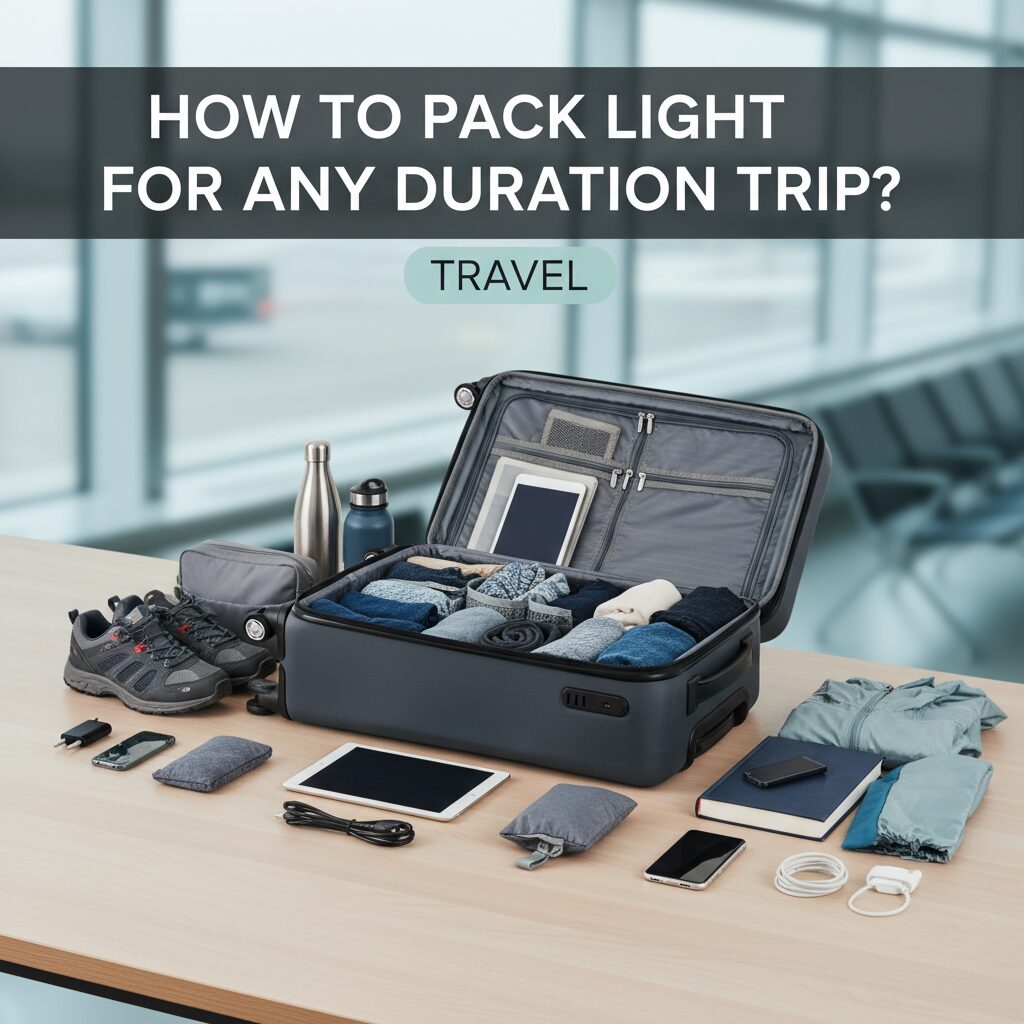
How to pack light for any duration trip?
How to Pack Light for Any Duration Trip: The Ultimate 2025 Guide
There is a specific kind of anxiety that hits you at the baggage carousel. You know the feeling: staring at the rubber flaps, watching identical black suitcases tumble out one by one, praying yours isn’t the one that decided to take a detour to Honolulu while you’re in Helsinki.
I’ve been there. But more importantly, I’ve seen the data that proves that anxiety is justified. According to the Bureau of Transportation Statistics (BTS), U.S. airlines collected a record-breaking $7.27 billion in baggage fees recently. That is billions of dollars travelers paid just to wait in line, risk lost items, and haul heavy gear they likely didn’t use.
But here is the thing that changed my travel life: packing light isn’t about sacrifice; it’s about freedom.
Whether you are going off-grid for two months or heading to a business conference for two days, the rules of physics and logistics remain the same. In this guide, I’m going to walk you through the exact methodology—the 5-4-3-2-1 rule, the fabric choices, and the 2025 airline restrictions—that will let you bypass the carousel and walk straight out of the airport.
Global airline ancillary revenue from baggage in 2024.
The “Golden Rules” of Light Packing
The biggest mistake I see people make is assuming that a longer trip requires a bigger bag. It sounds logical, but it’s a trap. A trip of three weeks doesn’t require three times the clothes of a one-week trip.
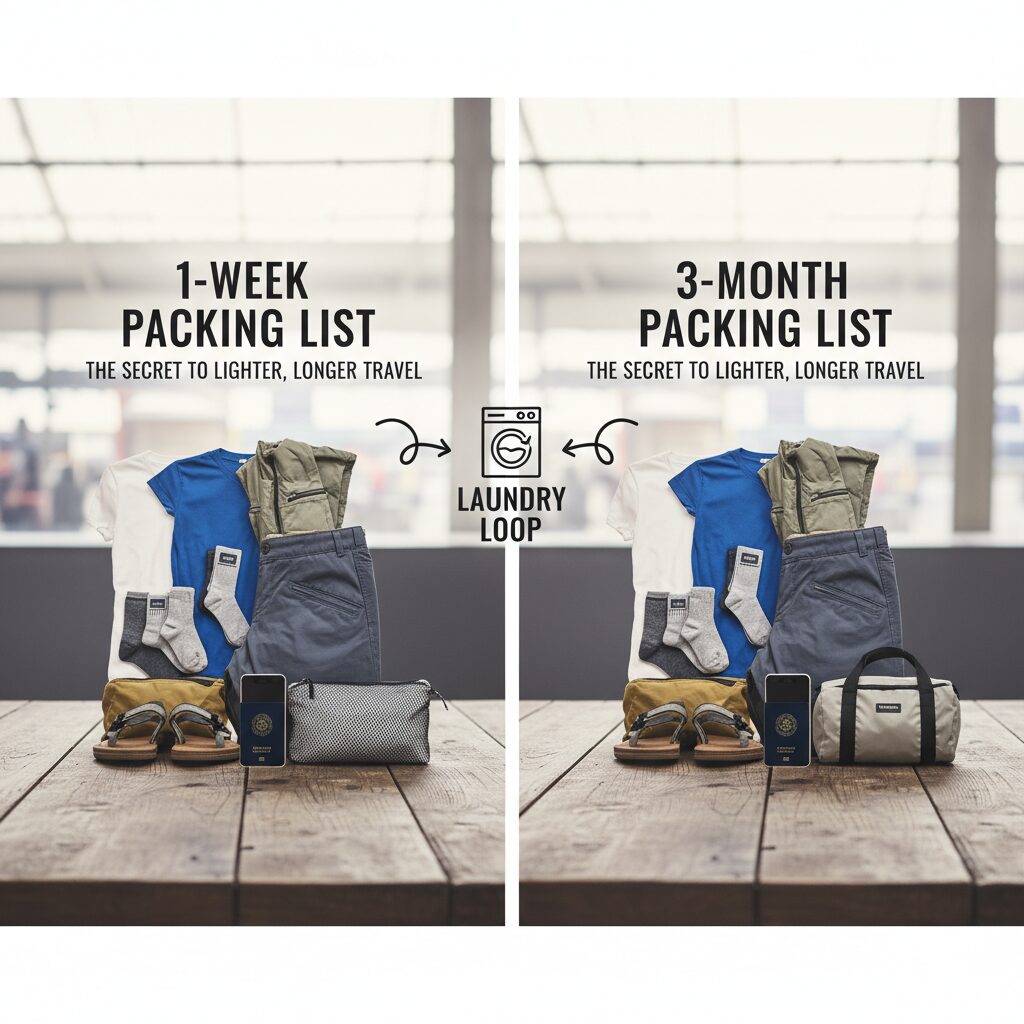
The 1-Week Laundry Loop
Here is the secret: You only ever pack for one week.
If your trip is 10 days, 30 days, or 6 months, your packing list should look exactly the same. This is the “Laundry Loop.” You pack enough clothing for 7 days, and you plan to do laundry once a week.
In my experience, finding a laundromat in Tokyo or washing a few items in a hotel sink in London is infinitely easier than lugging a 50-pound suitcase over cobblestones. Plus, it’s safer. According to SITA Baggage IT Insights 2024, international transfer flights are 5 times more likely to lose checked luggage than domestic flights. By keeping your bag with you, you eliminate that risk entirely.
The 5-4-3-2-1 Packing Method
If you need a rigid structure to stop you from overpacking, this is the gold standard for a flexible carry-on wardrobe.
- 5 Tops: A mix of t-shirts, button-downs, or blouses. Focus on layers.
- 4 Bottoms: Think one pair of jeans, one pair of chinos/lightweight trousers, one pair of shorts/skirt, and one pair of joggers/leggings for travel days.
- 3 Accessories: Sunglasses, a hat, and a scarf (or belt).
- 2 Shoes: One comfortable pair for walking (wear these on the plane) and one nicer pair for evenings.
- 1 Swimsuit: Or one heavy jacket, depending on the destination.
Expert Insight
“You’ll never meet a traveler who brags: ‘Every year, I pack heavier.’ It’s not a hardship to pack light, it’s a sort of enlightenment.” — Rick Steves, Travel Expert.
The “Just in Case” Trap
Psychologically, we overpack to manage anxiety. We think, “What if there’s a gala dinner?” or “What if it hails in July?”
Marie Kondo’s advice applies beautifully here: “Pack only what sparks joy and is absolutely essential for the trip you are taking, not the trip you imagine you might take.” If that rare “what if” scenario actually happens, remember that people in other countries also sell umbrellas and socks. You can buy what you need, usually for less than the cost of a checked bag fee.
Building Your Capsule Wardrobe
To make the 5-4-3-2-1 rule work, you can’t just throw random clothes in a bag. They need to work together. This is where the “Capsule Wardrobe” comes in.
Fabrics Matter: The Merino Miracle
If you take one thing away from this article, let it be this: Cotton is the enemy of light packing. It is heavy, it dries slowly, and it holds odors.
I switched to Merino wool years ago and never looked back. Merino is naturally antimicrobial, meaning you can wear a shirt 3-4 times before it needs washing. It also regulates temperature better than synthetics. While it’s an investment, buying two high-quality Merino shirts allows you to leave five cotton t-shirts at home.
The Three-Color Rule
To ensure every top matches every bottom (maximizing outfit combinations), stick to three colors:
- Base Color: Black, Navy, or Charcoal (Pants and Shoes).
- Neutral Color: White, Grey, or Beige (T-shirts and layers).
- Accent Color: Olive, Burgundy, or Blue (Accessories or one statement shirt).
Shoe Strategy
Shoes are the heaviest and bulkiest items you own. Limit yourself to three pairs maximum, but ideally two.
- Wear your heaviest shoes (boots or chunky sneakers) on the plane.
- Pack your lightest shoes (canvas sneakers, flats, or sandals) in the bag.
- Utilize dead space: Never pack empty shoes. Stuff them with socks or underwear to maximize every cubic inch.
The Gear That Makes It Possible
You can have the best packing discipline in the world, but if you choose the wrong bag, you’re already behind. In 2025, airline sizing is stricter than ever.
Backpack vs. Suitcase
This is the great debate. Personally, I side with the backpack for one reason: Mobility. Europe’s cobblestones and Southeast Asia’s dirt roads are nightmares for roller wheels. Plus, having your hands free to check Google Maps is invaluable.
However, ergonomics are vital. According to the National Institutes of Health (NIH), to prevent injury, a backpack should generally not exceed 10-15% of the traveler’s body weight. If you have back issues, a high-quality 4-wheel spinner is the safer bet.
Budget Airline Survival Guide (2025 Dimensions)
Airlines have weaponized baggage dimensions. If you are flying budget carriers, “standard carry-on” often doesn’t exist without a fee. Here is the current landscape:
| Airline | Bag Type | Max Dimensions | Weight Limit |
|---|---|---|---|
| Ryanair | Personal Item (Free) | 40cm x 20cm x 25cm | None (must fit under seat) |
| EasyJet | Personal Item (Free) | 45cm x 36cm x 20cm | 15kg |
| Spirit Airlines | Carry-On (Paid) | 22″ x 18″ x 10″ | None |
| United/American/Delta | Standard Carry-On | 22″ x 14″ x 9″ | None (Usually) |
Note: Always verify with your specific airline before flying, as policies change rapidly. Source: Ryanair Official Baggage Policy 2025 and Spirit Airlines Contract of Carriage.
Packing Cubes: The Compressor
If you aren’t using compression packing cubes, you are wasting about 30% of your bag’s volume. They work like vacuum bags without the vacuum. I organize mine by category: tops in one, bottoms in another. This prevents your bag from exploding into chaos every time you need a fresh pair of socks.
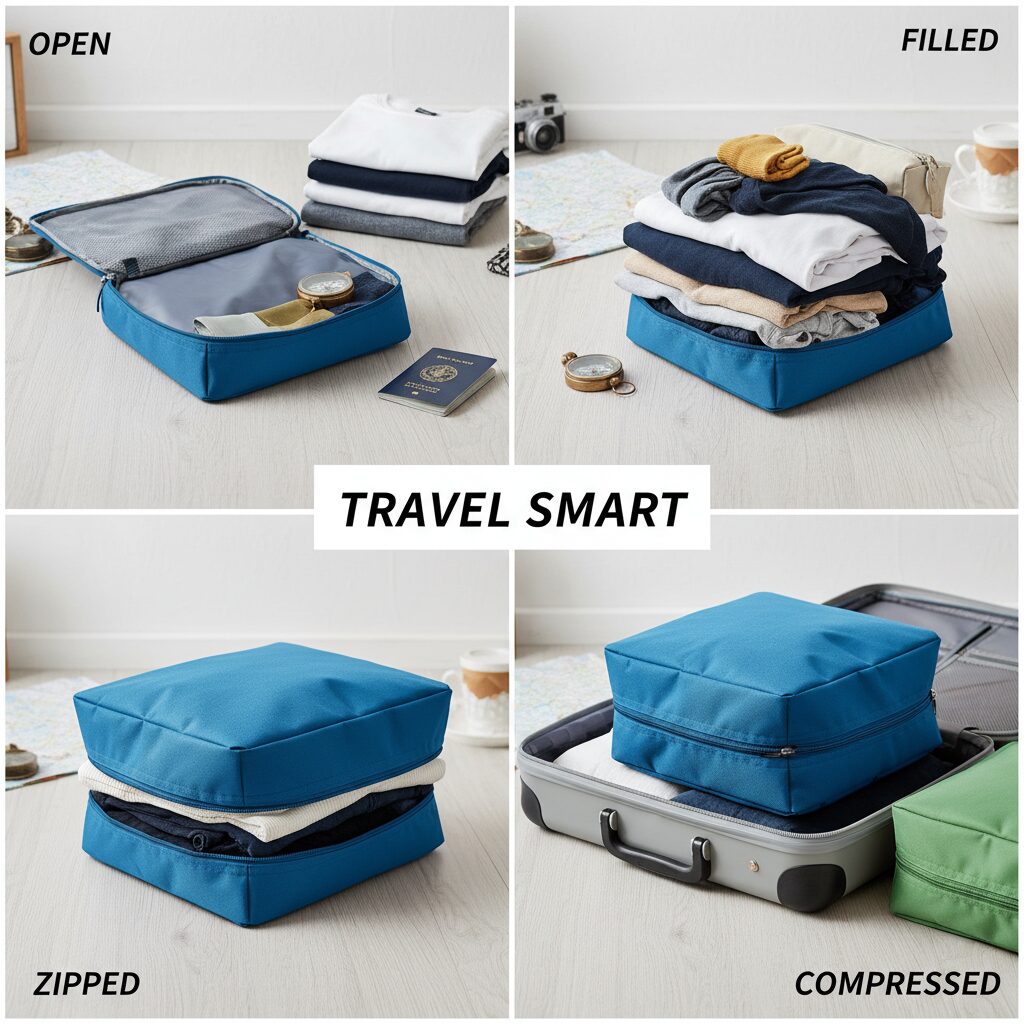
How to Pack It: Techniques
Now that you have the gear, how do you put it in the bag? The debate between rolling and folding is fierce, but the answer is actually “both.”
Roll vs. Fold: The Verdict
I’ve tested this on dozens of trips. Here is the rule:
- Roll softer synthetic fabrics, t-shirts, and jeans. It saves space and prevents hard creases.
- Fold stiff fabrics like blazers, collared shirts, or dress slacks. Rolling these creates deep wrinkles that are hard to steam out.
Tetris-ing Your Bag
Weight distribution matters for your comfort. Place the heaviest items (toiletry bag, shoes, tech) at the bottom of the bag (if it’s a suitcase) or closest to your back (if it’s a backpack). This keeps the center of gravity close to your body, making the load feel lighter.
Toiletries & The 2025 Liquid Rules
Despite the rollout of new CT scanners in some major airports (like London City and parts of Amsterdam), the global standard is still lagging behind.
According to the TSA Media Room and UK transport updates, sticking to the 3.4oz (100ml) rule remains the safest bet for 2025. You don’t want to be the person forcing the security agent to throw out your expensive moisturizer because you assumed the new scanner technology was everywhere.
Go Solid to Save Space
Liquids are heavy and restricted. Switch to solid toiletries. Solid shampoo bars, toothpaste tabs, and stick deodorants don’t count toward your liquid limit and won’t leak on your clothes.
Digital Nomad & Tech Lite Packing
For those of us working from the road, tech is non-negotiable. But do you really need that tangle of cables?
The GaN Charger Revolution
Gallium Nitride (GaN) chargers have changed the game. You can now buy a charger the size of a deck of cards that can power your laptop, phone, and camera simultaneously. Look for a 65W or 100W GaN charger with multiple USB-C ports. This allows you to leave the bulky MacBook brick at home.
Digitize Everything
Paper is dead weight. I use Google Drive or Dropbox to scan copies of my passport, travel insurance, and vaccination records. Not only does this save space, but it’s also a vital backup if your physical bag is stolen.
FAQ: Common Packing Light Questions
Is it better to roll or fold clothes for packing?
Generally, rolling is better for saving space and works best for casual clothes like t-shirts and jeans. Folding is better for structured items like button-down shirts or blazers to minimize wrinkles. A hybrid approach is usually best.
What is the 5-4-3-2-1 packing rule?
It is a minimalist packing formula for a one-week trip: 5 tops, 4 bottoms, 3 accessories, 2 shoes, and 1 swimsuit (or hat). This provides enough variety for over 2 weeks of outfits without overpacking.
How can I avoid baggage fees on budget airlines?
The only surefire way is to pack within the “Personal Item” dimensions (usually fitting under the seat in front of you). For Ryanair, this is strictly 40x20x25cm. Use a soft-sided backpack, as they can be squished into sizers, whereas hard-shell cases cannot.
Can I bring a razor in my carry-on?
Yes, you can bring disposable razors and electric shavers in your carry-on. However, safety razors with removable blades are generally prohibited unless the blade is removed. TSA guidelines confirm disposable razors are fine.
Conclusion
Packing light requires a shift in mindset. It asks you to trust that you can handle the “what ifs” without a physical item to solve every potential problem. But the reward is immense.
When you travel with one bag, you are more mobile, more secure, and less stressed. You move through the world with agility rather than burden. As American Express Travel trends indicate, 68% of modern travelers are prioritizing flexible itineraries. Nothing kills flexibility faster than a 50-pound anchor with wheels.
So, for your next trip, try the 5-4-3-2-1 rule. Leave the “just in case” items on the bed. Experience the joy of walking past the baggage claim and stepping straight into your adventure.

Related Posts
Maximize PTO: How to extend travel time?
How to plan accessible travel easily?