Is solo travel cheaper to plan?
Is Solo Travel Cheaper? The 2025 Cost Breakdown & Real Numbers
There is a specific moment every prospective solo traveler faces. You have the credit card in hand, the flight to Tokyo or Rome pulled up on your screen, and you hesitate. A nagging question circles your mind: Am I being ripped off because I don’t have a partner?
In my decade of analyzing travel economics, I’ve seen the industry shift from treating solo travelers as anomalies to recognizing them as a powerhouse demographic. Yet, the pricing structures haven’t fully caught up. We call this the “Freedom Premium.”
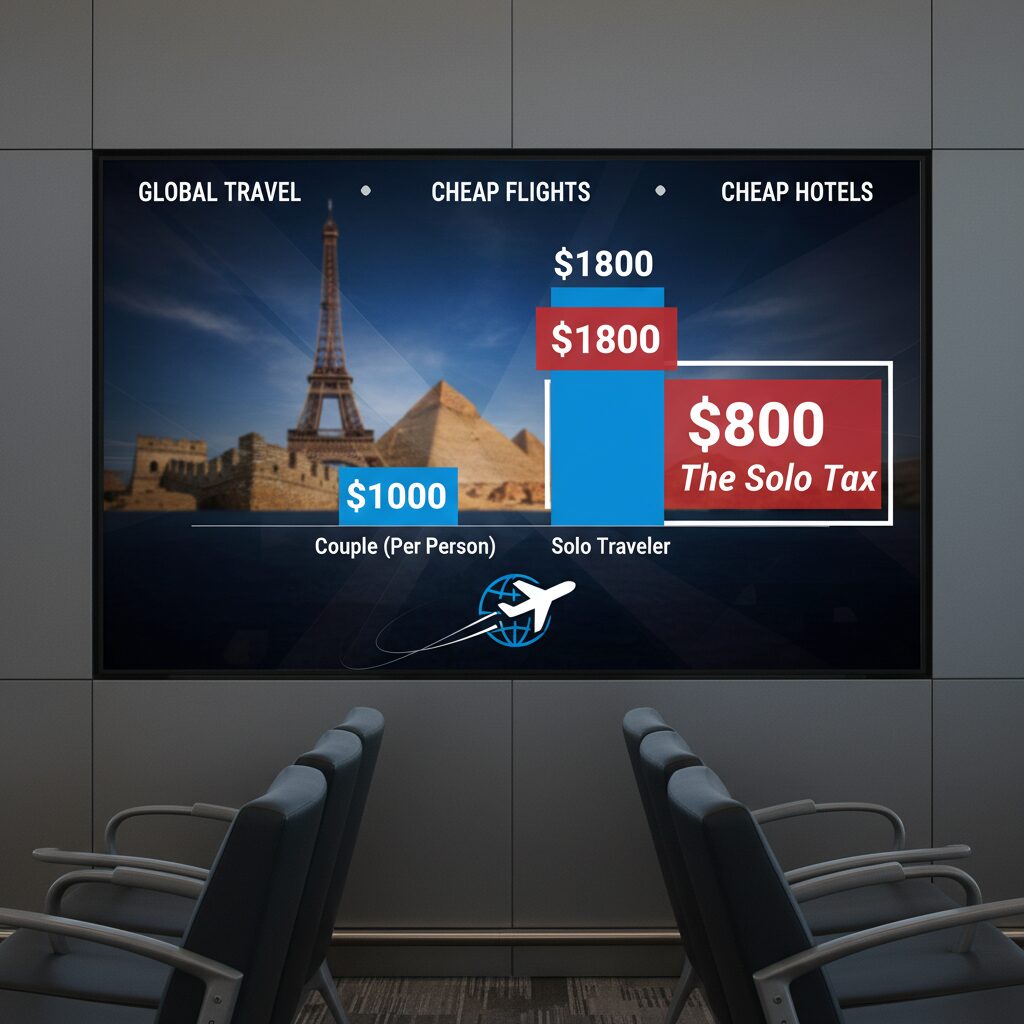
Let’s look at the hard truth immediately. According to Radical Storage / Condor Ferries industry data (2024), a person traveling alone pays an average of 47% more than someone traveling as part of a couple due to single supplement charges. On paper, solo travel is significantly more expensive per person.
But paper trails don’t account for the “Compromise Tax”—the money you waste on group dinners you hate or museums you didn’t want to visit. While the unit cost is higher, the experience cost might actually save your bank account.
The Short Answer: The “Solo Tax” vs. The “Compromise Tax”
To determine if solo travel is cheaper for you, we have to distinguish between fixed costs and psychological costs. The “Solo Tax” is real, but it is often offset by the agility of being alone.
According to the American Express Global Travel Trends Report (March 2024), 76% of Millennials and Gen Z respondents are planning on taking a solo trip this year. They aren’t doing this because they love paying extra; they are doing it because the value proposition has shifted.
Fixed Costs vs. Variable Costs Breakdown
| Expense Category | Solo Traveler Status | Couple/Group Status |
|---|---|---|
| Accommodation | 🔴 Expensive: You pay 100% of the room rate. | 🟢 Cheaper: Split cost (50% each). |
| Food & Drink | 🟢 Cheaper: Total control (street food vs. fine dining). | 🟡 Neutral: Often leads to “compromise dining” (pricier). |
| Transportation (Flights) | ⚪ Neutral: A seat is a seat. | ⚪ Neutral: No bulk discount for two. |
| Transportation (Taxis) | 🔴 Expensive: You pay full fare. | 🟢 Cheaper: Split fare. |
| Tours/Activities | 🟡 Variable: Often hit with single supplements. | 🟢 Cheaper: Group rates often apply. |
The “Single Supplement” Reality: The #1 Budget Killer
If you have ever booked a cruise or a group tour, you have likely encountered the dreaded “Single Supplement.” This is an industry standard surcharge ranging from 10% to 100% of the standard double-occupancy rate.
Why does this exist? It comes down to revenue management. Hotels and cruise lines calculate revenue based on “double occupancy.” They assume two people will be in the room, buying two breakfasts, two drinks at the bar, and booking two spa treatments. When you book that room alone, you are statistically less valuable to them.
“A single supplement is an extra fee charged by travel companies to solo travelers… it’s a practice many solo travelers describe as feeling punished for traveling alone.”
— Kendra Guild, VP of North America at Solos (Forbes Interview, 2024)
According to Forbes Advisor / Cruise Critic (November 2024), these supplements on cruises can range from 10% to 100% (or even 200%) of the standard fare. If a cruise costs $1,000 per person for a couple, a solo traveler might be asked to pay $2,000 for the exact same cabin.
The Shift: 2025 Industry Trends
However, the tide is turning. Hilton’s 2025 Trends Report identifies “MeMooners” as a major emerging cohort. Their data shows that 64% of solo travelers prefer solitude over meeting others. Hotels are beginning to realize that alienating this demographic is bad business. We are seeing a rise in “waived supplement” weeks, particularly from operators like G Adventures and certain cruise lines (like Virgin Voyages) that allocate specific cabins for solos.
Cost Showdown: Solo Traveler vs. Couple (Case Study)
Let’s move away from percentages and look at raw dollars. I’ve constructed a pricing model for a 7-Day Trip to Rome in 2025 based on current average pricing.
The Scenario: A mid-range hotel, eating out for every meal, and standard sightseeing.
1. Accommodation (The Solo Loss)
Hotels in Rome do not generally charge “per person”; they charge per room.
Couple: $200/night room ÷ 2 people = $100 per person/night.
Solo: $200/night room = $200 per night.
Result: Over a week, the solo traveler pays $700 more for housing.
2. Food & Dining (The Solo Win)
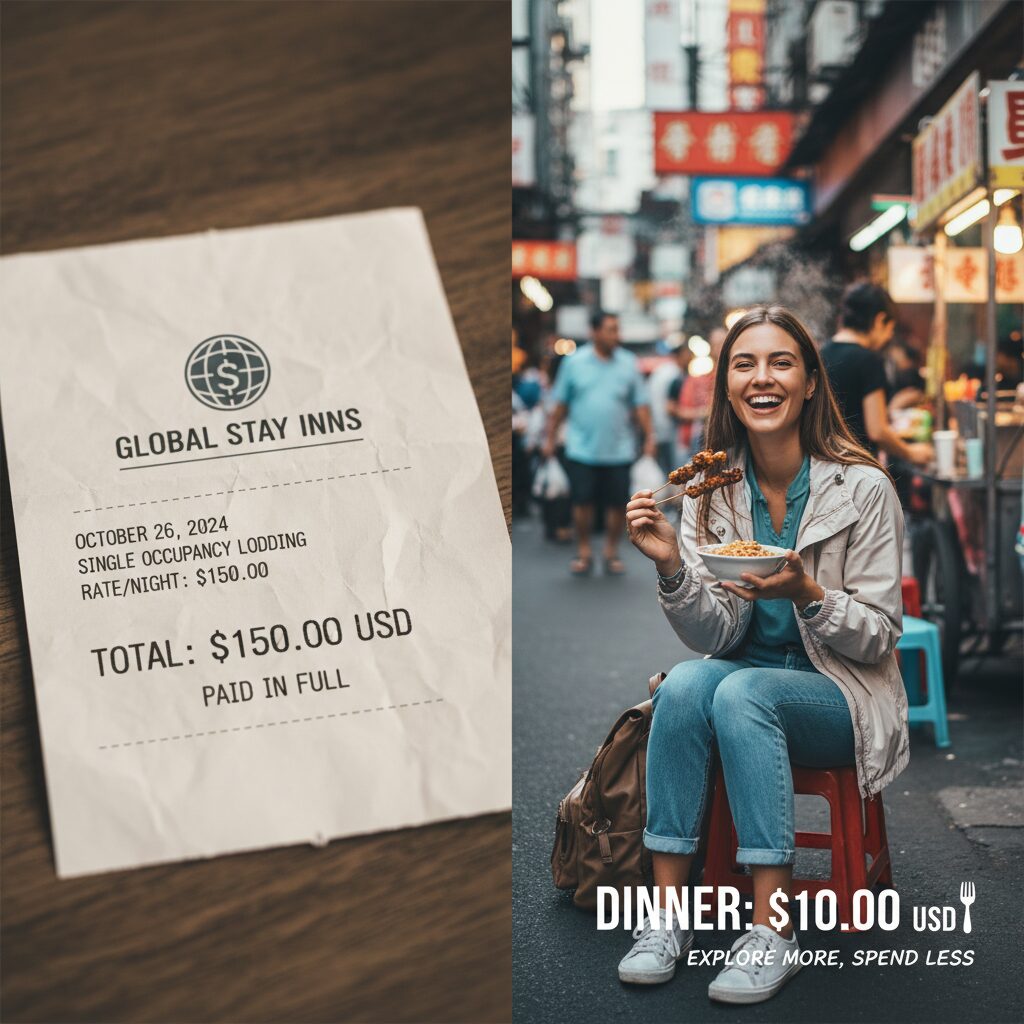
Here is where the psychology of spending kicks in. Couples tend to sit down for dinner. It’s romantic; it’s an event. Solo travelers are statistically more likely to grab a slice of pizza on the go or eat a simple meal.
Couple Average: $80/day per person (Sit-down lunch and dinner + wine).
Solo Average: $40/day (Panini for lunch, casual pasta dinner, less alcohol).
Result: Over a week, the solo traveler saves $280 on food.
3. The Bottom Line
Comparing this to the Nomad Numbers 2024 Spending Report, we see this played out over the long term. A nomadic couple spent $23,757 per person for a full year of travel. A baseline solo trip for the same duration and comfort level (per A Little Adrift’s 2024 RTW Budget Report) sits around $30,000. The couple saves about 20% largely due to shared housing.
🧮 The Solo Budget Calculator
Estimate your “Solo Tax” based on your next trip.
The Hidden Financial Benefits of Solo Travel
If the math looks grim regarding hotels, why does Atlys / Booking.com Analysis (2025) predict that 62% of global travelers intend to take 2–5 solo trips this year? Because flexibility is a currency of its own.
1. Speed of Travel
I have found this to be the most overlooked factor in travel budgeting. Solo travelers move faster. A couple might need 4 days in Rome to satisfy both people’s wish lists (The Vatican for him, the Catacombs for her). A solo traveler can ruthlessly prioritize, seeing what they want in 2.5 days. This saves two full nights of accommodation and dining costs, often equalizing the budget.
2. The Last-Minute “Sniper” Booking
Airlines and hotels often release distressed inventory 24-48 hours before a date. Finding two seats together on a flight or a room with specific requirements for a couple is hard. Finding one single seat? Much easier. Solo travelers can capitalize on “error fares” and last-minute deals that couples simply cannot coordinate quickly enough.
“Travelers are taking trips alone, embracing the ease of planning and the ability to tailor itineraries that are a perfect fit for them.”
— Audrey Hendley, President of American Express Travel (March 2024)
How to Hack the System: Lowering Solo Costs in 2025
You don’t have to accept the 47% markup. Here is how experienced solo travelers are circumventing the system in 2025.
1. Embrace the “Pod” Hotel Revolution
The rise of high-end hostels and “pod” hotels (like CitizenM or Yotel) has changed the game. These properties sell small, single-occupancy rooms designed for one person. You aren’t paying for empty space you don’t use. In cities like London and Tokyo, this cuts accommodation costs by 40% compared to traditional hotels.
2. Use Solo-Friendly Tour Operators
If you prefer guided travel, stop looking at generic operators. Look for companies with “solo-share” options. Companies like G Adventures and Intrepid Travel allow you to book a spot on a tour and will pair you with a roommate of the same gender. If they can’t find you a roommate, they waive the single supplement. You get the half-price rate, guaranteed.
3. Destination Arbitrage
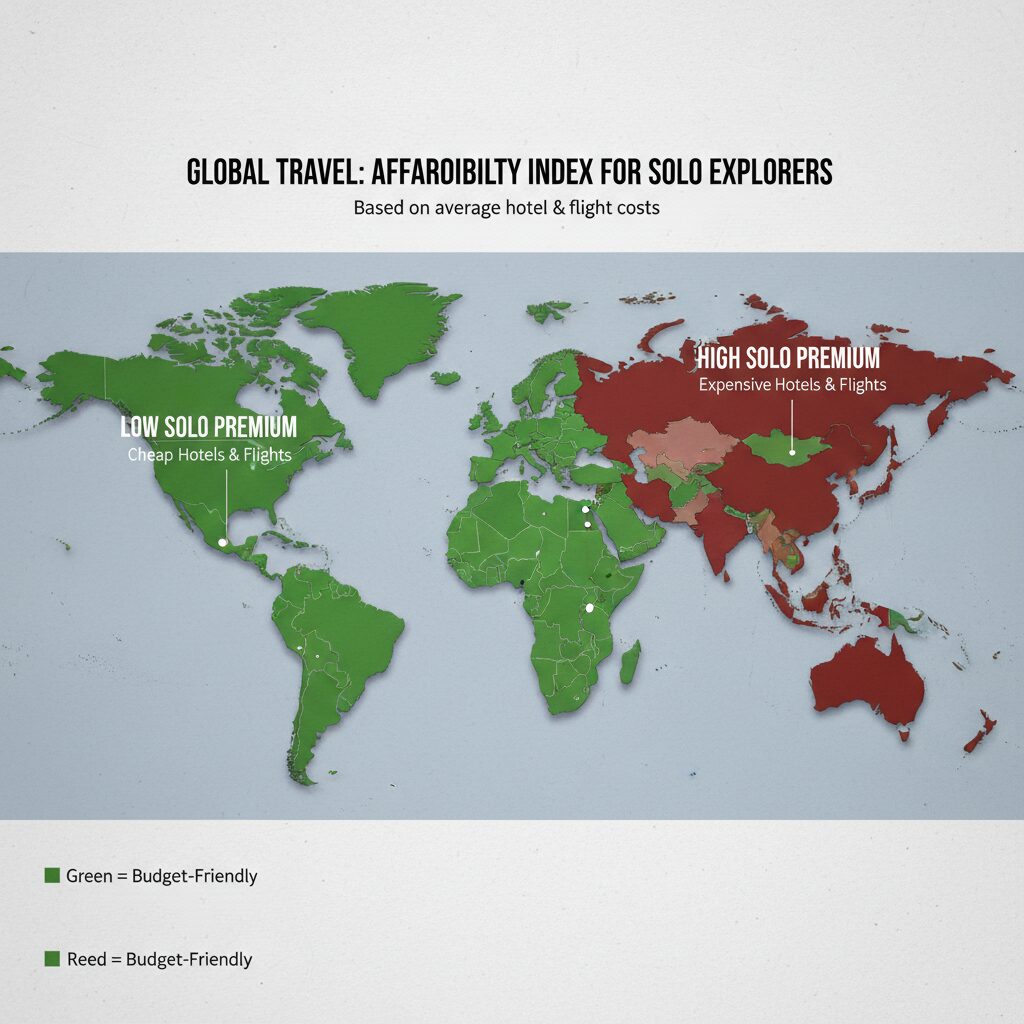
According to Skyscanner’s Solo Travel Survey (October 2024), solo travelers spend between $1,000 and $3,000 per week. To stretch this, go where the currency favors the solo traveler. In Southeast Asia (Vietnam, Thailand) or parts of Eastern Europe, the cost of a private room is so low ($15-$25/night) that the “Solo Tax” becomes negligible compared to Western Europe.
FAQ: Your Solo Budget Questions Answered
Does traveling solo cost double?
Not exactly double, but close for accommodation. Expect to pay 100% of the room rate. However, food, transport, and activity costs remain single. Overall, expect a 30-50% increase in total trip cost compared to your share of a couple’s trip.
What is the single supplement fee in 2025?
On cruises and escorted tours, the single supplement currently averages between 50% and 100% of the trip cost. However, specialized solo travel lines are increasingly waiving this to attract the “MeMooner” demographic.
Is Airbnb cheaper for solo travelers?
Often, no. Airbnbs frequently charge high cleaning fees and service fees that are fixed regardless of occupancy. For short stays (1-3 nights), a hotel or pod hotel is usually cheaper for one person. For month-long stays, Airbnb becomes competitive.
Do travel agents charge more for solo trips?
Travel agents do not charge higher commissions for solo travelers, but they are bound by the hotel and cruise pricing structures. A good agent, however, knows which cruise lines are currently running “no single supplement” promotions.
Conclusion: The Price of Freedom
So, is solo travel cheaper to plan? If we look strictly at the economics of accommodation, the answer is no. The data is clear: the 47% markup on housing is a significant hurdle.
However, framing it purely on hotel costs misses the point. Solo travel allows you to control the variable costs—dining, speed of travel, and activity choices—with ruthless efficiency. You aren’t paying for someone else’s expensive taste in wine or their desire to stay in a hotel with a pool you won’t use.
In 2025, you are paying a premium for freedom. And for the millions of travelers heading out alone this year, that is a price happily paid.