
Maximize PTO: How to extend travel time?
Maximize PTO: The Ultimate Guide to Extending Travel Time (2025 Strategy)
Let’s look at the numbers, because they aren’t pretty. The average American is currently leaving more than four vacation days on the table every single year. That is, effectively, a free week of travel that you are paying to lose.
According to the 2024 Vacation Deprivation Report by Expedia, 65% of Americans feel vacation deprived—an 11-year high—yet 53% of us still don’t plan to use all our time off. It’s a paradox: we are exhausted, yet we refuse to rest.
In my decade of experience working with corporate professionals and digital nomads, I’ve realized the problem isn’t usually a lack of days; it’s a lack of strategy. Most people treat PTO (Paid Time Off) as a scarce resource to be hoarded for emergencies. But if you shift your mindset to view PTO as a financial asset—which it is—you can manipulate the calendar to double your time off.
This isn’t just about basic “holiday stacking.” We’re going to look at the Workcation Protocol, how to negotiate “Purchase PTO” programs, and the math behind turning 12 days of leave into 45 days of freedom in 2025. Here is how you maximize PTO without quitting your job.

The “PTO Stacking” Strategy (The Calendar Hack)
If you take nothing else from this guide, take this: Never use a vacation day on a random Tuesday. The secret to maximizing PTO lies in identifying the “bridge days” surrounding public holidays.
I call this the “Sandwich Method.” You use the public holiday as the meat, and your PTO days as the bread, effectively creating long stretches of time off for a fraction of the cost.
The 2025 Holiday Algorithm
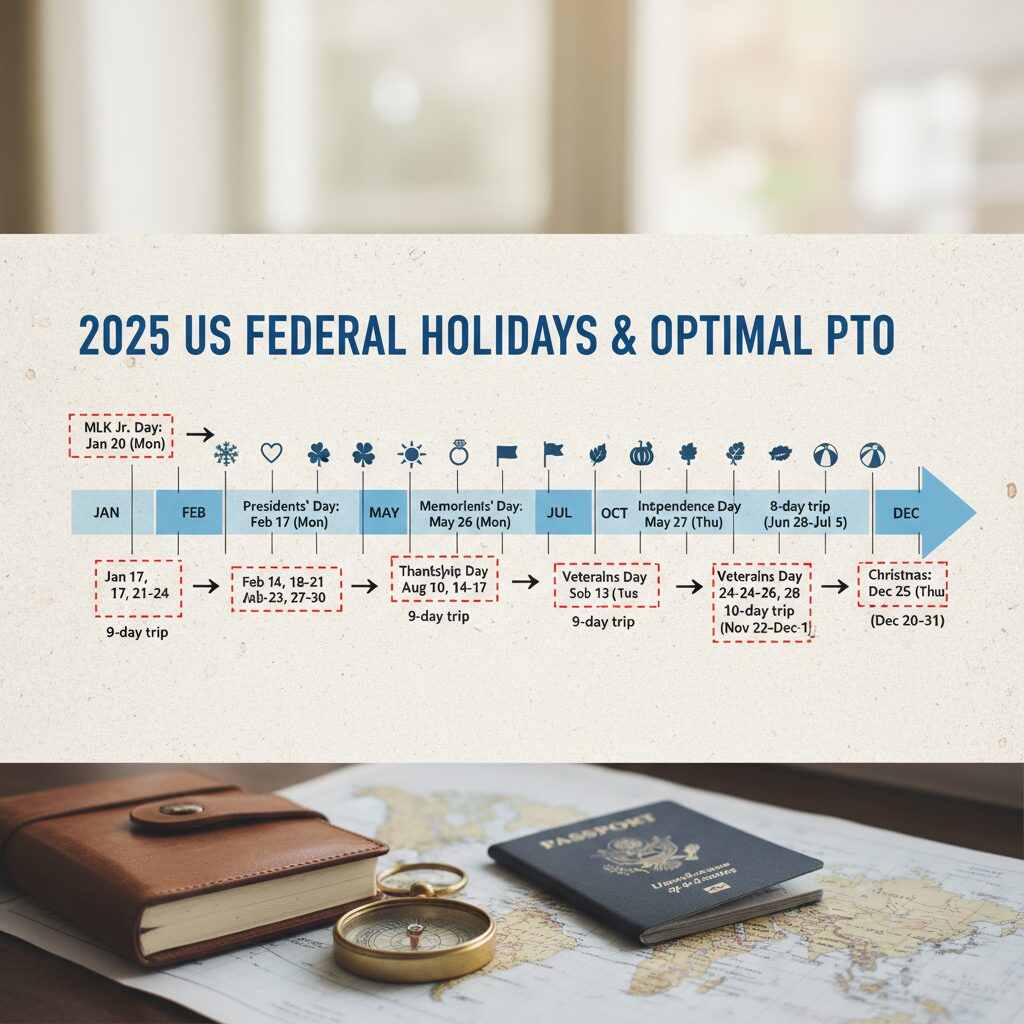
Looking ahead to the 2025 calendar, the alignment of federal holidays offers some specific, high-value opportunities. I’ve broken down the math for you below:
The Dates: Good Friday is April 18, 2025.
The Hack: Take off Mon-Thu (April 14-17).
The Result: You get 10 consecutive days off (including weekends) for the cost of 4 PTO days.
The Dates: June 19, 2025, falls on a Thursday.
The Hack: Take Friday, June 20 off.
The Result: An instant 4-day weekend for the price of 1 PTO day.
The Dates: July 4, 2025, is a Friday.
The Hack: Take June 30 – July 3 off.
The Result: 9 days of travel (June 28 – July 6) for just 4 PTO days.
The Dates: Thursday, Nov 27, 2025.
The Hack: Take Friday (Nov 28) plus Mon-Wed (Nov 24-26).
The Result: 9 days off for 4 PTO days.
Floating Holidays & “Invisible” Days Off
Beyond the federal holidays, check your employee handbook for “floating holidays.” These are often overlooked assets. Many companies offer days for voting, religious observations not covered by the federal calendar, or even your birthday.
I recently worked with a client who realized she had two “personal observance” days she hadn’t touched in three years. By combining those with a Memorial Day weekend, she booked a week in Tulum without spending a single hour of her standard vacation bank.
The “Workcation” Protocol: Travel Without Burning Days
Sometimes, maximizing PTO means not using PTO at all. This is where the concept of the “Workcation” comes in. However, we need to make a critical distinction here between “Quiet Vacationing” and legitimate flexibility.
The Data on “Quiet Vacationing”
According to The Harris Poll’s 2024 Out of Office Culture Report, 28% of employees have taken time off without telling their manager—a trend dubbed “Quiet Vacationing.” Millennials lead this charge at 37%.
While sneaking off to a beach with a mouse jiggler might seem tempting, it’s a high-risk strategy that causes anxiety and burnout. I advocate for what Jennifer Kraszewski, CHRO at Paycom, calls “Loud Vacationing” or, in this context, “Loud Flexibility.”
“It’s the idea that workers should feel comfortable communicating, ‘I’m taking my vacation. I’m excited, and I don’t feel guilty about it!'”
— Jennifer Kraszewski, via Forbes
How to Pitch a “Work-From-Destination” Week
Instead of hiding, negotiate a “Work-From-Destination” arrangement. According to Pew Research Center’s December 2024 findings, 40% of workers are dissatisfied with their remote flexibility. This is your leverage point. Employers are often willing to grant flexibility if it doesn’t cost them productivity.
The Script:
“I’m planning to visit family/travel to [Location] next month. I’d like to work remotely Wednesday through Friday from there. I’ve confirmed the Wi-Fi speed is 200mbps+, and I will stick to Eastern Standard Time hours. This allows me to save my PTO for my actual vacation later in the year.”
The “Thursday Night Flight” Rule
If full remote work isn’t an option, adopt the Thursday Night Flight rule. By flying out Thursday evening after work (rather than Friday morning), you wake up at your destination on Friday. If you work remotely on that Friday, you are physically on vacation while professionally present.
Bleisure Travel: Pivot Business Trips into Vacations
The line between business and leisure is blurring rapidly. The “Bleisure” travel market is projected to reach an astounding $762 billion in 2025, according to Fortune Business Insights. If you aren’t tacking personal days onto business trips, you are losing money.
The Cost-Benefit Analysis
Think about it: Your company pays for the most expensive part of the trip—the flight. Your only responsibility is the hotel and food for the extra weekend days.
For example, if you are sent to London for a conference Monday through Wednesday, fly back Sunday instead of Thursday. You simply request Thursday and Friday as PTO. You get a 4-day London vacation for the price of 2 PTO days and a few hotel nights.

IRS & Policy Compliance
A word of caution: Keep your receipts separate. Expenses incurred during your “leisure” portion are not reimbursable. The IRS and corporate finance departments are strict about this. I recommend booking the hotel for the extra nights on a personal card to keep the paper trail clean.
Advanced PTO Negotiation & Policy Hacks
Most employees look at their contract, see “15 days PTO,” and accept it as law. It isn’t. There are advanced mechanisms to “buy” time that many HR departments don’t advertise broadly.
“Buying” More Time (The Salary Sacrifice)
Large corporations often have “Purchase PTO” programs. This allows you to “buy” an extra week of vacation, with the cost deducted from your paycheck spread out over the year.
Why do this? Time is often more valuable than money. If you earn $80,000 a year, a week of gross pay is roughly $1,538. Would you pay $1,500 to have an entirely extra week of freedom? For many travelers, the answer is a resounding yes.
The “Unlimited PTO” Trap
If you are job hunting or negotiating a new contract, be wary of the “Unlimited PTO” allure. It sounds like a dream, but the data suggests it’s a psychological trap.
According to the Sorbet State of PTO Report (2024), employees with unlimited PTO actually take fewer days off than those with fixed accrual banks. Without a “use it or lose it” deadline, there is no urgency, and social pressure prevents people from taking time.
The Strategy: If you have unlimited PTO, set a personal “floor.” Commit to yourself: “I will take a minimum of 25 days this year.” Put them on the calendar in January.
Negotiating Unpaid Sabbaticals
If you need a month or more to backpack Southeast Asia, standard PTO won’t cut it. This is where you negotiate an unpaid leave of absence or sabbatical. It requires trading salary for time, but it preserves your job security.
Overcoming “Vacation Guilt” (Psychological Barriers)
The strategies above are useless if you are too afraid to submit the request. We live in a culture where 46% of U.S. workers take less time than offered because they worry about falling behind, according to Pew Research Center.
The “Replaceability” Fallacy
There is a fear that if we leave for two weeks, the company will realize they don’t need us—or conversely, that everything will fall apart. Both are usually untrue. In my experience, the employee who never takes a break is the one who makes the most mistakes due to burnout.
Veetahl Eilat-Raichel, CEO of Sorbet, puts the financial reality into perspective:
“PTO is not just an abstract concept, but represents a significant financial benefit. This is money they’ve earned, but cannot touch until they part ways with the company.”
— Veetahl Eilat-Raichel, via Forbes
When you skip vacation, you are essentially working for free during time you are being paid to not work. According to Sorbet’s data, the average employee leaves $3,000 worth of accrued PTO on the table annually. Don’t donate $3,000 back to your employer out of guilt.

Handover Excellence
The cure for vacation guilt is a bulletproof handover plan. Don’t just set an Out of Office email. Create a coverage document that outlines:
- Current project status.
- Where files are located.
- Who is covering which specific responsibility.
- What constitutes a true “emergency” that warrants a text.
When you present this to your boss, you aren’t asking for permission to slack off; you are demonstrating professional management of your time.
FAQs: Maximizing Your Time Off
Can I get fired for taking approved PTO?
In most “at-will” employment states (like the US), you can theoretically be fired for almost any reason. However, firing an employee specifically for using a benefit included in their compensation package is rare and can lead to legal complications for the employer. The key is following company policy regarding notice periods and approval channels.
What is the difference between PTO and vacation pay?
Traditionally, “vacation pay” was separate from “sick leave.” Modern PTO (Paid Time Off) bundles vacation, sick days, and personal days into one bucket. This gives you more flexibility but requires better management—if you burn all your PTO on a trip in January, you have no cushion for the flu in November.
How do I negotiate more PTO in a job offer?
Always negotiate PTO after the salary is agreed upon but before you sign the contract. It is often easier for a hiring manager to give you an extra week of vacation than an extra $5,000 in salary, as it doesn’t hit the department budget the same way.
Is it illegal to work on vacation?
No, it isn’t illegal. However, for non-exempt (hourly) employees, working while on vacation can create wage and hour disputes regarding overtime. For exempt (salaried) employees, checking emails is legal but detrimental to your mental health.
Conclusion
Extending your travel time isn’t about cheating the system; it’s about optimizing the benefits you have already earned. The modern workforce is evolving. We are moving away from the badge of honor associated with burnout and toward a model where performance is valued over presence.
By using the 2025 holiday stacking method, leveraging “Loud Flexibility” for workcations, and understanding the financial value of your time, you can transform a standard 15-day allowance into a year full of adventure.
Look at your calendar today. Identify that Juneteenth weekend. Draft that “Purchase PTO” email. The time is yours—but only if you take it.

Related Posts

How to pack light for any duration trip?

How to plan accessible travel easily?