How to document travel memories well?
How to Document Travel Memories: The 2025 Guide to Mindful Preservation
You take 500 photos of a sunset in Santorini, but six months later, can you remember the smell of the salt air? Can you recall the specific sound of the donkey bells on the cobblestones? If the answer is “no,” you aren’t alone.
We are living in a paradox. We have better cameras in our pockets than professional filmmakers had twenty years ago, yet our ability to retain the feeling of a trip is eroding. In my fifteen years as a travel writer and photographer, I’ve realized that the greatest thief of memory is often the device we use to capture it.
Science backs this up. It’s called the “photo-taking impairment effect,” and it suggests that by offloading the memory to an SD card, our brains stop doing the heavy lifting of encoding the experience. But here is the good news: you can reverse it.
This isn’t just another list of “best journals.” This is a comprehensive, psychologically backed strategy to document your travels in a way that preserves the sensory texture of your life. Drawing on the latest 2025 travel trends and cognitive research, we will explore how to move from passive clicking to active archiving.
The Psychology of Memory: Why We Forget Our Vacations
Before we discuss tools, we have to understand the brain. When you travel, you are bombarded with new stimuli. Your brain is trying to filter what is important. When you instantly snap a photo, you are sending a signal: “I don’t need to remember this details; the machine has it.”
Linda Henkel, a psychologist at Fairfield University, conducted pivotal research on this phenomenon. According to research cited by Unplugged (2024) referencing the Journal of Cognitive Psychology, the act of taking a photo offloads our memory onto the camera, resulting in us remembering less of the actual experience. We become curators of our lives rather than participants.
However, the science offers a loophole. The same research indicates that if you use the “zoom” function or focus intently on a specific detail before snapping the shutter, the impairment effect disappears. The cognitive effort required to focus actually strengthens the memory.
In 2025, the goal isn’t to stop taking photos—it’s to change how we take them. We need to shift from “documentary vision” (capturing everything) to “curatorial vision” (capturing what moves us).
Phase 1: Pre-Trip Intentions (The Setup)
Great documentation starts before you pack your bags. According to Hilton’s 2025 Trends Report, 63% of travelers want to use technology to “maximize” their trip, yet nearly a quarter admit they are disconnecting from social media more than they used to. This signals a shift toward private, meaningful documentation over public performance.
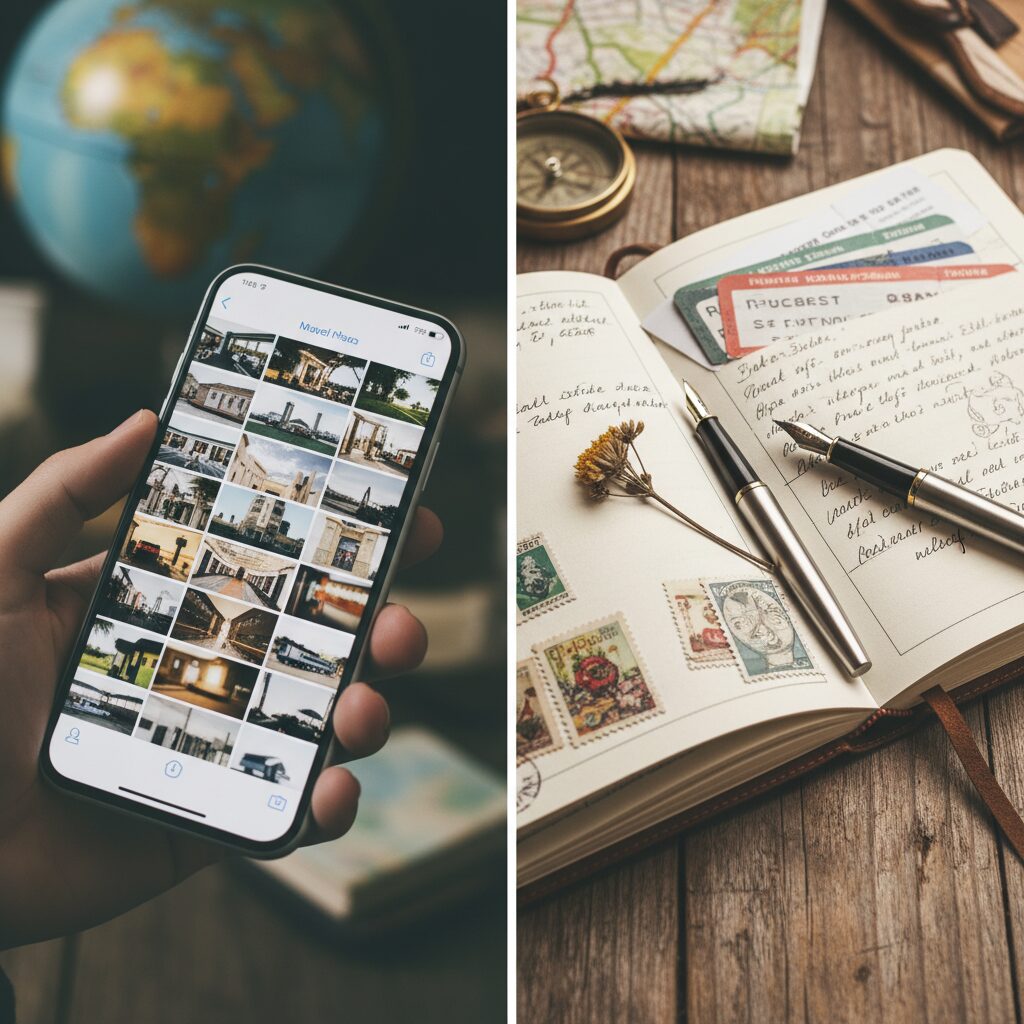
Choosing Your Medium: The Digital vs. Analog Debate
There is no “right” way, but there is a right way for you. I’ve tried carrying bulky DSLRs and heavy sketchbooks, and I’ve tried going digital-only. The best method is the one offering the least friction.
- The Analog Purist: Best for tactile people. Use a Traveler’s Notebook or a Moleskine. It allows for “ephemera collecting” (sticking tickets/leaves in).
- The Hybrid Archivist: Best for efficiency. Use an app like Day One or Polarsteps. These apps automatically log your location and weather, letting you focus on writing the emotional details.
- The Audio Logger: Best for “lazy” writers. If writing feels like homework, audio is your medium (more on this in Phase 2).
The “Shot List” Strategy
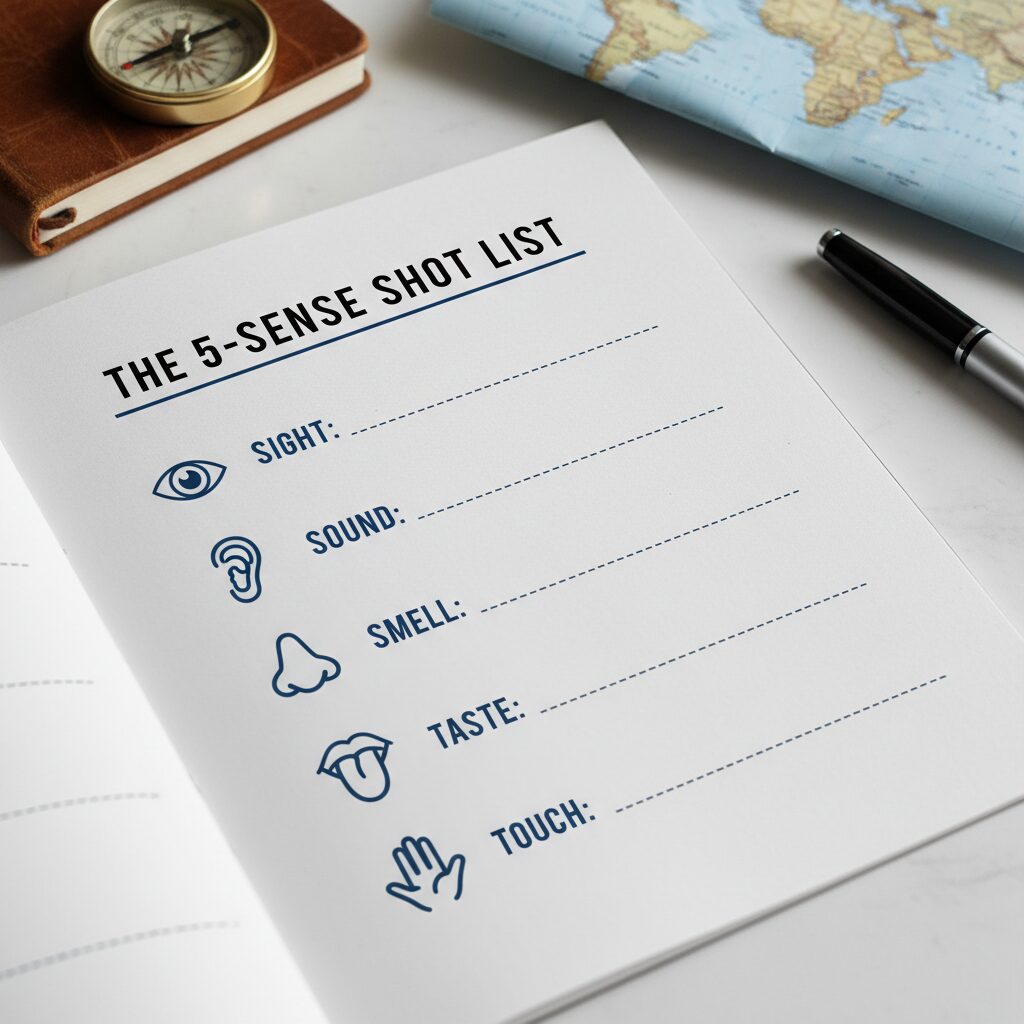
Professional photographers rarely shoot without a plan. Why should you? Instead of planning to photograph “The Eiffel Tower,” plan to capture emotions. Write a list of 5 things you want to hunt for:
- A texture that looks rough.
- The color of the local light at 5:00 PM.
- A stranger laughing.
- A meal that surprised you.
- A moment of silence.
Phase 2: On The Road (Sensory Capture Techniques)
This is where most people fail. They focus entirely on the visual. But research by Professor Lutz Jäncke suggests that memory is multisensory. To document well, we must engage the ears and the nose.
1. Audio Soundscapes: The Invisible Souvenir
I believe audio is the most underutilized tool in travel documentation. A photo of a busy market in Marrakech shows you the colors, but it misses the chaotic symphony of hagglers, mopeds, and the call to prayer.
How to do it: Use the Voice Memo app on your phone. Record 30 seconds of “ambient noise” in unique locations—a train station in Tokyo, a rainforest in Costa Rica, or a café in Rome. Label them immediately. When you listen to these tracks years later, the transportive effect is far more potent than a static image.
This aligns with the rising trend of “Noctourism” (Dark Sky tourism). According to Booking.com’s Travel Predictions 2025, demand for dark sky experiences is up 60%. You can’t photograph the dark well, but you can record the silence of the desert or the crackle of a campfire.
2. The “Ephemera” Hunt: Tactile Memories
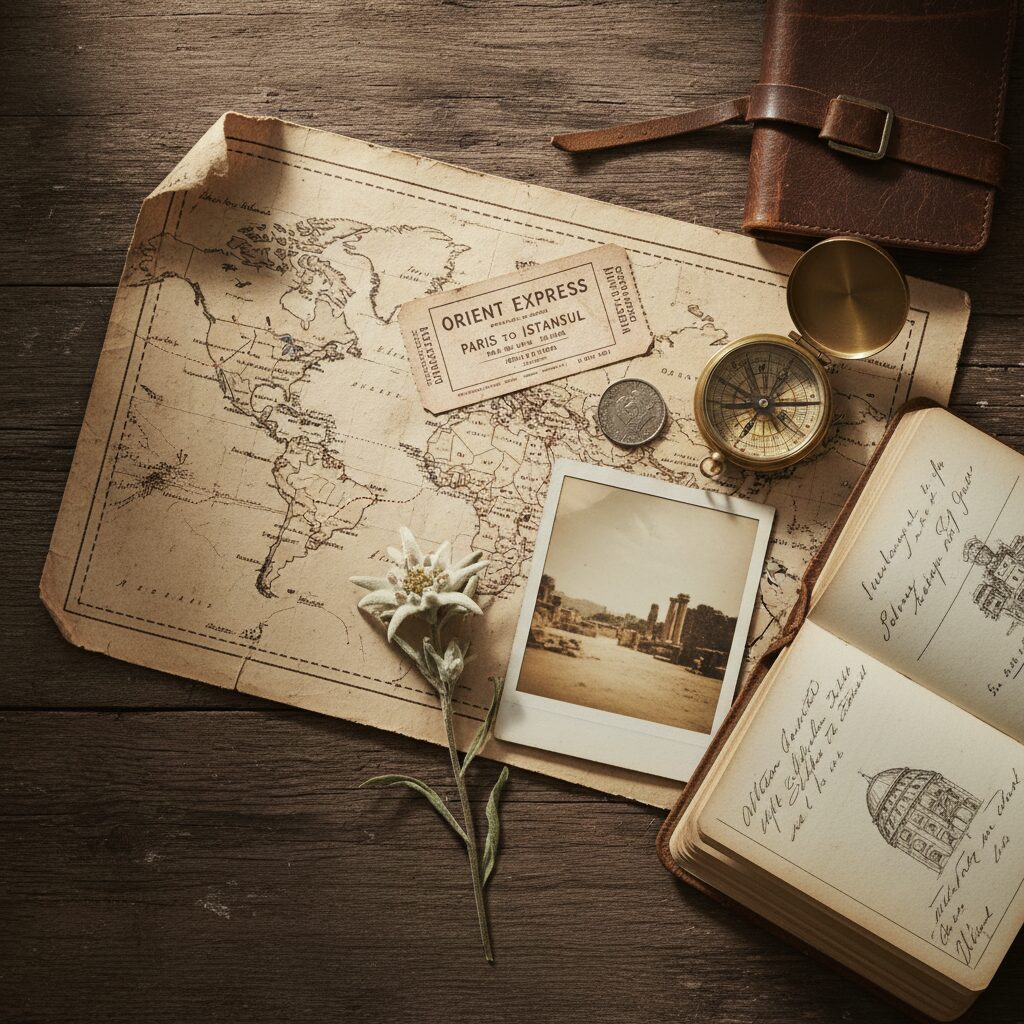
Ephemera refers to paper items originally meant to be discarded. Ticket stubs, beer coasters, sugar packets, dried leaves, local newspapers. In my experience, these items often hold more weight than souvenirs.
According to Booking.com’s 2025 predictions, there is a surge in “Vintage Voyaging,” with 73% of travelers buying second-hand items abroad. This desire for the old and physical is a reaction against the digital cloud. Keep a small ziplock bag in your daypack specifically for these scraps.
3. The 5-Minute Journaling Routine
You don’t need to write a novel. Long-form journaling can feel like a chore, which leads to abandonment. Instead, use the “Sensory Stacking” method while having your morning coffee.
The 5-4-3-2-1 Method
Write down:
- 5 things you saw yesterday.
- 4 things you physically felt (wind, cobblestones, sand).
- 3 sounds you heard.
- 2 things you smelled.
- 1 thing you tasted.
According to Life Note AI (citing Frattaroli’s Meta-Analysis), expressive writing about experiences for just 15-20 minutes can significantly lower travel-induced stress. It helps process the “travel fatigue” and encodes the memory deeply.
Phase 3: Post-Trip Curation (The “Keep” Phase)
You’ve returned home. You have 3,000 photos and a bag of receipts. Now what? The biggest mistake travelers make is Digital Hoarding. We fear deleting anything, so we end up with a cluttered mess we never look at.
Beating Digital Clutter: The 10-Star Rule
According to recent projections on data usage, humans took over 5 billion photos daily in 2023. We are drowning. To document well, you must be ruthless.
The Strategy: During your flight home, or the weekend you return, go through your camera roll. You are allowed to keep only the “10 Stars” of each day.
Delete duplicates. Delete the blurry shots. Delete the photo of the sandwich that looks unappetizing. By reducing 100 photos to 10 meaningful ones, you create a narrative arc that is actually enjoyable to revisit.
Physical Artifacts: Print It Out
Digital files are fragile. Formats change. Passwords get lost. Physical books do not.
According to Hilton’s 2025 Trends Report, 58% of parents revisit childhood destinations with kids to pass down shared experiences. Imagine handing your child a hard drive versus a physical photo book. The emotional weight is incomparable.
Modern Options:
- Artifact Uprising: For premium, gallery-quality cloth books.
- Zines: For a grittier, artistic, and cheaper option. Perfect for the “Raw Content” trend Gen Z prefers.
- Shadow Boxes: Create a 3D display of your ephemera (shells, tickets) for your wall.

2025 Trends in Documentation
The Rise of “Raw” and “Private”
The era of the perfectly curated Instagram feed is dying. Booking.com (2025) notes that 44% of travelers will refrain from tagging locations to prevent “Instatourists” from ruining hidden gems. This “Gatekeeping Trend” suggests a move toward documenting for yourself, not for an audience.
This aligns with Sensor Tower’s 2024 data showing a 19.5% revenue increase in private digital journaling apps. We are seeing a return to the diary—a safe space to be honest about the trip, including the moments that went wrong. Honest documentation is far more valuable 20 years later than a sanitized highlight reel.
Video over Photo: The Cinematic Shift
With the rise of “Set-Jetting” (visiting TV locations), which DreamArt Photography notes as a major 2025 luxury trend, travelers are thinking cinematically. Short-form video (3-5 second clips) captures the energy of a place better than a still. Stitching these into a “1 Second Everyday” compilation is a fantastic, low-effort way to document a month-long journey.
FAQ: Common Documentation Struggles
1. How do I document a trip with kids without being distracted?
Delegate the task. Give your child a disposable camera or a rugged point-and-shoot. Seeing the trip through their eyes (literally, from their height) is fascinating. Plus, it keeps them engaged.
2. What is the best travel journal app for 2025?
Day One remains the gold standard for versatility (audio, photo, text). Polarsteps is best for visualizing your route automatically. For a minimalist approach, the standard Apple Journal app (introduced in iOS 17) uses on-device machine learning to prompt you based on your photos and location.
3. How do I organize digital travel photos efficiently?
Use facial recognition and geotagging. Create albums labeled “Place + Year” (e.g., “Tokyo 2025”). Do not leave them in the general “Recents” folder. Back them up to at least two clouds (e.g., iCloud and Google Photos) immediately.
4. Why do I feel post-trip blues, and how does documentation help?
Post-trip blues often stem from the sudden loss of novelty. Creating a photo book or editing a video is a form of “savoring,” a psychological technique that extends the positive emotions of the trip. It provides a gentle transition back to reality.
Conclusion: Don’t Let the Memories Fade
In a world of infinite scrolling, the most radical act you can commit is to slow down and pay attention. Documenting travel memories well isn’t about buying the most expensive camera or having the prettiest handwriting. It is about intentionality.
It is about resisting the urge to snap 50 photos of the same cathedral and instead standing still for five minutes to record the sound of the bells. It is about writing down what the air smelled like. It is about printing the photos so they exist in the real world, not just on a server.
My challenge to you for your next trip is simple: Pick one method from this guide—whether it’s the “10-Star Rule” or “Audio Soundscapes”—and commit to it. Your future self, decades from now, will thank you for preserving not just the sights, but the soul of your journey.

Related Posts

Where to find authentic local food?

What are top sustainable travel tips?