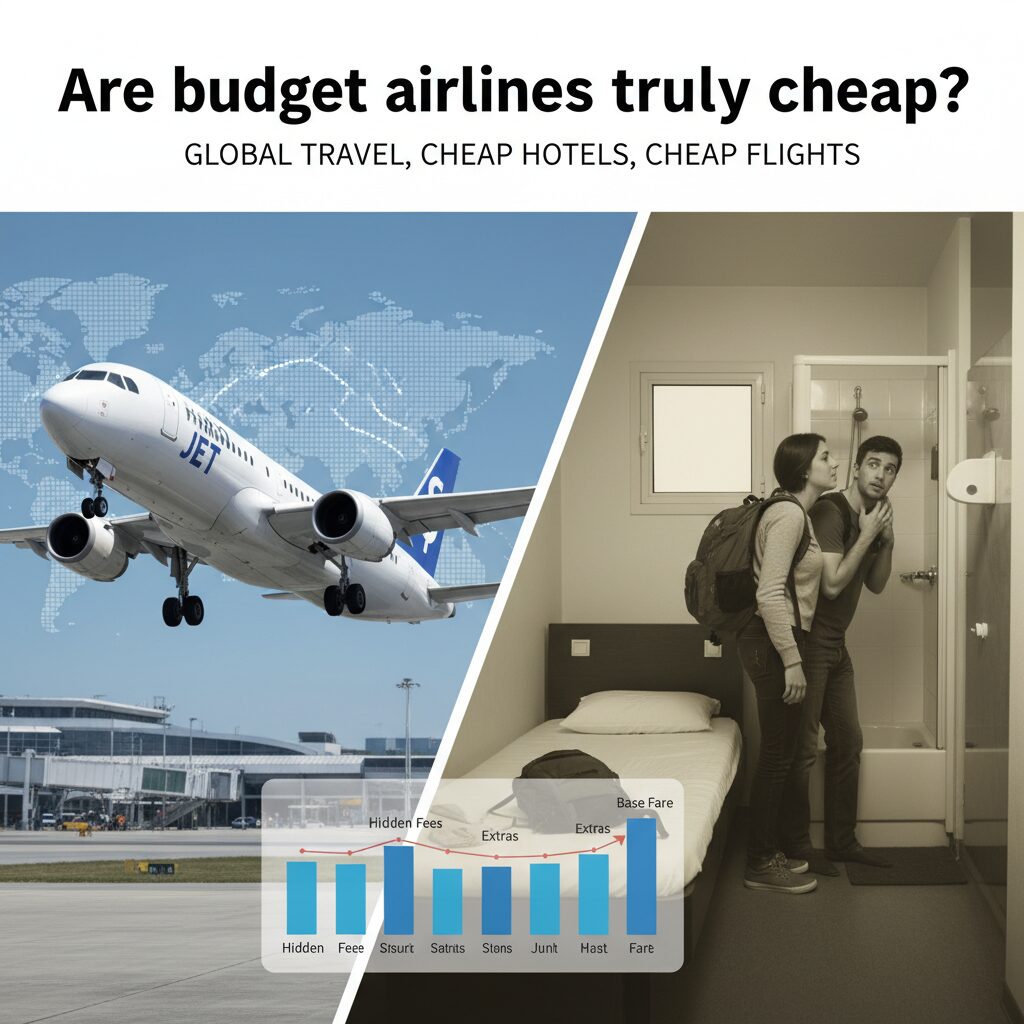
Are budget airlines truly cheap?
Are Budget Airlines Truly Cheap? The Hidden Economics of the $29 Fare
We’ve all been there. It’s 11:00 PM, you’re scrolling through flight options for a weekend getaway, and you see it: a $29 fare to Miami. Your pulse quickens. It feels like a glitch in the matrix, a secret deal that only you have found. You reach for your credit card, fueled by the adrenaline of a bargain.
But by the time you reach the checkout page, that $29 ticket has morphed. Between seat selection, a carry-on bag, and a “convenience fee” for printing your boarding pass at home, the total is suddenly $148.
This bait-and-switch isn’t accidental; it is a meticulously engineered financial model. In my years covering the aviation industry, I’ve learned that asking “Are budget airlines truly cheap?” is the wrong question. The real question is: What are you actually paying for?
The reality is that budget airlines—or Low-Cost Carriers (LCCs)—aren’t really in the business of selling travel. They are in the business of real estate. They sell you a 17-inch slot of space on a metal tube, and then rent you everything else—your legroom, your hydration, and even the air inside the overhead bin—at a premium markup.
In this guide, we are going to dismantle the math behind the low-cost model, using the latest 2024 financial data and regulatory updates, to help you decide if that “cheap” flight is actually a deal or a financial trap.

The “Unbundling” Business Model Explained
To understand if you are getting ripped off, you have to understand “unbundling.” Legacy carriers like Delta or United operate on a bundled model (though they are increasingly copying LCCs). When you buy a standard ticket, you are paying for the flight, a bag, seat selection, and flexibility. It’s an all-inclusive resort approach.
Budget airlines take a sledgehammer to that bundle. They strip the ticket down to its naked core: the right to be transported from Point A to Point B. Everything else becomes an “ancillary revenue” stream.
Projected Global Airline Ancillary Revenue in 2024
This isn’t pocket change. According to a press release from IdeaWorksCompany & CarTrawler dated October 29, 2024, global airline ancillary revenue hit a projected $148.4 billion in 2024. The report notes that this massive figure represents “an increase largely built on 2023 passenger growth and increasing market share gains by low cost carriers.”
Think about that. Airlines are making nearly $150 billion just on the extras. When you fly a budget carrier, you aren’t just a passenger; you are a walking wallet they intend to open multiple times before you land.
The Hidden Fee Breakdown: The Math Behind the Madness
Let’s look at the specific numbers. It’s easy to say “fees are high,” but the financial reports tell a more specific story.
The $64 “Hidden” Average
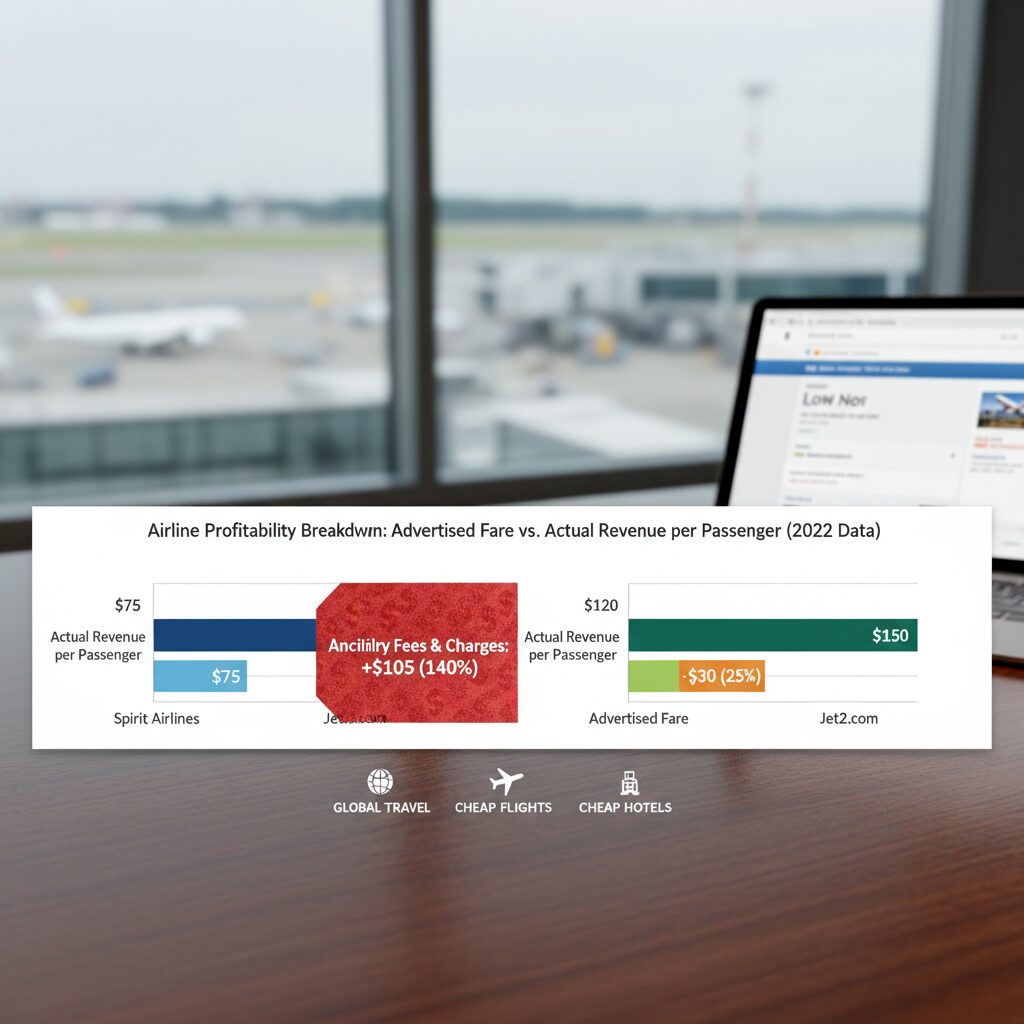
Spirit Airlines is often the poster child for this model in the US. According to Spirit Airlines’ Q2 2024 Earnings Guidance released on July 17, 2024, their non-ticket revenue (fees) per passenger segment was approximately $64.
This means if you bought a ticket for $39, the airline statistically expects to extract another $64 from you, bringing the real revenue to $103. If you manage to fly without paying fees, you are technically beating their algorithm—but they make it incredibly difficult to do so.
The Extreme Case: Jet2.com
If you think US carriers are aggressive, the European market is even tighter. According to the 2024 CarTrawler Yearbook by IdeaWorksCompany (released September 2024), the highest ancillary revenue per passenger in the world is achieved by Jet2.com, coming in at a staggering $95.83 per passenger.
Why Carry-Ons Cost More Than Checked Bags
You might have noticed a strange phenomenon: it often costs more to bring a bag on the plane than to check it underneath. This is pure operational economics.
Boarding is the most critical time for a budget airline. If boarding is slow because passengers are fighting for overhead bin space, the plane departs late. Late planes burn money. By charging a premium for carry-ons, they discourage you from bringing them, speeding up the boarding process. They are literally charging you for the privilege of not slowing them down.
Reliability vs. Cost: The “Time Tax”
Here is the factor most budget travelers ignore until it’s too late: the cost of your time. If a budget flight is delayed or canceled, the financial impact on you can eclipse any savings on the ticket price.
Budget airlines run their fleets with incredibly high “utilization rates.” Their planes fly 11 to 13 hours a day with very tight turnaround times on the ground. If a Spirit or Frontier flight is delayed by 20 minutes in Miami at 8:00 AM, that delay cascades. By the time that plane reaches Denver at 5:00 PM, it might be three hours late. Legacy carriers often build more buffer time into their schedules.
The Reliability Gap
The data proves this structural weakness. According to a NerdWallet analysis of Bureau of Transportation Statistics (BTS) data published in November 2025 (reflecting late 2024 data), the difference is stark:
- Delta Air Lines: Maintained an on-time percentage of approximately 84%.
- Frontier Airlines: Dropped below 69% for on-time arrivals.
Furthermore, The Points Guy reported in June 2024 that Frontier Airlines had a cancellation rate of 2.13%, which was significantly higher than competitors like Allegiant (0.68%) or Delta.
The Takeaway: When you fly budget, you are accepting a statistically higher risk of delay. If you are flying to a cruise departure, a wedding, or a job interview, a budget airline is a gamble I wouldn’t recommend taking.
Case Study: The Real Cost of a Weekend Trip
Let’s move away from percentages and look at dollars. I’ve built a simple calculator below to help you visualize the difference. This is based on average pricing models seen in Q3 2024.
✈️ Flight Cost Calculator
Estimate the real cost of your trip.
Compare this to the average domestic airfare. According to the Bureau of Transportation Statistics (BTS), the average U.S. domestic fare in Q2 2024 was $382. While budget carriers advertise fares under $50, once you add a carry-on ($55) and a seat ($25) each way, a round trip can easily swell to $250+. The gap narrows quickly.
New Protections: The 2024 DOT Rules
There is some good news for the consumer. The regulatory landscape shifted dramatically this year, and many travelers still aren’t aware of their new rights.
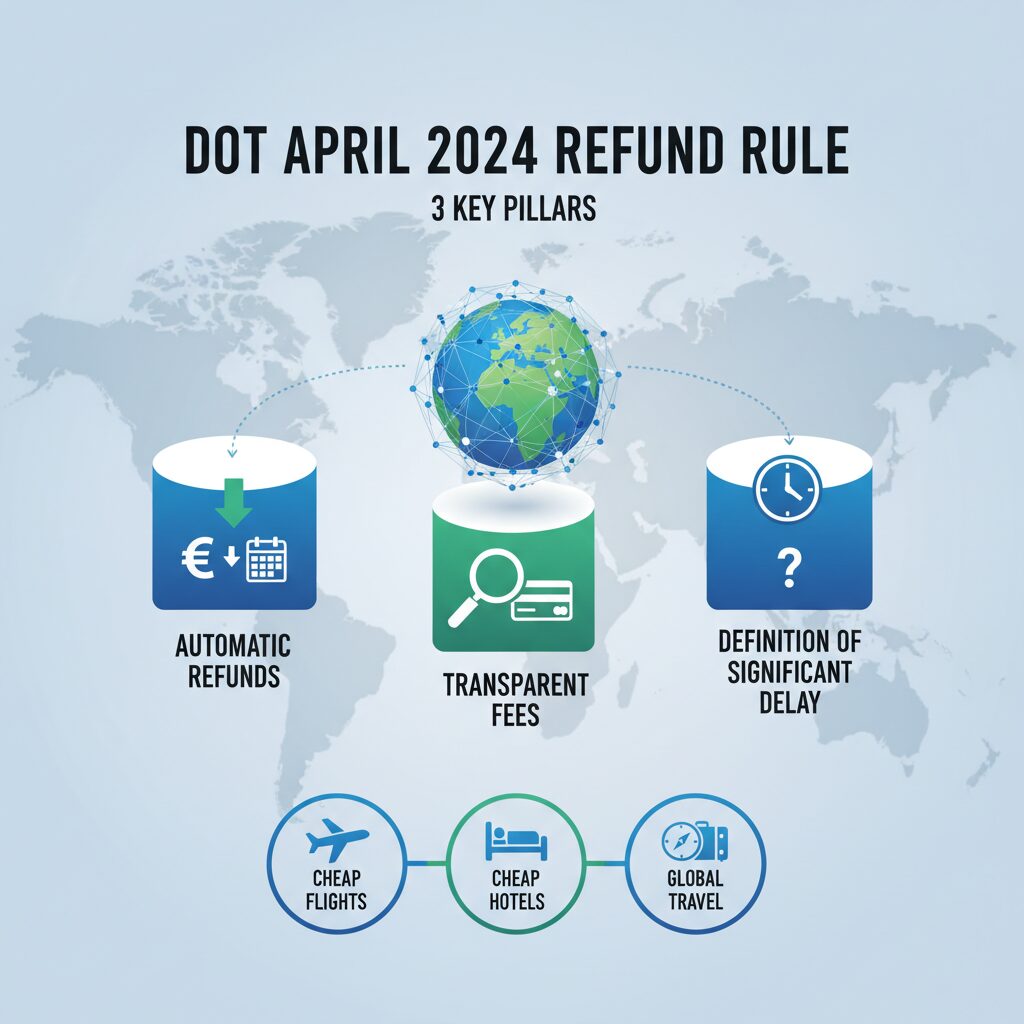
In April 2024, the Biden-Harris Administration announced a final rule regarding airline refunds. According to the U.S. Department of Transportation (DOT), airlines must now provide automatic refunds if they cancel or make a “significant change” to a scheduled flight and the passenger does not accept the alternative.
“Airlines must provide automatic refunds… if they cancel or make a significant change to a scheduled flight.” — U.S. Department of Transportation, April 2024
What this means for you: Previously, budget airlines would try to trap your money in “flight credits” with expiration dates if they canceled your flight. Now, by law, if they cancel and you choose not to travel, they must refund the cash to your original payment method automatically. This removes one of the biggest financial risks of booking with unreliable Low-Cost Carriers.
When Budget Airlines Are Actually a Steal
I don’t want to paint an entirely negative picture. I fly budget airlines frequently, but I do it strategically. There are specific scenarios where they truly are the cheapest option:
1. The “Backpack Only” Strategy
This is the only way to get the true advertised price. If you can travel for a weekend with nothing but a “personal item” (a backpack that fits under the seat), you avoid the $50-$100 baggage fees. You are beating the airline at their own game.
2. One-Way Positioning Flights
Budget airlines price tickets on a one-way basis. Legacy carriers often penalize one-way tickets by pricing them higher than round trips. If you need to fly from New York to Orlando one way, JetBlue or Spirit will almost always be cheaper than Delta.
3. Secondary Airports
Budget carriers often fly into secondary airports (like Islip instead of JFK, or Mesa instead of Phoenix Sky Harbor). If you live closer to these smaller hubs, the convenience and parking savings can be massive, regardless of the airfare.
Conclusion: The “Rule of $50”
So, are budget airlines truly cheap? The answer is a conditional “yes,” but only if you are willing to sacrifice comfort, flexibility, and potentially your time.
When I advise clients or friends on travel, I use the Rule of $50:
If the price difference between a Budget Carrier (after adding bags/seats) and a Legacy Carrier is less than $50, always fly the Legacy Carrier.
The $50 premium buys you:
- Better on-time reliability (84% vs 69%).
- Interline agreements (if Delta cancels, they can put you on American; Spirit cannot).
- Free carry-on bags (usually).
- More legroom.
However, if the savings are $150 or $200, the budget airline becomes a viable product—provided you know the rules of engagement. Pack light, download your entertainment beforehand, and perhaps most importantly, buy travel insurance for when that “utilization rate” catches up with you.
Frequently Asked Questions
Do budget airlines cancel flights more often?
Yes. Data from The Points Guy (2024) shows Frontier had a cancellation rate of 2.13%, significantly higher than legacy carriers like Delta. Because budget airlines lack “interline agreements” with other airlines, they cannot easily rebook you on a competitor if your flight is canceled.
What is the average hidden cost on a budget flight?
According to Spirit Airlines’ Q2 2024 data, the average non-ticket revenue per passenger is approximately $64. This covers bags, seats, and other fees.
Are budget airlines less safe?
No. In the US and Europe, budget airlines are subject to the exact same FAA and EASA safety maintenance regulations as legacy carriers. The cost-cutting happens in customer service and comfort, not engine maintenance.

Related Posts

How to find cheap flights fast?

Best flight search sites revealed?