How to visit Europe on a shoestring budget?
How to Visit Europe on a Shoestring Budget in 2025 (The €50/Day Guide)
Stop saving for “someday.” If you are waiting until your bank account looks like a phone number to visit Europe, you might never go. The common narrative is that Europe is a playground for the wealthy, especially with inflation dominating the headlines.
But here is the reality I’ve seen firsthand after a decade of backpacking: Europe isn’t just for the rich—if you know how to dodge the 2025 price spikes.
While many travel blogs are still warning you about the €7 ETIAS entry fee, official sources have confirmed a reprieve. According to the European Commission’s ETIAS Official Site, the entry requirement fee is officially delayed until late 2026. This means for your 2025 trip, you pay €0 in entry fees. We will show you exactly how to reinvest that savings below.
You don’t need a trust fund. You need a strategy. This is your realistic roadmap to traveling the continent on €40-€70 per day without eating plain bread for every meal.
Article Contents
- 1. The 2025 Budget Breakdown: What Does “Shoestring” Cost?
- 2. Getting There for Cheap: Flight Hacks that Actually Work
- 3. Accommodation: Sleeping for €0 – €30 Per Night
- 4. Transport: Trains, Planes, and Automobiles
- 5. Eat Like a Local, Spend Like a Pauper
- 6. Financial Tools: Stop Leaking Money to Fees
- 7. 3 Shoestring Itineraries for 2025
- 8. FAQ: Your Budget Travel Questions Answered

The 2025 Budget Breakdown: What Does “Shoestring” Really Cost?
Let’s strip away the Instagram filters and look at the raw numbers. Inflation hasn’t been kind to the traveler. According to Eurostat Inflation Data 2024, tourism inflation for package holidays in the EU rose by 6.6% in 2024. This means the advice you read in 2022 is dangerously outdated.
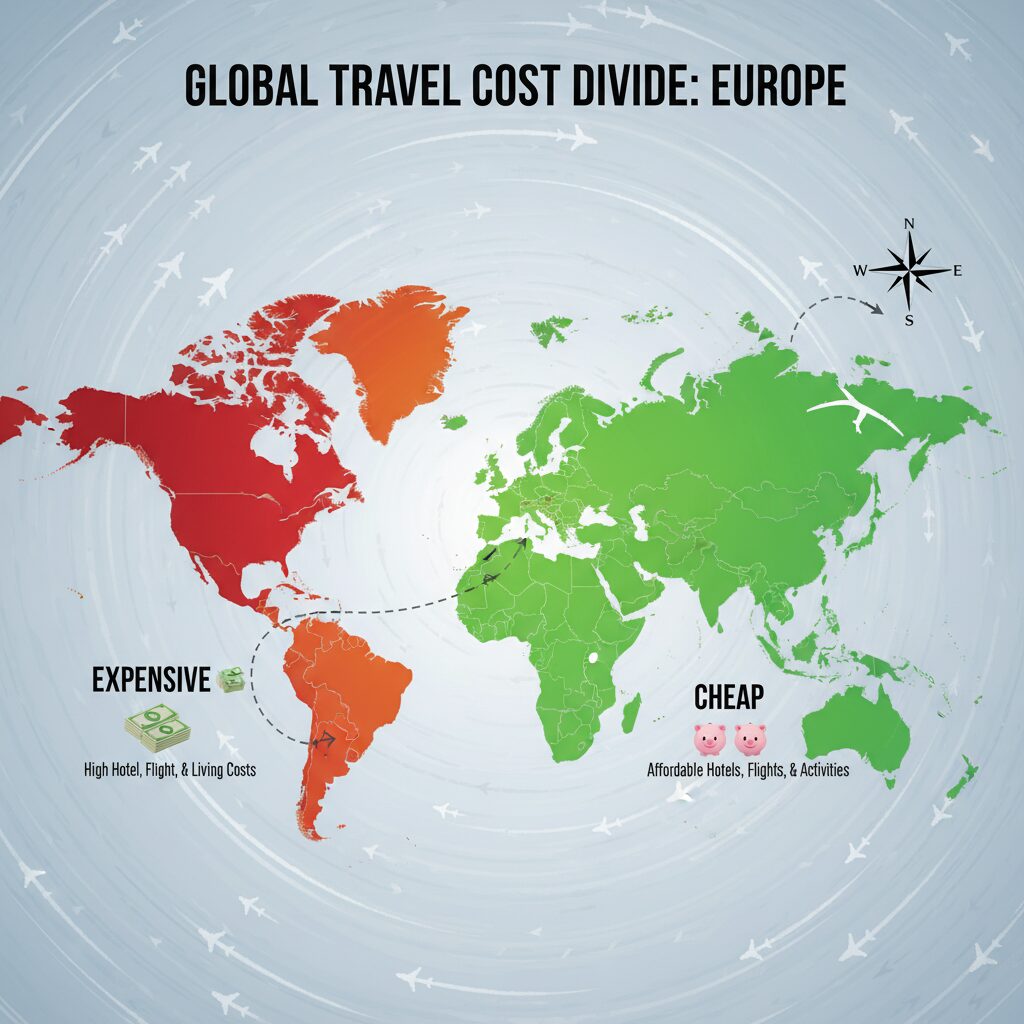
Western vs. Eastern Europe Price Divide (The “Iron Curtain” of Costs)
If your heart is set on London, Paris, and Zurich, your shoestring is going to snap. The most critical decision you make is where you go. In 2025, the price disparity between West and East is staggering.
Western Europe (France, UK, Scandinavia): You need to budget roughly €80+ per day just to survive on a hostel-and-sandwich diet.
Eastern Europe (Romania, Albania, Poland, Baltics): Here, you can live comfortably on €40 per day. I recently spent a week in the Baltics and was shocked by the value.
Data supports this experience. According to the Post Office City Costs Barometer 2025, Riga, Latvia is the #1 best value city in Europe for 2025, with a total weekend cost of approx £253. Compare that to over £700 for a similar weekend in Amsterdam.
The “Inflation Buffer”
When planning your finances, do not use the exact numbers you see on booking sites today. I always recommend adding a 15% buffer. If you calculate you need €1,500 for a month, save €1,725. Unexpected costs—a missed train, a city tax, or a sudden urge for a real restaurant meal—are guaranteed.
Getting There for Cheap: Flight Hacks that Actually Work
The transatlantic flight is usually the single biggest expense. But if you are flexible, it doesn’t have to be.
The “Hub” Strategy
Here is a mistake I see rookies make constantly: they search for flights from “Home” to “Dream Destination” (e.g., New York to Rome). Direct flights to major tourist capitals carry a “convenience tax.”
Instead, fly where it’s cheap, then hop. In 2025, the cheapest entry points into Europe are often Dublin, Lisbon, and Milan. You can often save 30% by flying into Dublin and then taking a €20 Ryanair flight to your final destination.
Don’t book too early, and definitely don’t book late. Scott Keyes, Founder of Going, states: “The ‘Goldilocks Window’ for booking transatlantic flights is 3-6 months out. For summer 2025, aim to book by February.” Mark your calendar now.
Shoulder Season Magic
If you have any control over your schedule, avoid July and August. Those months are hot, crowded, and ridiculously expensive. The new “Summer” for budget travelers is May and October.
In May, the flowers are blooming, and in October, the harvest festivals are in full swing. The weather is generally mild, but flight prices can drop by up to 40% compared to peak season.
Accommodation: Sleeping for €0 – €30 Per Night
This is where your budget lives or dies. The days of the €10 hostel in Western Europe are largely gone.
The Hostel Strategy (Dorms vs. Privates)
Hostels remain the backbone of backpacker travel, but prices have shifted. According to the Hostelworld / Airdna Market Review 2025, the average hostel dorm price in Western Europe has stabilized at €40-60 in high season 2025. That hurts.
To combat this, you must book early—at least 3 weeks out for summer travel. Also, look for hostels that offer free breakfast. A hearty breakfast can save you €10 a day on lunch.

“Sweat Equity”: Worldpackers & Workaway
If you have more time than money, this is the ultimate hack. Platforms like Worldpackers allow you to trade a few hours of work per day for free accommodation and food.
I met a traveler in Tuscany who spent two months living in a vineyard villa for exactly €0, just by helping with the grape harvest for 4 hours a day. According to Worldpackers Pricing 2025, annual membership is roughly $59, which allows for unlimited free accommodation exchanges. One night of free stay covers the cost of the membership.
House Sitting & Couchsurfing
TrustedHousesitters is another avenue, though it requires a bit more vetting. You watch someone’s cat or water their plants while they are away, and you get a full apartment to yourself. It’s competitive in 2025, so build your profile locally before applying for that penthouse in Paris.
Transport: Trains, Planes, and Automobiles
Europe’s connectivity is legendary, but the costs can be confusing.
The Great Eurail Debate: Is it Worth it in 2025?
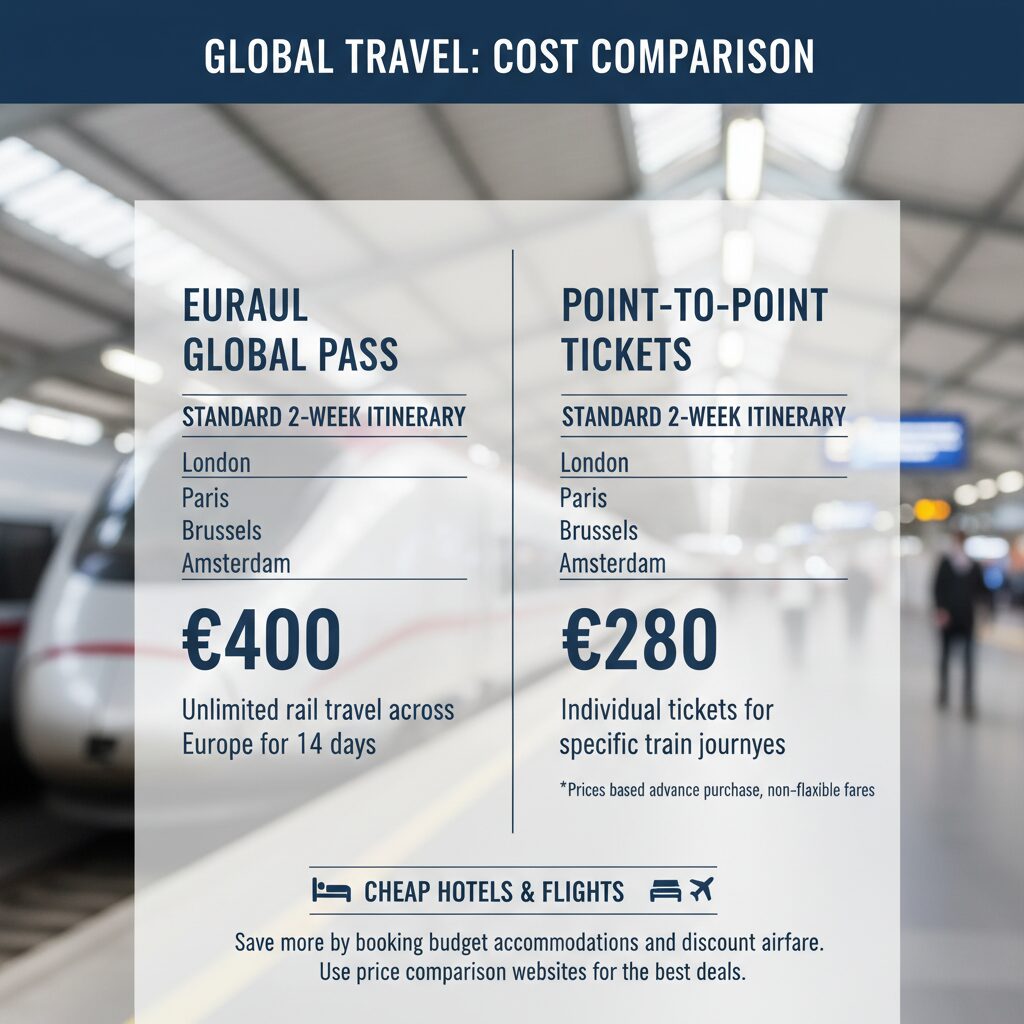
For decades, the Eurail Pass was the golden ticket for backpackers. But in 2025? It’s complicated. The pass price has increased, and many high-speed trains (like the Eurostar or TGV in France) require mandatory “seat reservation fees” that can cost €30+ on top of your pass.
The Man in Seat 61 (Mark Smith), the world’s leading rail expert, advises: “In 2025, the Eurail pass only breaks even if you take at least 3 long-distance high-speed trains. For short hops, use Omio.”
The Rise of the Budget Bus (FlixBus)
If you can tolerate less legroom, the bus is your best friend. Companies like FlixBus dominate the continent. I’ve personally snagged tickets from Munich to Prague for as low as €15.
The trick: Book at least two weeks in advance. The difference between a walk-up fare and an advance fare can be 300%.
Ridesharing (BlaBlaCar)
BlaBlaCar is a ridesharing service for long distances. It’s incredibly popular in France, Spain, and Germany. You simply hop in a car with a local driving the same direction.
Not only is it often cheaper than the train, but it’s also a fantastic way to meet locals and practice the language. It turns a boring transit day into a cultural experience.
Eat Like a Local, Spend Like a Pauper
Food is the silent budget killer. Three restaurant meals a day will bankrupt you in a week.
The “Too Good To Go” App Revolution
This is my number one tip for 2025. Download the app Too Good To Go immediately. Restaurants and bakeries list “Magic Bags” of unsold food at closing time for a fraction of the price—usually €3 to €5.
I have feasted on high-end sushi in London and artisan pastries in Copenhagen for the price of a coffee. It fights food waste and saves you a fortune.

Street Food & Grocery Hauls
In the UK and Western Europe, look for the “Meal Deal” in supermarkets (Tesco, Sainsbury’s, Carrefour). For about €4-€5, you get a sandwich, a snack, and a drink. It’s not Michelin-star dining, but it fuels the adventure.
Also, don’t be afraid to cook in your hostel. A simple pasta dinner with a bottle of local wine costs about €4 per person if you split it with roommates. It’s also the easiest way to make friends.
Financial Tools: Stop Leaking Money to Fees
Using your home bank card in Europe is like lighting money on fire. Foreign transaction fees (usually 3%) and bad exchange rates add up fast.
Best No-Fee Bank Cards for 2025
You need a multi-currency card. I highly recommend Wise (formerly TransferWise) or Revolut. These allow you to hold money in Euros and spend like a local with the real market exchange rate.
If you are from the US, the Capital One VentureOne card is excellent because it has 0% foreign transaction fees and no annual fee.
Travel Insurance: Do You Really Need It?
Yes. If you trip on a cobblestone in Rome and break an ankle, the medical bill will end your trip. But you don’t need expensive “cruise ship” insurance.
For budget travelers, I compare two main options. According to SafetyWing Pricing 2025, their “Nomad Insurance” for ages 18-39 averages just $56.28 per 4 weeks. It operates like a subscription (Netflix for insurance) which is perfect for flexible trips.
Alternatively, World Nomads offers more robust coverage for adventure sports but costs significantly more. For a shoestring budget, SafetyWing is usually the winner.
3 Shoestring Itineraries for 2025
Here are three proven routes that maximize value.
1. The Balkan Budget King (€35/day)
Route: Albania (Tirana, Himare) -> Montenegro (Kotor) -> Bosnia (Mostar, Sarajevo).
Why: The Balkans are arguably the most beautiful and affordable region in Europe right now. You get Mediterranean beaches in Albania for a fraction of the cost of Greece or Italy.
2. The Central Classic (€50/day)
Route: Prague (Czechia) -> Krakow (Poland) -> Budapest (Hungary).
Why: Incredible history, cheap beer, and excellent hostel infrastructure. Transport between these cities is cheap via FlixBus or train.
3. The Western Hack (€65/day)
Route: Portugal (Porto, Lisbon) -> Southern Spain (Seville, Granada).
Why: While Western Europe is expensive, Portugal remains the cheapest country in the West. Andalusia (Southern Spain) offers free tapas with drinks in many cities (especially Granada), which helps the food budget immensely.
FAQ: Your Budget Travel Questions Answered
Frequently Asked Questions
- How much is the ETIAS fee for 2025?
- It is currently €0. The implementation has been delayed until late 2026 or 2027.
- Can you do Europe on €50 a day?
- Yes, absolutely. In Eastern Europe, €50 allows for a comfortable backpacker lifestyle. In Western Europe (Paris, London), €50 requires strict discipline: dorm beds, cooking your own meals, and limiting paid attractions.
- What is the cheapest month to fly to Europe?
- Generally, November and February are the absolute cheapest. However, for a balance of weather and price, late October is the sweet spot.
- Do I need cash or card for Europe travel?
- In 2025, Europe is 90% contactless. You can use your phone/card almost everywhere in the North and West. However, in Germany (surprisingly) and parts of the Balkans, Cash is King. Always carry €50 in cash.
Conclusion
Visiting Europe on a shoestring budget in 2025 isn’t about deprivation; it’s about making deliberate choices. It’s about trading a generic hotel room for a hostel where you meet lifelong friends. It’s about skipping the overpriced tourist trap restaurant to eat a picnic in a park with a view of the Eiffel Tower.
The ETIAS delay has given you a financial head start. The inflation is real, but so are the workarounds. Whether you are WWOOFing in Tuscany or catching a FlixBus to Krakow, the continent is accessible if you prioritize cleverness over comfort.
Don’t overthink it. Book the flight during the shoulder season, download the apps, and go. The experience is worth every penny you scrimp to save.
Disclaimer: Prices and regulations were accurate at the time of writing (2025). Travel costs fluctuate based on season and economic conditions. Always verify visa requirements on official government websites before booking.