
Can I find last-minute cheap flights?
Can You Actually Find Last-Minute Cheap Flights? The 2025 Data-Backed Truth
We have all been there. Maybe it’s a family emergency, a sudden business trip, or perhaps you just desperately need to escape the grind this Friday. You open your laptop, heart rate slightly elevated, and type “cheap flights” into the search bar, hoping for a miracle.
But here is the brutal reality: the “standby” myth you saw in 90s movies is dead. The algorithm knows you are desperate, and it is designed to extract maximum value from your panic.
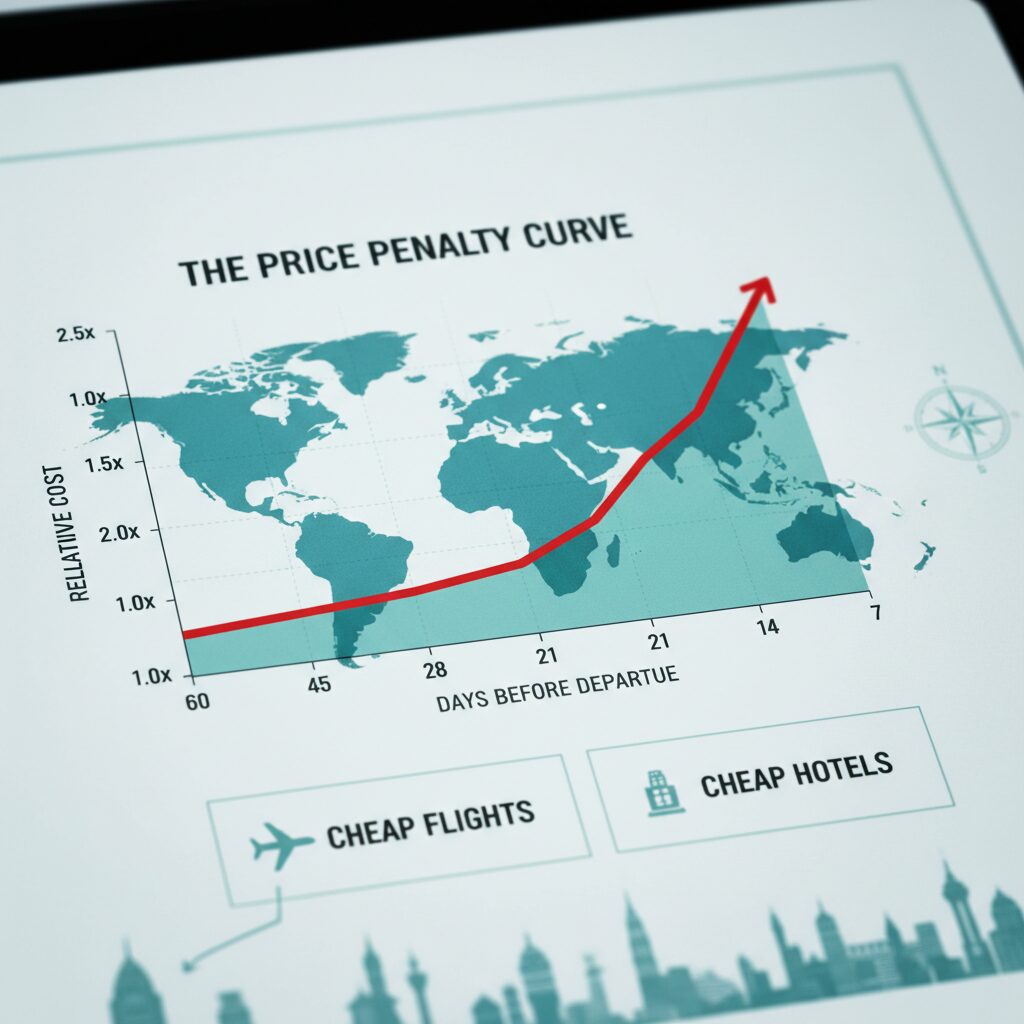
That 59% penalty is the industry standard for procrastination. However, after spending years analyzing flight pricing models and reviewing the latest 2025 travel outlooks, I can tell you that while the “system” is rigged against late bookers, it isn’t bulletproof.
You aren’t going to find a cheap flight by doing what everyone else does. You need to stop looking for a “sale” and start looking for a loophole. In this guide, I’m going to show you exactly how to bypass the price gouging using the latest tools and strategies available in 2025.

The “Last Minute” Price Penalty: What the Data Says
Before we get to the hacks, you need to understand the enemy. Airlines use sophisticated Revenue Management Systems (RMS). These are AI-driven algorithms that predict demand and adjust prices in real-time. They know that business travelers book late and are less price-sensitive, so prices skyrocket as the departure date approaches.
The 59% Rule and the 21-Day Cliff
The days of airlines slashing prices to fill empty seats at the last minute are largely over. According to the CheapAir.com Annual Airfare Study published in January 2024, that 59% price hike is consistent. But it doesn’t happen all at once.
Prices typically hit a “cliff” at three intervals:
- 21 Days Out: The first significant jump.
- 14 Days Out: The second jump (often targeting leisure travelers).
- 7 Days Out: The “Desperation Zone” where business fares kick in.
If you are reading this inside that 7-day window, you are statistically in the most expensive booking period possible.
The 2025 Inflation Factor
To make matters tighter, 2025 is proving to be an expensive year for aviation. According to the Hopper Q1 Consumer Travel Index & 2025 Outlook, airfare started the year approximately 12% higher than the previous January. Furthermore, the Amex GBT Air Monitor 2025 projects that business class fares within North America will rise another 2.7%.
What this means for you: The base price is higher, and the last-minute penalty is steeper. Waiting for a “price drop” is mathematically a bad bet. You need to act now.
The 3 Legit Methods to Find Cheap Flights <7 Days Out
If you are booking for travel this week, standard search engines will fail you. You need to use specific tools that visualize inventory differently.
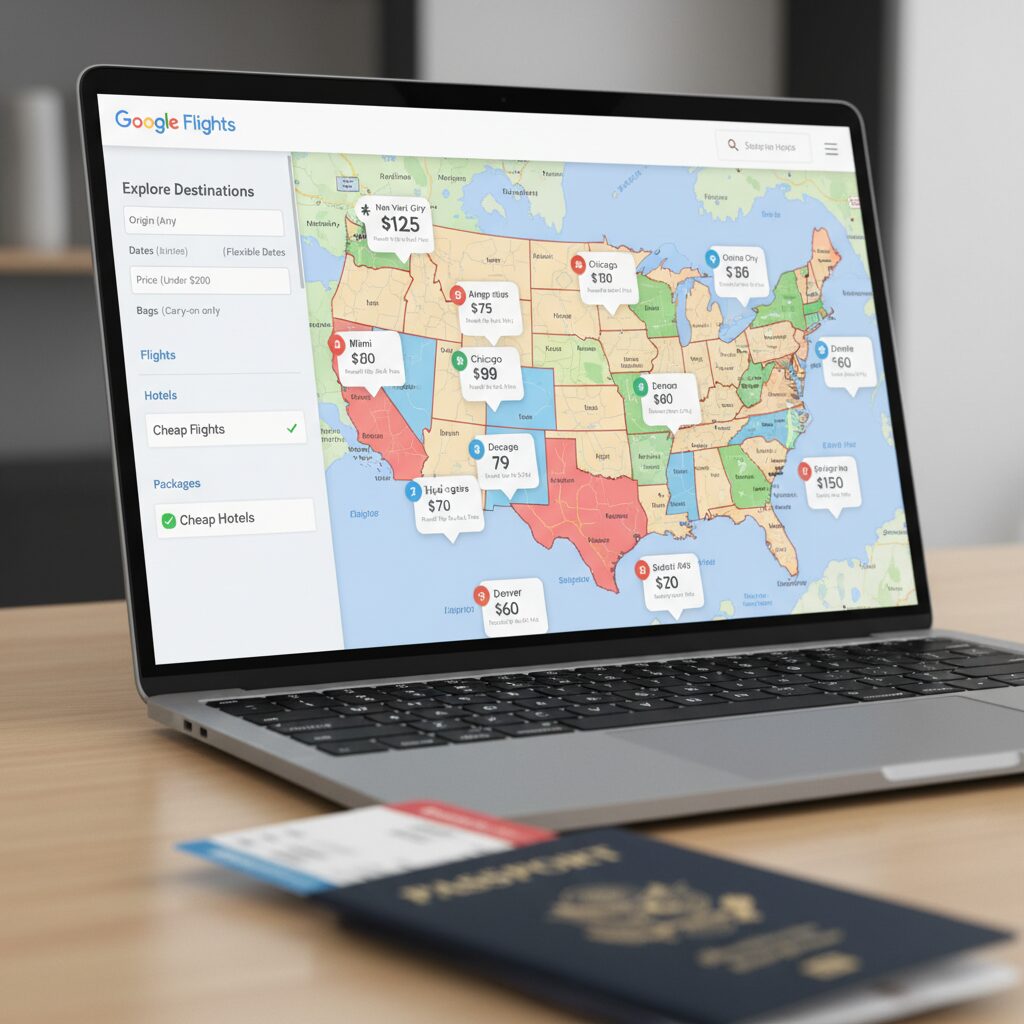
1. The “Google Flights Explore” Method (The Spaghetti Map)
If you have any flexibility regarding where you go, this is your strongest weapon. Most people search “New York to Miami.” That forces the algorithm to give you one specific price.
Instead, use the “Anywhere” function.
The Strategy:
- Go to Google Flights.
- Enter your departure city.
- Leave the destination blank (or select “Anywhere”).
- Click “Explore.”
- Select “Specific Dates” and choose your upcoming weekend.
You will see a map populate with prices for every airport in your region. Often, flying into a secondary hub (like Milwaukee instead of Chicago, or Providence instead of Boston) can save you hundreds of dollars.
Why this works: Google’s data shows that for domestic trips, the lowest prices are usually found 38 days out (Google Flights Trends Report, 2024). By using the Explore map, you are manually hunting for the few routes that haven’t hit their capacity “cliff” yet.
2. The “Hidden City” Risk (Skiplagging)
This is controversial, and I have to be honest about the risks. “Hidden city ticketing” is when you book a flight from City A to City C with a layover in City B—but you get off the plane in City B (your actual destination) and skip the second leg.
For example, a flight from New York to Dallas might cost $400. But a flight from New York to Austin with a layover in Dallas might cost $250. You book the Austin flight, fly to Dallas, and simply walk out of the airport.
Airlines hate this. If you do this often, they can ban you from their frequent flyer program.
- No Checked Bags: Your bag will fly to the final destination (City C). You must fly carry-on only.
- One-Way Only: If you skip a leg, the airline will cancel your return ticket immediately.
- Don’t Use Your Frequent Flyer Number: Do not associate your loyalty account with this ticket.
If you are desperate and willing to follow the rules above, sites like Skiplagged are designed specifically to find these fares. It works, but use it sparingly.
3. Re-positioning: The Hub-and-Spoke Trick
If you need to fly internationally at the last minute, the pain is severe. Google’s 2024 Trends Report notes that for international travel, the lowest prices are 101 days before departure. You missed that boat a long time ago.
However, you can save money by “re-positioning.” Instead of searching for “Chicago to Rome,” search for “Chicago to London” or “Chicago to Dublin” or even “Chicago to New York.”
Find the cheapest flight across the ocean to any major European hub. Once you are in Europe, budget carriers (like Ryanair or EasyJet) can get you to your final destination for under $100, even last minute. You book two separate tickets. Yes, it’s a hassle to grab your bags and re-check them, but it can save you $1,000+ on a last-minute trans-Atlantic fare.
Does “Standby” Still Exist? (Mythbusting)
Let’s address the elephant in the room. I often hear people say, “I’ll just go to the airport and fly standby for cheap.”
Stop. Do not do this.
In 2025, “Standby” is almost exclusively for passengers who already have a ticket and want to change to an earlier or later flight. It is not for people without tickets trying to snag a deal.
If you walk up to a ticket counter on the day of travel to buy a ticket, you will be charged the “Walk-Up Fare” (often Class Y). This is usually the most expensive price category in the entire system. You literally pay a premium for the inconvenience you cause the airline.
The Only Real “Standby”: Same-Day Confirmed Changes
There is one exception. If you find a cheap flight for 6:00 AM (which nobody wants) but you really want the 5:00 PM flight (which is expensive), you can book the cheap 6:00 AM flight.
Many airlines allow “Same-Day Confirmed” changes for a flat fee (or free for elites). You book the cheap flight, then 24 hours before departure, you try to switch to the better flight. It’s a gamble, but it’s a calculated one.

Tactical “Hacks” That Actually Work (Tested 2024/25)
Beyond the tools, there are behavioral strategies you can use to squeeze out savings.
The “Wednesday Effect” vs. The “Sunday Booking” Rule
You have likely heard that booking on a Tuesday at midnight saves money. According to Google’s data, that is mostly a myth (saving only about 1.9%). However, the day you fly matters immensely.
According to Google Flights 2024 Trends, flying on Monday, Tuesday, or Wednesday is historically 13% cheaper than flying on weekends. If you can shift your “emergency” trip from a Friday departure to a Saturday or Tuesday departure, the savings are instant.
Furthermore, the Expedia Air Travel Hacks Report 2024 suggests that booking your flight on a Sunday (regardless of when you fly) can save up to 13%. If you are searching on a Friday, and you can wait until Sunday morning to book, you might see a dip—but only if the flight isn’t nearly sold out.
The 24-Hour Cancellation Loophole
This is my favorite safety net. The US Department of Transportation mandates that for flights to/from the US booked at least 7 days in advance, airlines must offer a 24-hour free cancellation window. (Note: Many airlines extend this even for last-minute bookings, though you must check the specific terms).
The Strategy:
If you see a fare that is “okay” but you hope for better, book it. Lock in that price. Then, spend the next 24 hours hunting aggressively. If a better deal pops up, book the new one and cancel the old one for a full refund. If prices go up, you are safe because you already booked.
Best Apps for Last-Minute Inventory
Not all apps are created equal. When the clock is ticking, delete the others and use these:
1. Hopper (For the Price Freeze)
Hopper has a unique feature called “Price Freeze.” If you find a flight but need to talk to your boss or spouse before confirming, you can pay a small deposit to freeze that price for a set time. In a volatile last-minute market where prices jump hourly, this is invaluable.
2. Skyscanner (For “Everywhere” Search)
Similar to Google, Skyscanner allows you to search “Everywhere.” I find their interface slightly better for budget airlines and smaller carriers that Google sometimes misses. Their “Cheapest Month” view is great, but for last-minute, stick to the specific date grid.
3. HotelTonight (For the Bundle)
Sometimes, booking a “vacation package” (flight + hotel) even 2 days before travel unlocks bulk pricing rates that aren’t available for flight-only bookings. Check Expedia or Priceline bundles if flight-only prices are absurd.

FAQ: Emergency Travel & Timing
Q: Do flight prices drop on the day of the flight?
Almost never. Revenue management algorithms assume that if you are booking on the day of departure, you have zero flexibility and high willingness to pay. Prices usually peak 24 hours before takeoff.
Q: Is there a “bereavement fare” anymore?
Rarely. Most airlines have discontinued bereavement fares. Those that still have them (like Delta or Air Canada) often require significant documentation, and the discount is usually off the flexible fare, which is already expensive. You are usually better off finding a standard “lowest economy” ticket online.
Q: Does Incognito Mode actually help?
It’s a myth. I have tested this dozens of times. Flight prices are determined by global distribution systems (GDS), not cookies on your browser. However, Incognito mode does stop the annoying retargeting ads you’ll see later.
Q: What time of day is cheapest to book?
While the time of day matters little for price, it matters for reliability. Expedia’s data shows that flights departing after 3 p.m. have a 50% higher chance of being canceled than earlier flights. If you are booking last minute, book the first flight of the morning to ensure you actually get there.
🚀 The Desperate Traveler’s Decision Tree
Use Google Flights “Grid View” to see if flying +/- 1 day saves money.
Use Google Flights “Explore” or Skyscanner “Everywhere” to find the cheapest airport near you.
Check Skiplagged for hidden city tickets (at your own risk).
Book the first available flight immediately. The price is likely only going up.
Conclusion: The Checklist for the Desperate Traveler
Finding a cheap last-minute flight in 2025 isn’t about luck; it’s about checking the right boxes. The 59% price penalty is real, but it applies to the “average” traveler who books blindly.
Here is your action plan:
- Don’t wait. If you are inside the 21-day window, book now. The “wait and see” strategy fails 90% of the time.
- Be flexible with airports. Check every airport within a 100-mile radius of your destination.
- Use the “Anywhere” tool. Let the map dictate where you go if you just need a getaway.
- Consider the one-way hack. Sometimes two one-way tickets on different airlines are cheaper than a round-trip.
As Jeff Klee, CEO of CheapAir.com, noted in their 2024 report: “Securing affordable flights in a competitive travel landscape can be challenging.” That is the nice way of saying it’s a war. Use the data, use the tools, and don’t let the algorithm win.

Related Posts

How to find cheap flights fast?

Best flight search sites revealed?