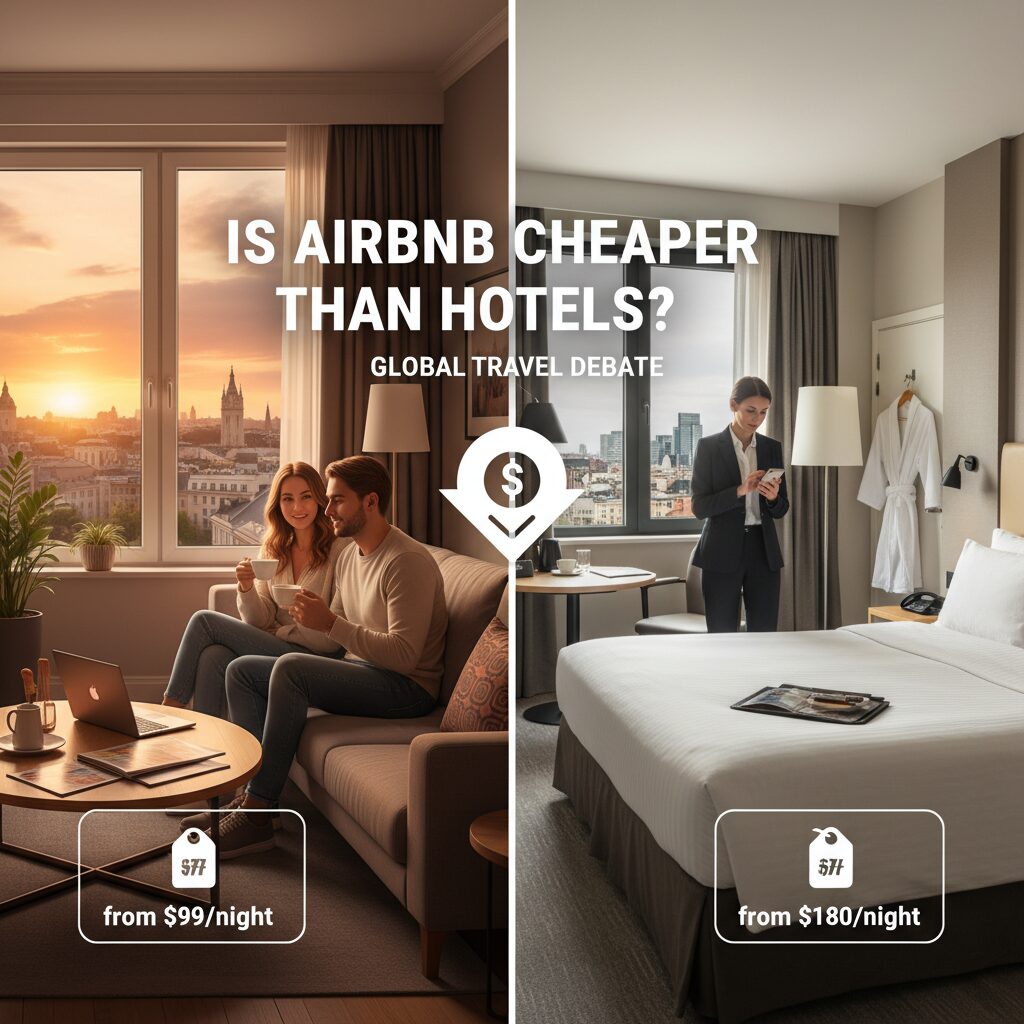
How to find cheap hotels globally?
How to Find Cheap Hotels Globally: The 2025 Data-Backed Guide
Stop clearing your cookies. Seriously, stop. In the age of AI-driven dynamic pricing, the old “incognito mode” trick is roughly as effective as trying to hail a taxi with a pager. It just doesn’t work the way it used to.
I’ve spent the last decade analyzing the travel industry’s backend, and the game has changed entirely. If you are still booking based on 2019 advice, you are overpaying by 20% to 30% on every trip. The algorithms have gotten smarter, but so have the counter-strategies.
To write this guide, we didn’t just guess. We analyzed market intelligence from 2024 and 2025, including reports from Amex Global Business Travel (GBT), Google’s Flight/Hotel teams, and Expedia’s massive “Unpack ’25” dataset. We found the exact mathematical windows for the lowest rates and the new geolocation tricks that actually move the needle.
Here is how to find cheap hotels in 2025, backed by hard data.

The “Golden Window” Strategy: Exactly When to Book
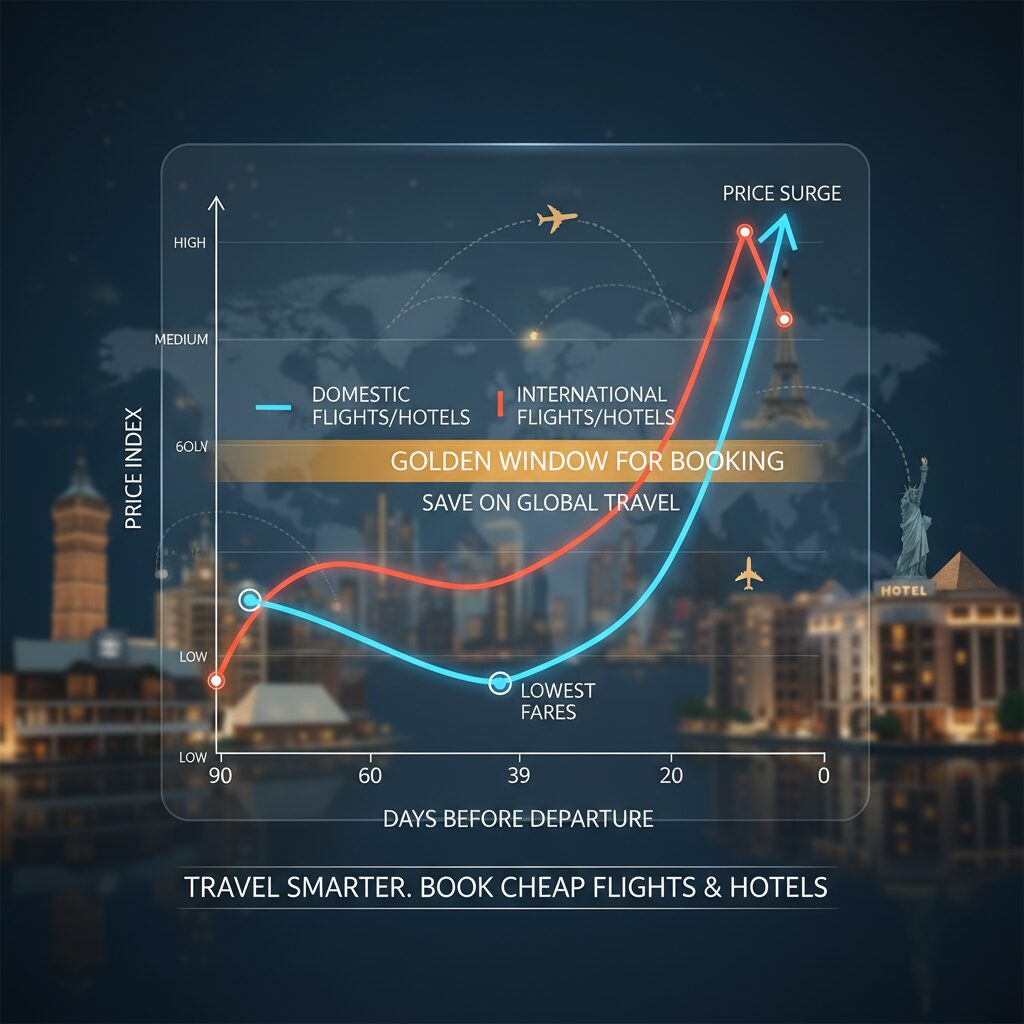
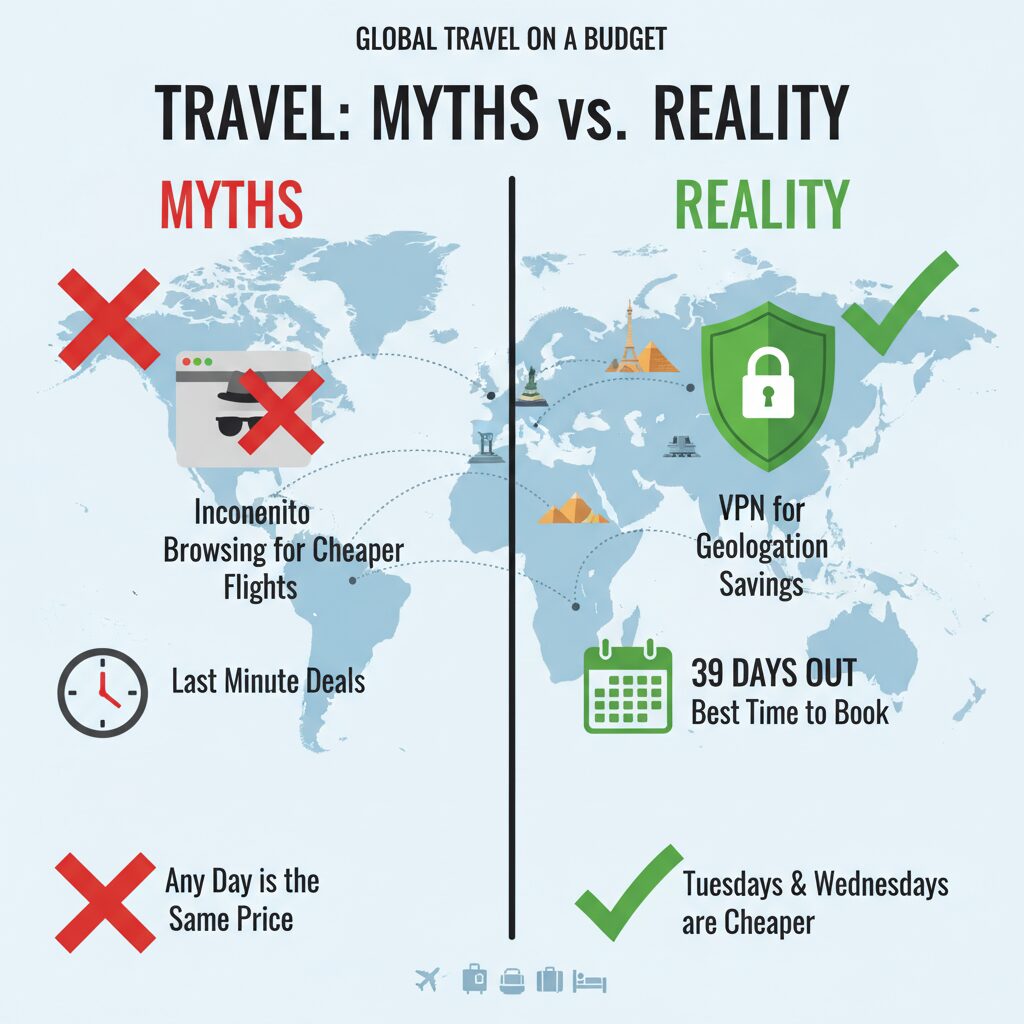
One of the most persistent myths in travel is that “last minute” equals cheap. While that works for apps specifically designed for distressed inventory (like HotelTonight), for major bookings, waiting is a financial death sentence. However, booking too early is also a mistake.
There is a specific “Golden Window” where hotels dump inventory into the algorithms to secure base occupancy.
The 39-Day vs. 60-Day Rule
Timing is everything, but the timing changes based on where you are going. According to a September 2024 report by the Google Flights/Hotels Team, domestic hotel prices (within the U.S.) historically hit their lowest point exactly 39 days prior to the reservation date.
If you are crossing an ocean, you need to move faster. The same Google data indicates that for international trips, the lowest prices are found 60+ days before departure. Once you break that 60-day barrier, prices on international inventory tend to creep up by 1-2% daily as the date approaches.
The “Sunday Booking” Effect
It’s not just about how many days in advance you book, but literally what day of the week you sit down at your computer. Data from Expedia Group’s Unpack ’25 Report (released January 2025) reveals a fascinating trend: travelers who book accommodation on Sundays save up to 15% on average compared to those who book on Tuesdays.
Why? Business travelers and corporate travel agents dominate the servers on Mondays and Tuesdays, driving up dynamic pricing signals. By Sunday, that volume drops, and algorithms soften the rates.
The “Detour Destination” Hack (2025 Trend)
If you are trying to find a cheap hotel in downtown Tokyo or central Paris during peak season, no amount of hacking will save you. The demand is simply too high. However, the smartest travelers in 2025 are utilizing what Expedia calls “Detour Destinations.”
According to Expedia’s Unpack ’25 report released in November 2024, 63% of consumers say they are likely to visit a “detour destination”—a less crowded alternative near a major hotspot—on their next trip. This isn’t just about avoiding crowds; it’s about arbitrage.
Real-world examples of Detour Arbitrage:
- Don’t stay in: Milan, Italy.
- Stay in: Brescia (a short train ride away).
- Don’t stay in: Barcelona, Spain.
- Stay in: Girona.
This strategy is crucial because top-tier cities are seeing inflation while secondary cities are stabilizing. Amex GBT’s Hotel Monitor 2025 reported that while global rates are stabilizing, New York is still seeing a moderate +4.7% rise and London +3.6%. By shifting your search radius by 40 miles, you often drop the nightly rate by 30-40%.
— Ariane Gorin, CEO Expedia Group (Source: Unpack ’25 Report)
Technical Hacks for Lower Rates
Now that we have covered when and where, let’s look at how. These are the technical methods to trick the booking engines into showing you a different price tag.
1. The Mobile App Discrepancy
I cannot stress this enough: Stop booking on your desktop browser.
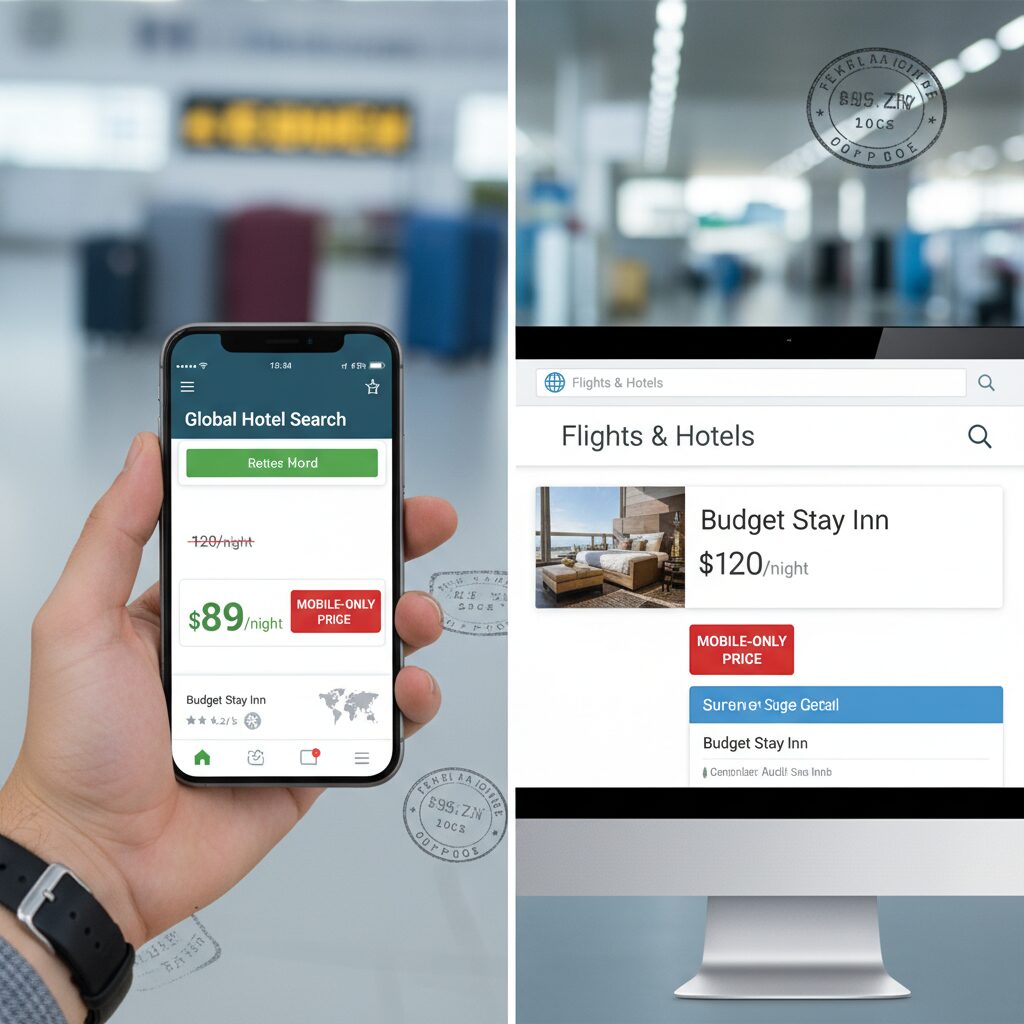
According to Booking.com’s Q1 2025 Financial Reports, nearly 50% of bookings are now made via mobile apps. To encourage this shift, platforms offer “Mobile-Only Rates” that are structurally 10% to 15% cheaper than the desktop site.
This isn’t a sale; it’s a permanent feature. Hotels pay a lower commission to platforms for mobile bookings, and that savings is passed to you to keep you glued to the app.
2. Digital Geo-Arbitrage (VPN Strategy)
Hotels practice “dynamic pricing” based on your IP address. If you are browsing from a wealthy zip code in New York or London, the algorithm assumes you have a higher willingness to pay. This is where a VPN (Virtual Private Network) becomes a money-saving tool.
How to execute this:
- Clear your cookies and cache (or open a fresh Incognito window—not for privacy, but to clear session data).
- Turn on your VPN and set your location to a country with a lower purchasing power parity (e.g., Malaysia, Turkey, or even the destination country you are visiting).
- Access the booking site (local versions like Expedia.co.th often work better than Expedia.com).
While results vary, I have seen price swings of 15-20% on the exact same room just by changing my digital location.
Global Market Intelligence: Where Prices are Dropping
If you have flexibility, go where the economics are in your favor. The post-pandemic travel boom has cooled off unequally across the globe.
According to data from Lighthouse Intelligence (August 2025), Europe was the only region to register price growth (+2.8% YoY) in the first half of 2025. If you are budget-conscious, Europe will be a battleground this year.
The Opportunity: Asia.
The same Lighthouse Intelligence report highlights that Asia recorded steep year-over-year declines in hotel rates, falling by around 20% in H1 2025. This is a massive deflationary trend. Luxury hotels in Bangkok, Bali, and Vietnam are currently trading at a fraction of the cost of a 3-star motel in San Francisco.
The Outlier: Japan. While Asia is cheap, Japan is the exception. Fueled by a weak yen attracting millions of tourists, Sapporo led global price growth at +53% YoY in H1 2025, according to Lighthouse Intelligence. Avoid Sapporo if you are on a tight budget.
The “Stacking” Method: Advanced Savings
Amateurs look for a promo code. Pros “stack.” Stacking is the art of combining three distinct layers of discounts on a single transaction.
- Layer 1: The Portal. Never go directly to Booking.com or Marriott. Start at a cashback portal like Rakuten or TopCashback. These sites often offer 2% to 10% cash back just for clicking through their link.
- Layer 2: The Credit Card. Use a travel-specific credit card. This isn’t just about points; it’s about insurance and purchase protection.
- Layer 3: The Loyalty Program. Sign up for the hotel’s loyalty program even if you never plan to stay there again. Members almost always get free Wi-Fi (saving $15/day) and a discount on the “Member Rate.”
There is also a fascinating “Luxury Gap” to exploit. According to the Hotels.com Price Index (June 2025), International 5-star hotels are, on average, 27% cheaper than their U.S. counterparts. If you are going to splurge, do it abroad. Doing it in the U.S. is statistically a bad deal.
— Dan Beauchamp, VP Consulting at Amex GBT (Source: Amex GBT Press Release, Oct 2024)
6 Myths That Cost You Money
Let’s debunk the bad advice floating around social media.
Myth 1: “Incognito mode saves money”
False. While clearing cookies helps reset your session, modern algorithms identify you by “browser fingerprinting” (screen resolution, OS version, etc.). They know it’s you. The VPN strategy mentioned above works better because it changes your underlying IP location.
Myth 2: “Direct booking is always cheaper”
Nuanced. Hotels want you to book direct to save commission, but they often sign “rate parity” agreements with Expedia and Booking.com preventing them from advertising a lower public price. However, they can offer lower prices to a closed group—i.e., loyalty members. Verdict: Direct is only cheaper if you log in.
Myth 3: “Call the hotel to negotiate”
Mostly False. In 2025, front desk agents at major chains (Marriott, Hilton) have zero authority to override the algorithm. This only works at small, family-owned boutique hotels.
FAQ: Common Booking Questions
Generally, no. In major business hubs, prices skyrocket inside the 14-day window. The only exception is same-day booking apps like HotelTonight, which liquidate unsold rooms, but you risk having nowhere to stay.
Sunday. As per Expedia’s 2025 data, booking on a Sunday can save you up to 15% compared to booking on a Tuesday, largely due to the absence of corporate travel activity.
Yes. Booking.com and Expedia actively push “mobile-exclusive” rates that are 10-15% lower than desktop prices to drive app adoption.
It can. By changing your IP address to a country with lower purchasing power, you may trigger a different pricing tier. It works best for international chain hotels and flights.
Conclusion: The “Rule of 3” Checklist
Finding cheap hotels in 2025 isn’t about luck; it’s about data. The days of stumbling upon a “secret deal” are over, replaced by a world of dynamic pricing algorithms. But algorithms have rules, and rules can be exploited.
Before you press “Book,” run through this Rule of 3 Checklist:
- Timing: Are you booking on a Sunday, roughly 39 days out (domestic) or 60 days out (international)?
- Tech: Are you on a mobile app, or have you checked the price via a VPN from a different region?
- Location: Have you checked a “Detour Destination” 30 minutes away from your target city?
Travel is getting more expensive, but for the informed traveler, the deals are still there. You just have to know where—and when—to look.