How to get hotel deals under $50?
How to Get Hotel Deals Under $50 in 2025: 7 Verified Hacks Experts Use
Let’s address the elephant in the room immediately: finding a safe, clean hotel room for under $50 in 2025 feels like trying to find a needle in a very expensive haystack. If you’ve opened Expedia or Booking.com lately, you’ve seen the numbers. The days of stumbling upon a $39 Motel 6 rate by accident are largely behind us.
In fact, according to the Amex GBT Hotel Monitor 2025, global hotel rates are forecast to continue rising throughout this year, driven by labor shortages and rising wages. The average rate in major US cities is pushing well past $160.
But here is the good news: I’ve spent the last decade analyzing the backend of travel booking engines, and I can tell you that “unsold hotel room inventory” is a massive liability for hotels. An empty room earns $0. Because of this, deals under $50 do exist, but they are hidden behind opaque booking walls, specific mobile algorithms, and “blind” booking sites.
You don’t need luck; you need the right tools. In this guide, I’m going to walk you through the exact technical interventions—using browser extensions, specific map filters, and timing hacks—that expert travelers use to force that price tag down to $50.
“42% of travelers in 2025 are prioritizing budget-friendly accommodations, forcing the market to adapt with new discount avenues.”
Data from Simon-Kucher Travel Trends 2025
The $50 Challenge: Reality vs. Strategy in 2025
Before we dive into the hacks, we need to set the stage. If you are expecting a Ritz-Carlton in downtown Manhattan for $45 on a Friday night, stop reading now. That’s not a deal; that’s a scam.
However, getting a solid 3-star business hotel or a highly-rated independent inn for $50 is entirely possible if you understand how dynamic pricing works. The US Travel Association and BLS reported that the Lodging Away from Home index increased 1.7% in late 2024, signaling that inflation is sticky.
Brian Kelly, the founder of The Points Guy, put it best in a recent interview with Good Morning America: “Lodging has gone up dramatically… experts in the industry suggest positioning flights and staying in secondary cities to save costs.”
To hit the $50 mark, we have to exploit the “secondary city” logic and use technology to strip away the marketing fees that inflate prices.
Method 1: The “Opaque” Booking Hack (The #1 Way to Hit $50)
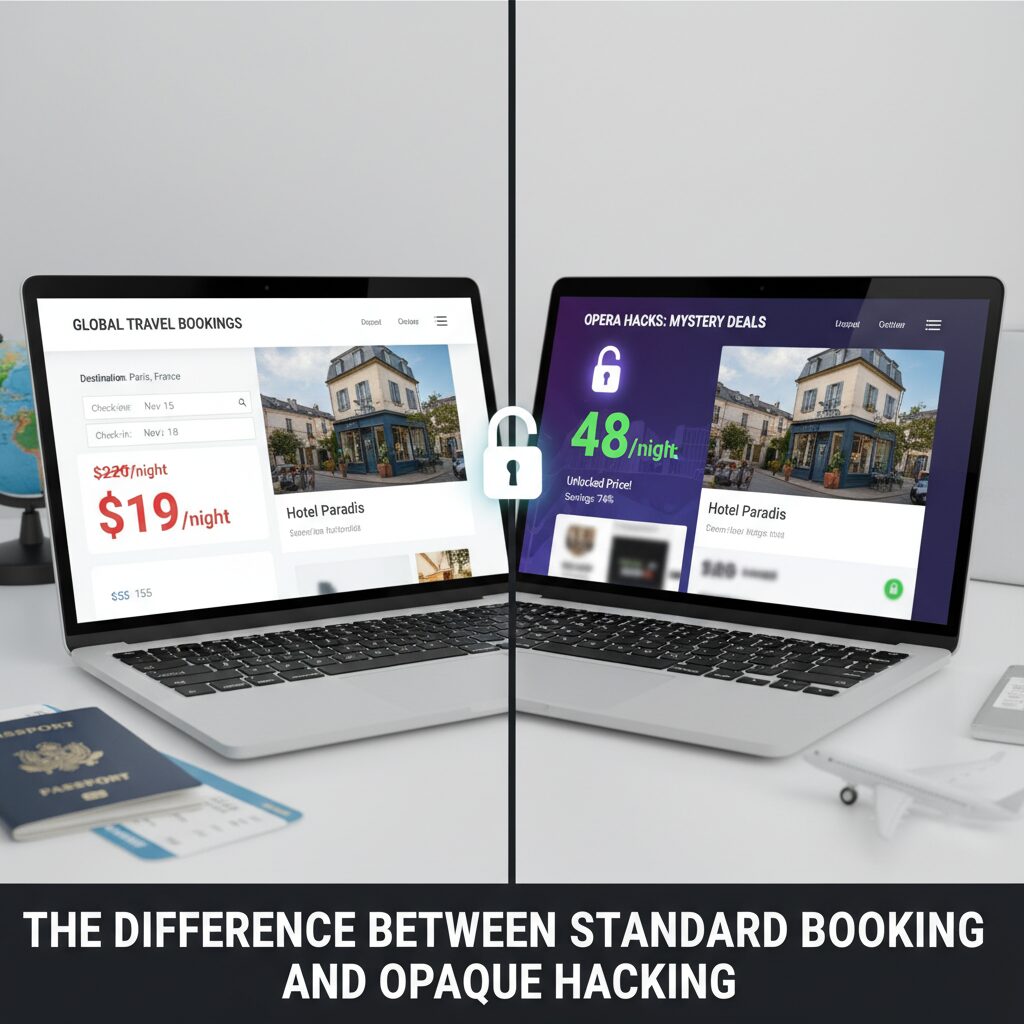
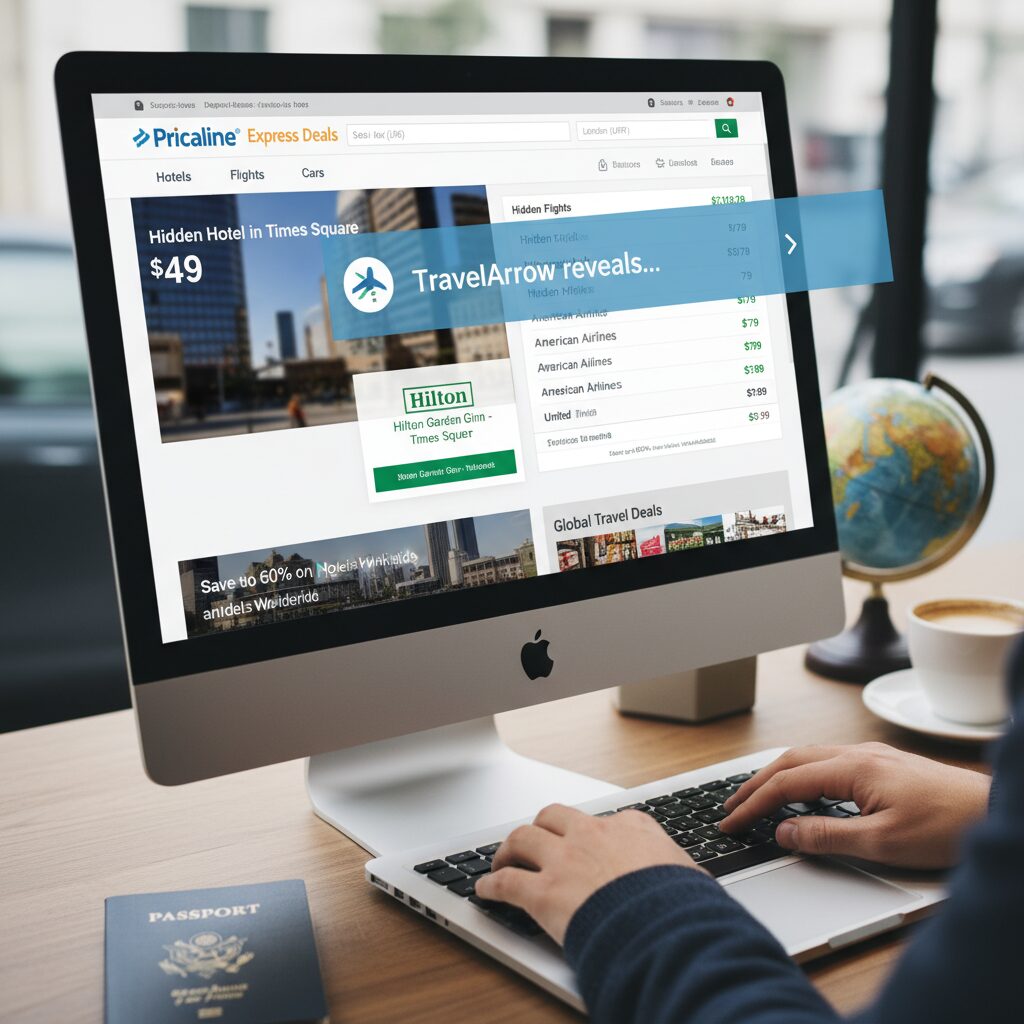
This is, without a doubt, the most effective strategy in my arsenal. Opaque booking sites like Priceline (Express Deals) and Hotwire (Hot Rates) offer massive discounts—often 60% off—because they hide the name of the hotel until you pay. This allows luxury brands to offload unsold inventory without damaging their public brand value.
The risk, of course, is booking a dump. But in 2025, technology has eliminated that risk.
The “TravelArrow” Reveal Hack
There is a Chrome extension called TravelArrow that has changed the game. It uses an algorithm to match the unique amenity icons and review counts of the “Mystery Hotel” against known databases to reveal the hotel’s identity before you book.
Here is the step-by-step process I use:
- Install the TravelArrow extension on your Chrome browser.
- Go to Priceline and search for “Express Deals” in your target city.
- Look for a 3-star or 4-star hotel listing that drops into the $45-$55 range.
- The Magic Moment: The extension will overlay a box on the mystery listing saying “Likely [Hotel Name]” with a high percentage of certainty.
According to a verifyied report by Frommer’s, this free tool is currently the most accurate way to “name the secret cheap hotels” on Hotwire and Priceline. I’ve used this personally to book a 4-star business hotel in Dallas for $48 (plus tax), while the direct rate was $129.
Method 2: The “Map View” Filter Technique
Most people use OTAs (Online Travel Agencies) like Expedia or Booking.com as a list. They scroll down, see the first ten results are all $150+, and give up. What you might not realize is that those top results are often sponsored ads.
The small, independent mom-and-pop motels that legitimately charge $50/night don’t have the marketing budget to appear at the top of that list. To find them, you must use Google Hotels Map View.
How to Execute the Hard Filter:
- Go to Google and search “Hotels in [City].”
- Ignore the list. Click directly on the Map View.
- Locate the price slider. Most people slide it to “Under $100.” You need to be aggressive. Slide it to Max $55.
- Zoom out slightly. You will see pins vanish from the city center and reappear on the periphery.
These pins are often independent motor courts or older inns. I’ve found that these properties are usually clean and safe, just dated. They rely on drive-by traffic, not online ads. By digging them out via the map, you bypass the algorithm that favors expensive chains.
Method 3: Alternative Lodging (Pod Hotels & “Poshtels”)
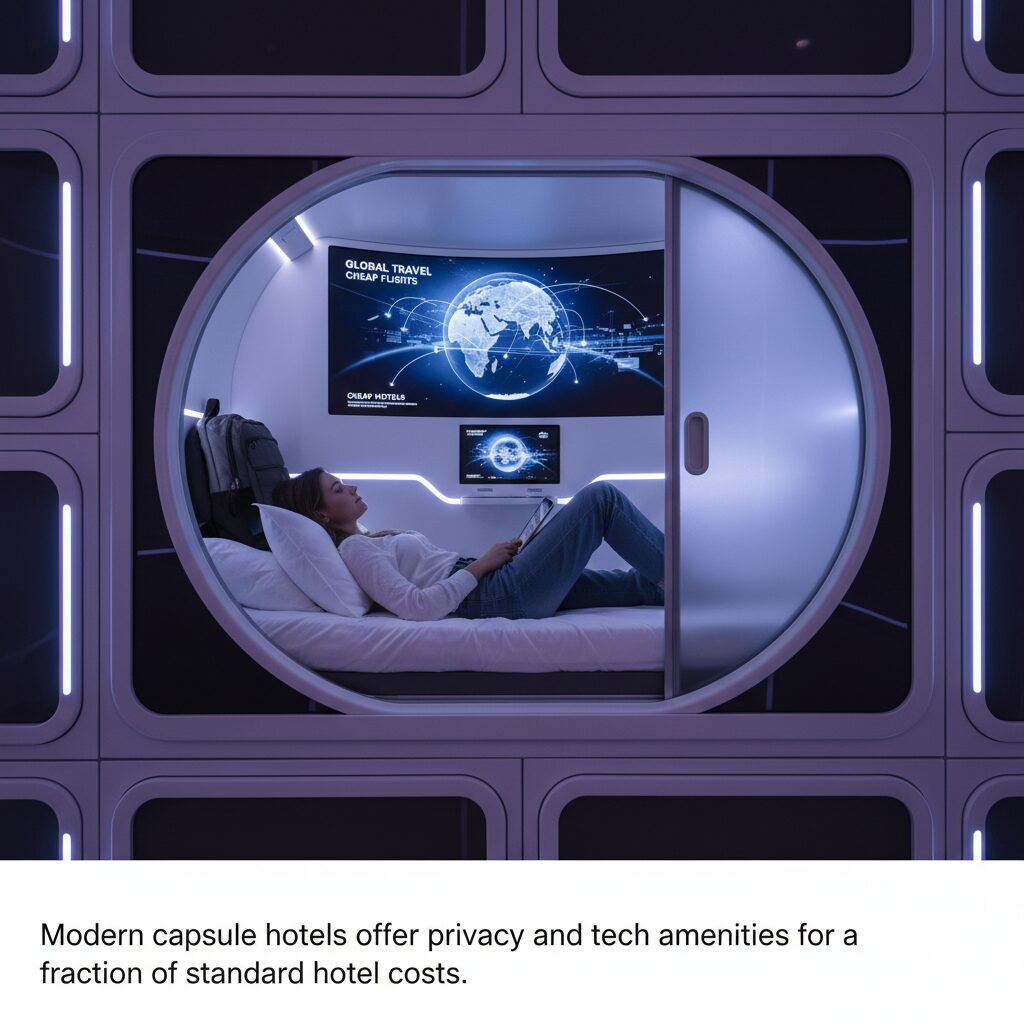
If you still think hostels are just for backpackers in their early 20s sleeping in 12-bed dorms, you are missing out on one of the fastest-growing sectors in travel: the “Poshtel” (Posh Hostel) and Capsule Hotel market.
According to a 2025 forecast by Straits Research, the global capsule hotel market is projected to reach over $290 million this year, growing at nearly 9%. Why? Because business travelers and digital nomads want privacy without paying for a 400-square-foot room they won’t use.
The Private Room Hack
Use Hostelworld, but filter specifically for “Private Room.” In many cities like Chicago, Philadelphia, or San Diego, you can find a private room with a shared bathroom (or sometimes an ensuite) for under $50.
These “Poshtels” often offer better amenities than budget motels, including coworking spaces, high-speed Wi-Fi, and modern security. It’s a trade-off: you get a smaller room, but a better location and a price tag that defies inflation.
Method 4: The “App-Only” & Mobile Inventory
Hotels treat mobile users differently than desktop users. Skift Research indicated in their Global Travel Outlook 2025 that mobile bookings now account for nearly half of all online travel sales. To capture this traffic, platforms offer “Mobile-Exclusive” rates.
Hopper vs. HotelTonight
I keep two apps on my phone specifically for this: Hopper and HotelTonight. They serve two different functions.
- Hopper (The Predictor): Hopper analyzes billions of price points to tell you when to book. However, for the under-$50 crowd, their “Flash Deals” are where the value lies.
- HotelTonight (The Closer): This is for the brave. HotelTonight specializes in unsold inventory for that same night. At noon, hotels release rooms they know won’t sell. I have seen rates in secondary markets drop from $110 to $45 at 4:00 PM.
My Strategy: If I’m on a road trip and just need a bed, I wait until 2:00 PM and check HotelTonight. The “Daily Drop” feature allows you to unlock a deeply discounted rate for 15 minutes. It’s a gamified way to save, but the savings are real.
Method 5: Stacking Discounts (The “Grey Hat” Section)
Sometimes the listed price is $70, and no amount of filtering will change that. This is where “stacking” comes in. We need to reduce the net cost to under $50, even if the sticker price is higher.
The Corporate & Membership Codes
You probably qualify for rates you aren’t using.
- AAA/CAA: Usually saves 10-15%.
- AARP: Here is a secret—you don’t have to be over 50 to join AARP. Anyone can join for about $16/year, and the travel discounts (often 10-20% at brands like Hilton or Best Western) pay for the membership in one night.
- Freelancers Union: If you are a gig worker, joining the Freelancers Union (free) often grants access to corporate travel portals with negotiated rates.
The Credit Card “Statement Credit” Stack
This is how advanced travel hackers operate. Let’s look at the math using a NerdWallet strategy regarding booking windows:
Scenario: You find a Quality Inn for $80/night.
- Apply AAA Discount (10%): Price drops to $72.
- Activate Cash Back Portal (e.g., Rakuten/TopCashback): Earn 10% back ($7.20). Net cost is now $64.80.
- Pay with Chase/Amex Offer: Many cards offer “Spend $70, get $15 back” at specific hotel chains.
- Final Net Cost: $49.80.
Result: You stayed for under $50, even though the website said $80.
2025 Price Watch: Best Booking Windows
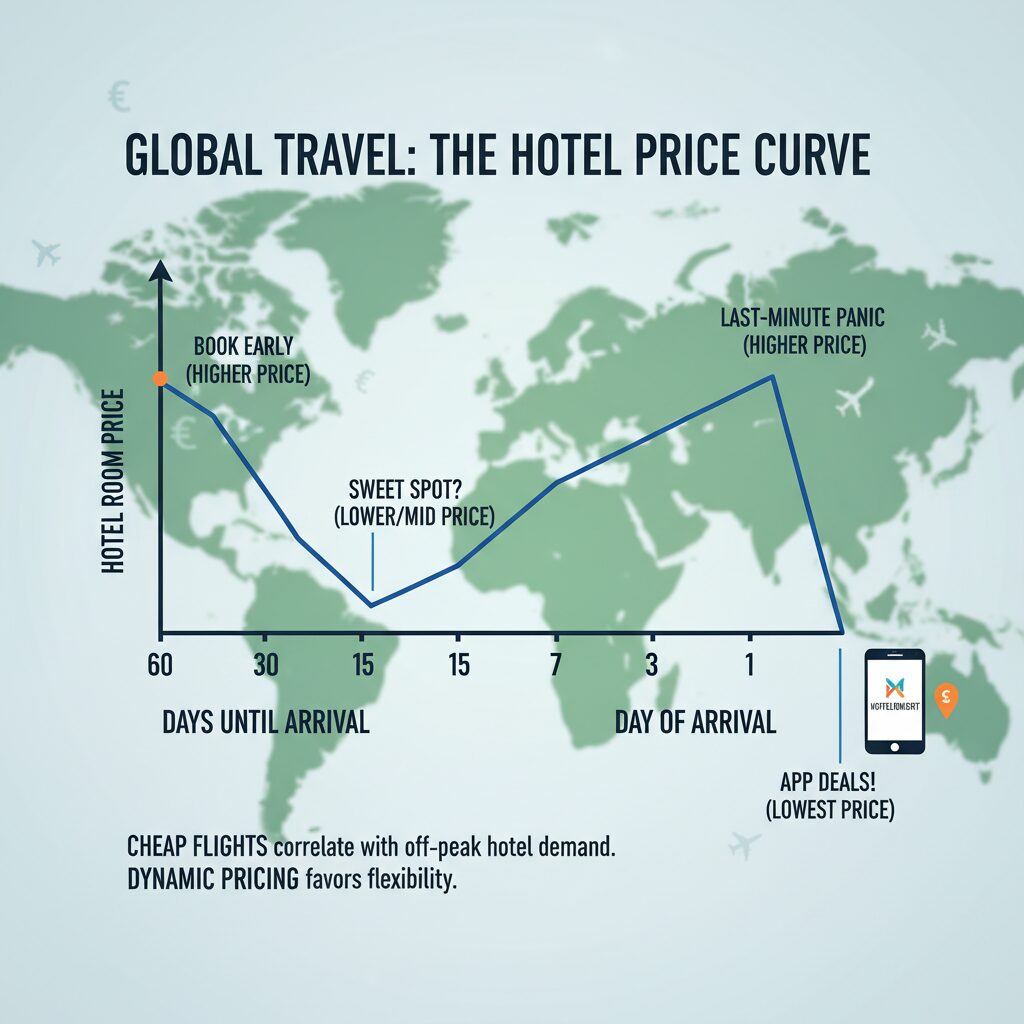
Timing is everything. If you book too early, you pay the “peace of mind” premium. Book too late (on standard sites), and you pay the “desperation” premium.
According to NerdWallet’s 2024 analysis, the sweet spot for hotel bookings is roughly 15 days before your scheduled arrival. Savings in this window can average around 13% compared to booking months in advance.
However, my advice for the sub-$50 hunter is different: Book refundable. Book a “safety” room 15 days out that allows cancellation. Then, 24 hours before your trip, check HotelTonight or Priceline Express. If you find a $45 deal, book it and cancel the safety room. This protects you from being homeless while keeping the door open for a rock-bottom price.
FAQ: Safety & Logistics for Budget Stays
Is a $50 hotel room safe in 2025?
It depends on how you got the rate. If the “retail” price is $50, be wary—check recent reviews for mention of safety or cleanliness. However, if you used the Opaque method (Method 1) and booked a hotel that is normally $120 for $50, it is just as safe as paying full price. You are staying in the exact same building as the person who paid double.
What is the cheapest day of the week to check-in?
Sunday nights are historically the cheapest, followed by Monday. Leisure travelers have gone home, and business travelers haven’t fully arrived. Avoid Friday and Saturday check-ins if your budget is strict.
Does clearing cookies actually lower prices?
This is a debated topic. While VPNs and Incognito mode can sometimes show different pricing based on your location (Geo-fencing), the price difference is usually minimal for domestic hotels. You are better off spending your time on specific mobile apps or opaque booking sites than clearing your cache repeatedly.
Conclusion: The Value Over Price Mindset
Finding a hotel under $50 in 2025 is not about being cheap; it’s about being smart. The travel industry relies on consumers who are too busy or too intimidated to look behind the curtain.
By using tools like TravelArrow to unmask hidden deals, leveraging map filters to find independent gems, and looking into the growing market of capsule hotels, you can navigate the inflation of 2025 without breaking the bank. As Sally French from NerdWallet recently said on the Smart Travel Podcast, “Save where you can and splurge where it counts.”
Your bed is just a place to sleep. Don’t let the price of the room dictate the quality of your adventure. Download the apps, install the extensions, and go beat the system.