How to save on resort stays?
How to Save on Resort Stays: The 2025 “Travel Maximizer” Guide
Dynamic pricing, junk fees, and inflation are eating your vacation fund. Here is the data-backed strategy to fight back.
Let’s be honest: The days of simply finding a “cheap deal” by booking six months in advance are over. In 2025, the travel landscape has shifted aggressively against the unprepared consumer.
I was reviewing my own travel expenses recently and realized that the sticker price is rarely what hits the credit card. Between dynamic pricing algorithms and the explosion of hidden costs, resort vacations are becoming a financial minefield. In fact, according to NerdWallet’s Resort Fee Analysis, the average resort fee hit $42.41 in 2024, effectively adding an 11% “tax” to your nightly rate that often doesn’t show up until checkout.
But here is the thing: While prices are rising—New York hotel rates alone are projected to jump 4.7% in 2025 according to the Amex GBT Hotel Monitor 2025—the savvy traveler has more tools than ever to beat the system.
This isn’t about skipping the latte to save for a trip. This is about becoming what Hilton’s 2025 Trends Report calls a “Travel Maximizer”—someone who strategically hacks the logistics to afford the experience.
In this guide, I’m going to walk you through the exact strategies I use, backed by the latest 2025 industry data, to slash resort costs by 30% or more.

The “Golden Window” for Booking Resorts (New 2025 Data)
For years, the conventional wisdom was “book as early as possible.” I used to preach this myself. However, recent data suggests that loyalty to this old rule is costing you money.
The 15-Day Rule
There is a sweet spot for booking that most travelers miss because it feels risky. According to an August 2025 analysis by Vacationspotter and NerdWallet, booking exactly 15 days in advance can yield 13% savings compared to booking four months out.
Why does this happen? Resorts use yield management software. When they have excess inventory two weeks out, they panic and drop rates to fill rooms. If you have flexible dates, this “blink contest” is one you can win.
The “Shoulder Season” Shift
Timing isn’t just about when you book, but when you go. The concept of “shoulder season” has shifted due to changing weather patterns and remote work flexibility.
The New Deal Zones: Data from Vrbo’s 2025 trends indicates distinct windows for maximum savings:
- Ski Resorts: Book by October 30th for the best inventory.
- Caribbean: Late August to mid-November offers the lowest rates (according to TravelAwaits data), provided you buy travel insurance for hurricane risks.
- Spring Break: Lock in rates by February 10th.
Tuesday vs. Friday Booking: Debunking the Myth
You’ve probably heard that booking on a Tuesday at midnight gets you the best deal. I’ve tested this extensively, and frankly, it’s a relic of the past. Modern dynamic pricing updates in real-time. What matters more is your stay dates. Expedia’s Unpack ’25 Report highlights that shifting your stay to start on a Sunday rather than a Thursday can lower your average nightly rate by up to 15%.
The “Daycation” Hack: Resort Amenities Without the Room Rate
This is my favorite strategy for 2025, especially for families. Sometimes, you don’t actually need to sleep at the resort to enjoy the resort. You just want the lazy river, the poolside service, and the spa.
ResortPass vs. Overnight Stay
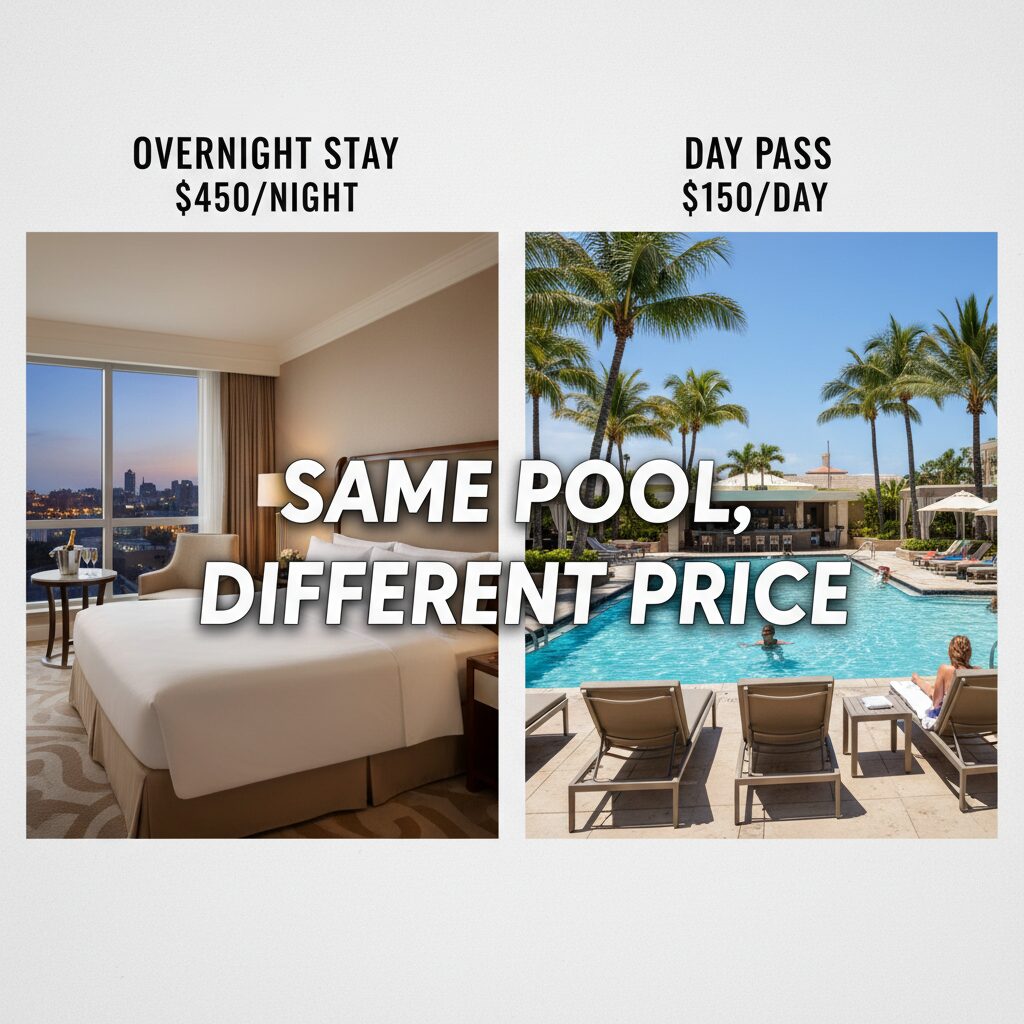
Platforms like ResortPass allow you to book day access to luxury properties. The savings can be astronomical. A NerdWallet ResortPass review from August 2024 found that a family of four can save approximately $200 per day by booking a day pass instead of an overnight room.
Case Study: The Orlando Strategy
Imagine a family of four wants to enjoy the Signia by Hilton Orlando Bonnet Creek.
- Traditional Cost: Overnight rate ($350) + Resort Fee ($45) + Taxes = ~$450/night.
- The Hack: They stay at a clean, budget hotel nearby ($120/night) and buy 4 ResortPasses ($45/adult, $30/child). Total = $270.
- Result: They save $180 per day while still enjoying the exact same lazy river and luxury pool.
Who is this for? This is perfect for cruisers with a long port stop, locals looking for a “daycation,” or travelers who utilize “split-stays” (sleeping cheap, playing expensive).
Tactical Negotiation: How to Waive Resort Fees
Resort fees are the scourge of modern travel. In Las Vegas, luxury properties like the Wynn and Venetian now charge upwards of $50 plus tax per night in mandatory fees, according to a 2024 TravelZork roundup.
Can you get out of them? It’s difficult, but not impossible. Walt Galanty, President of AIM Meetings, has gone on record stating, “Those [resort] fees are 100 percent negotiable… If the fee is $30 for the fitness center… tell them to charge half that amount.”
The key is that you cannot simply refuse to pay because you “don’t like it.” You must have a leverageable reason.
The “Ask” Script
Use this script at checkout (not check-in) if the amenities were unavailable or if you arrived too late to use them.
You: “Hi, I’m reviewing my bill. I see a $45 daily resort fee. This fee supposedly covers the pool, gym, and WiFi.”
You: “However, we checked in at 8 PM, and the pool closed at 9 PM. We physically couldn’t utilize the amenities included in this mandatory charge. Given that we didn’t receive the value promised, I’d like to request that the fee be waived for the first night.”
This approach works because it targets the “exchange of value.” If the gym was under renovation or the WiFi was spotty, you have a valid consumer claim.
Points Arbitrage: Buying Points vs. Paying Cash
This is where the math gets fun. Sometimes, it is cheaper to buy hotel points directly from the hotel and use them to book the room than it is to pay the cash rate.
Brian Kelly, The Points Guy, recently noted in a Fast Company interview (Feb 2025): “We are in the ‘Platinum Age of Travel’… don’t hoard your points. They become less valuable over time due to inflation.” This means you should burn them, but also buy them when the math works.
The Math
According to NerdWallet’s 2025 valuations, World of Hyatt points are valued at ~1.8 cents per point, while Hilton is ~0.5 cents.
If a Hyatt resort costs $500/night cash, or 20,000 points, the math is: 20,000 x $0.018 = $360. Using points “costs” you $360 in value, saving you $140 off the cash price.
Hotels often run “100% Bonus on Purchased Points” sales. If you can buy points at 1.2 cents during a sale, and redeem them for a room where the value is 2 cents, you are effectively buying the room at a 40% discount.
💰 Points vs. Cash Calculator
Should you pay cash or buy points? Enter the details below.
The All-Inclusive Era: Is It Actually Cheaper?
The stigma around all-inclusive resorts (bad buffets and watered-down drinks) is vanishing. Expedia’s Unpack ’25 Report shows that searches for “all-inclusive” resorts increased by 60% year-over-year. Why? Because Generation Z and Millennials are tired of “bill shock.”
The “Unbundling” Trap
At a standard resort, you pay for the room. Then breakfast ($30/pp). Then lunch ($40/pp). Then drinks ($18/each). A $300 room quickly becomes a $700 day.
However, you have to be careful. The “Unbundling Trap” happens when all-inclusives charge extra for the things you actually want—like premium liquor or steak dinners. To save, look for resorts that explicitly state “no supplemental charges for dining.”
My advice? Look at “Detour Destinations.” The same Expedia report notes that 63% of consumers are visiting lesser-known alternatives to save money. Skip Tulum; go to Bacalar. Skip Santorini; go to Paros.
Lesser-Known Booking Channels
Finally, stop searching exclusively on Booking.com or Expedia. You are fishing in the same pond as everyone else.
Timeshare Rentals (RedWeek/Koala)
This is the industry’s best-kept secret. You do not need to own a timeshare to stay in one. Sites like RedWeek allow owners to rent out their weeks when they can’t use them. I’ve seen listings for Marriott Vacation Club properties for 50% less than the hotel’s listed rate for the same unit. Plus, you get a full kitchen, which saves on dining costs.
Costco & Wholesale Clubs
Don’t roll your eyes. Booking Holdings reported a 40% increase in “connected trip” transactions in their Q3 2024 report. While they are pushing their own bundles, Costco Travel remains the king of the “value-add.” They often include airport transfers (worth $100+) and Costco Shop Cards (cash back) that other OTAs (Online Travel Agencies) simply cannot match due to margin constraints.
Frequently Asked Questions
Technically, no. If the fee was disclosed at the time of booking (even in fine print), it is a legal contract. However, negotiation is possible. You can ask for them to be waived if amenities were unavailable, or if you have high status with the hotel loyalty program. Always ask the manager, not the front line clerk.
Usually, yes. Direct bookings allow you to earn loyalty points and status credits. Furthermore, Hilton and Marriott publish “Member Only” rates that are typically 2-5% lower than Expedia or Booking.com prices. If you book via a third party, you are often the first to be walked if the hotel is overbooked.
Yes, but there is a risk. As mentioned in the 15-day rule section, prices often drop about two weeks out as hotels try to dump unsold inventory. However, for peak times (Christmas, Spring Break), prices will only skyrocket closer to the date.
Data analysis suggests that booking hotels and resorts 15 days prior to arrival often yields the lowest price for non-peak travel, saving an average of 13% compared to booking months in advance.
Conclusion: The "Travel Maximizer" Mindset
Saving on resort stays in 2025 isn't about being cheap; it's about being smart. The hotels are using sophisticated algorithms to extract maximum value from you. By using the 15-day rule, leveraging point valuations, considering day passes, and negotiating fees, you are simply leveling the playing field.
Consumer expert Clark Howard put it best: "My #1 rule of travel is buy the deal first and then figure out why you want to go there." If you stay flexible and follow the data, you can enjoy five-star luxury on a three-star budget.
Now, go check your point balances, open a private browser window, and start hunting for that 15-day window.